Jump to section
Food Standards Agency - Alerts Analysis
Last Updated: Sunday, February 08, 2026 09:24 AM - Data up to Saturday, 07 February, 2026
Allergen Analysis for Food Safety Alerts from food.gov.uk
Food safety alerts are an essential tool for protecting public health, as they enable swift action to be taken in response to potential threats. In the UK, the Food Standards Agency (FSA) is responsible for issuing food safety alerts to inform consumers and industry stakeholders of potential risks associated with certain foods or products. These alerts are critical for ensuring that contaminated or potentially harmful products are removed from the market as quickly as possible, thereby minimizing the risk of allergic reactions.
In the UK, the Food Information Regulations (FIR) require that food businesses list certain allergenic ingredients on their product labels. The 14 specified allergens are:
- Cereals containing gluten (such as wheat, barley, and rye)
- Crustacean
- Mollusc
- Peanut
- Tree nut
- Fish
- Egg
- Milk/ Lactose
- Soy
- Sesame
- Sulphites
- Lupin
- Mustard
- Celery
These allergens must be declared in the ingredients list if they are present above a certain threshold (0.5% for most of these allergens, except celery which is 1.25%). Additionally, food businesses may choose to provide more detailed information about the presence of these allergens, such as stating "contains peanuts" instead of just listing "peanuts" in the ingredients list.
It's worth noting that while there are no specific labeling requirements for gluten-containing cereals, food businesses must still declare the presence of gluten in their products if it is present above 20mg per kilogram.
This section of the analysis focuses on a comprehensive review of food safety alerts issued by the FSA with a specific emphasis on allergenic substances such as peanuts, tree nuts, milk, eggs, fish, shellfish, soy, and wheat. By examining these data, this study aims to assess the effectiveness of the current alert system in detecting and responding to outbreaks, identify trends and patterns in the types of allergens involved, and provide insights that can inform strategies for improving food safety and reducing public health risks.
Allergen Safety Alerts - Types by year
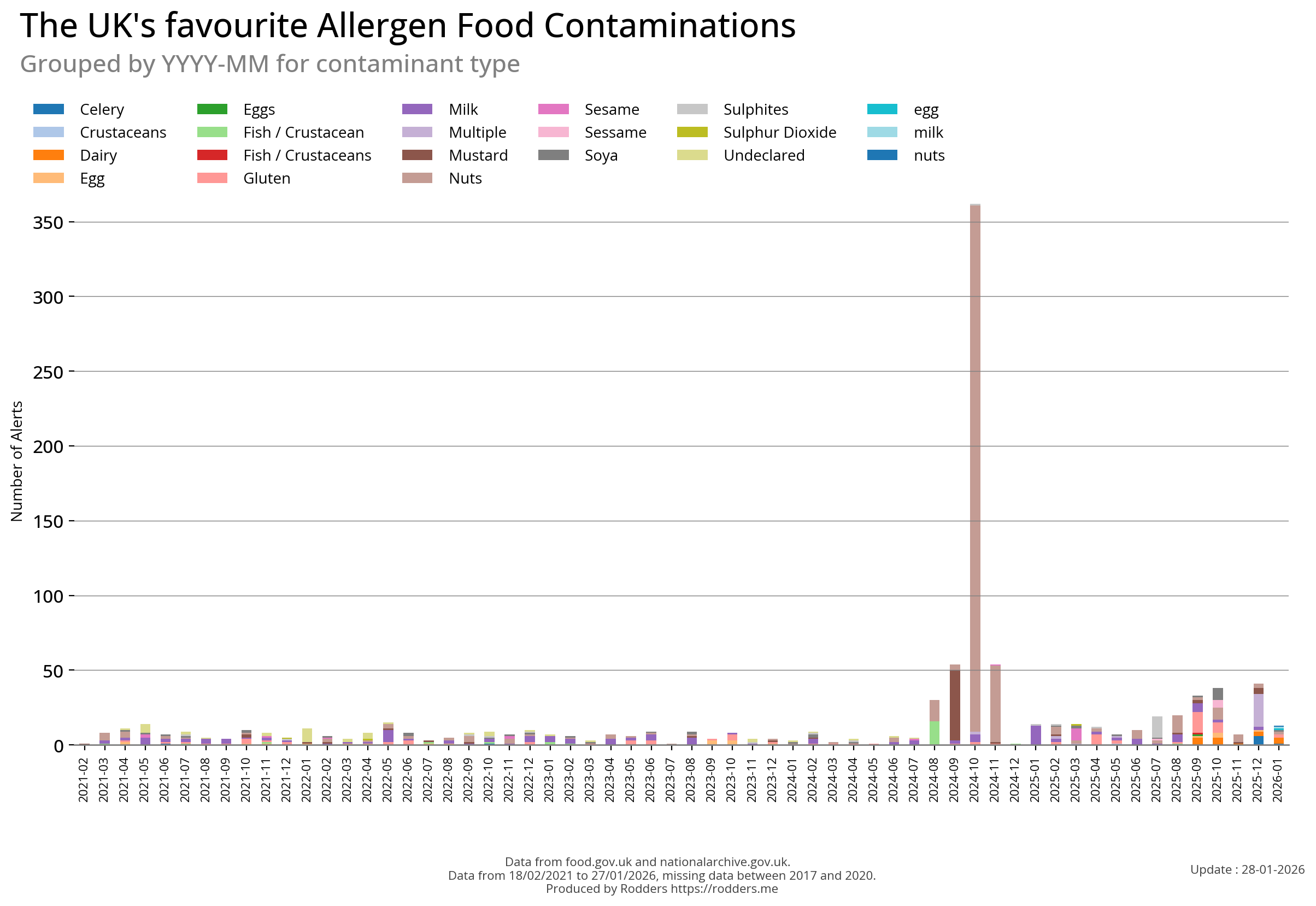
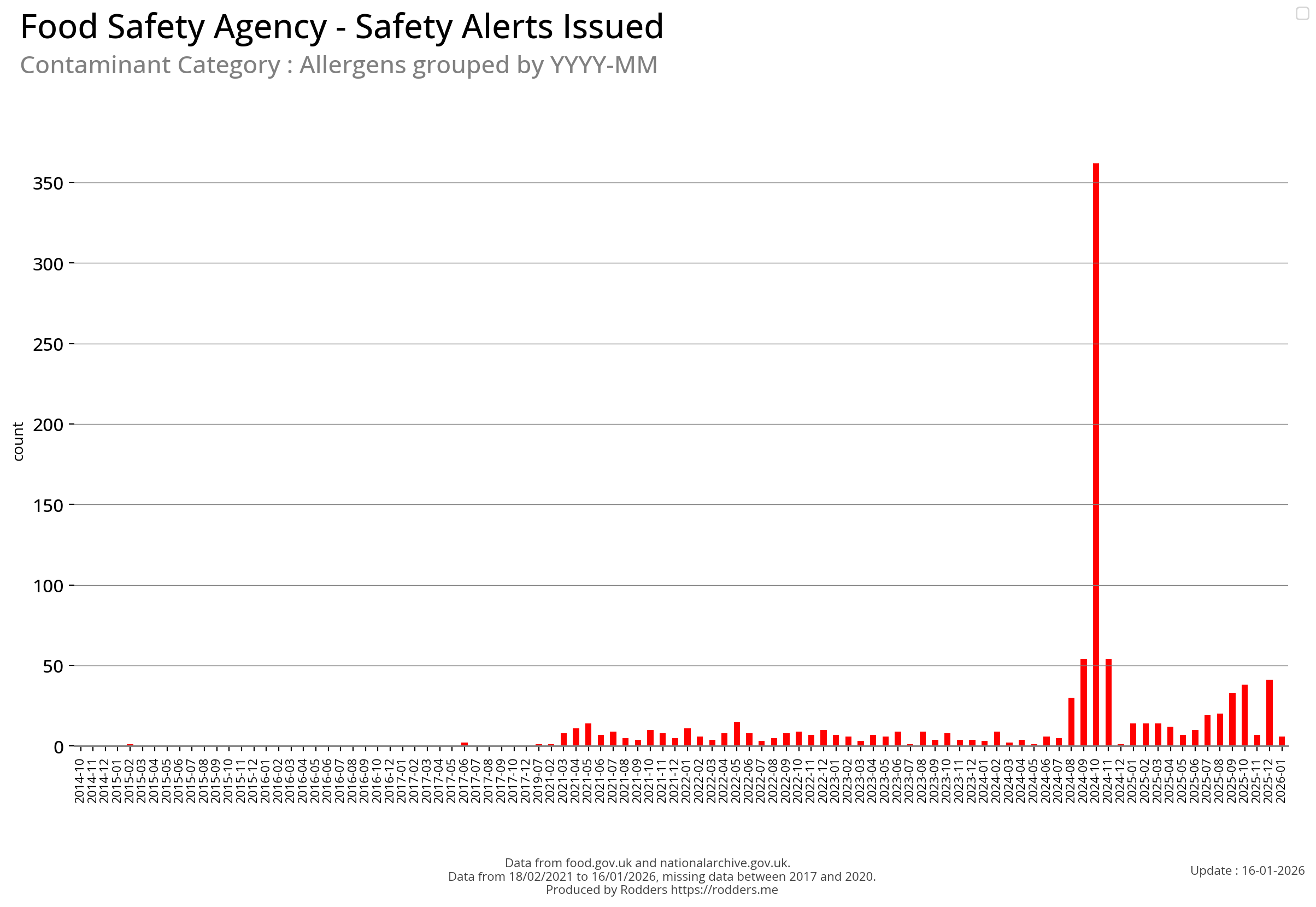
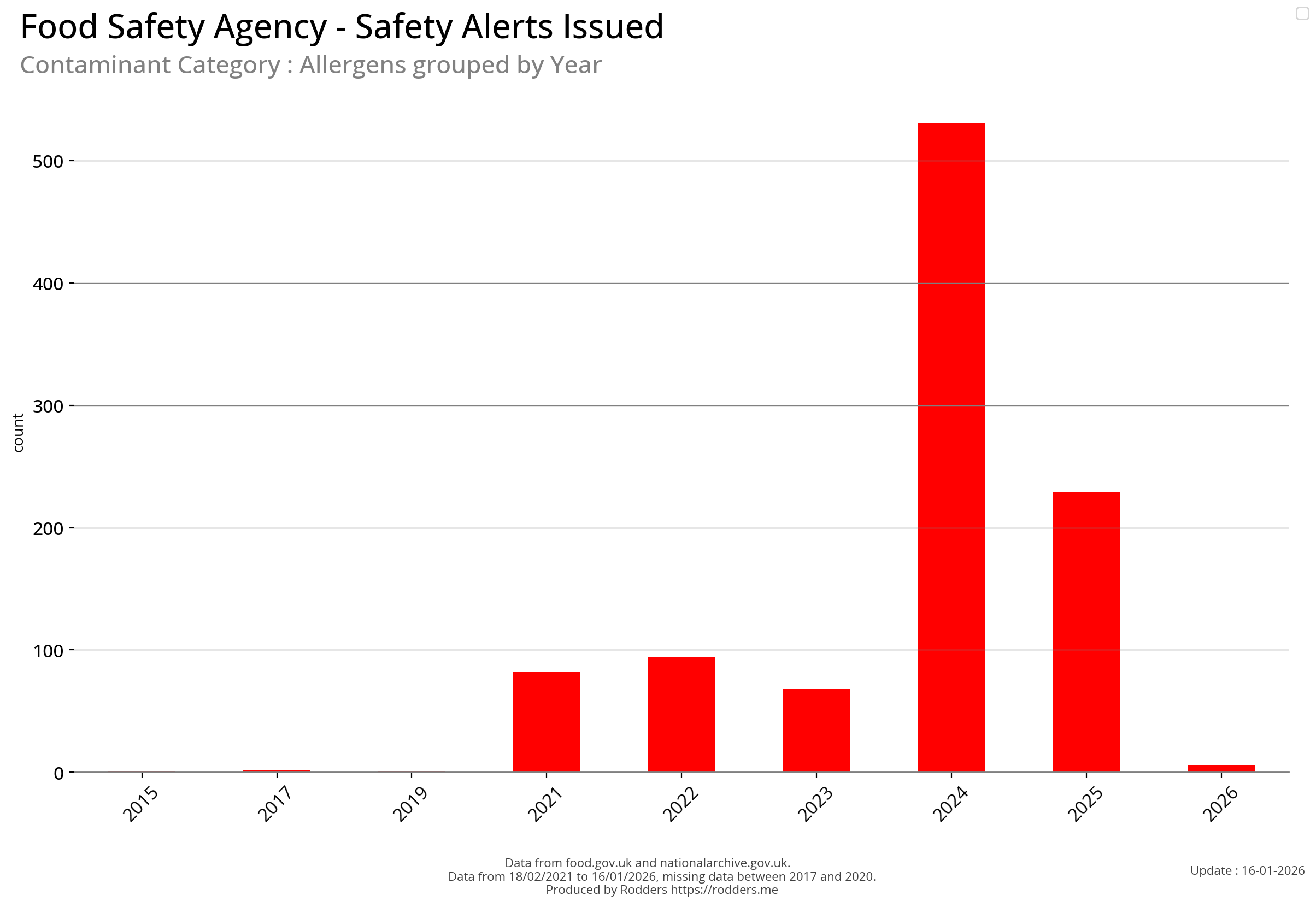
Note, data missing from 2017 to 2002. It appears that prior to 2017 Allergen Alerts were not being issued and with the missing data from 2017 to 2020, there are a lot less data points to visualise for Allergens compared to other Food Safety Alerts.
| Allergen | 2015 | 2017 | 2019 | 2021 | 2022 | 2023 | 2024 | 2025 | 2026 | total |
|---|---|---|---|---|---|---|---|---|---|---|
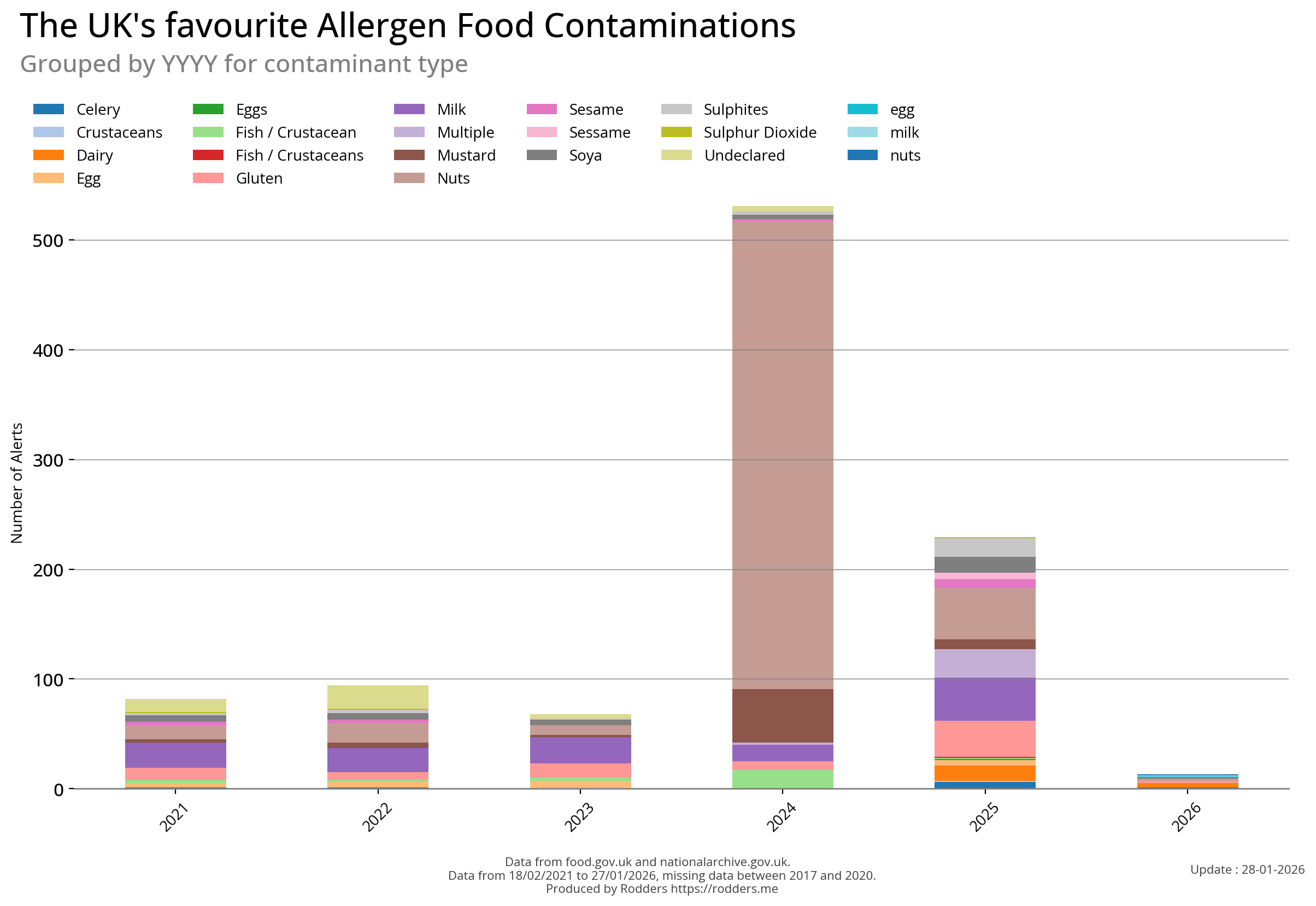
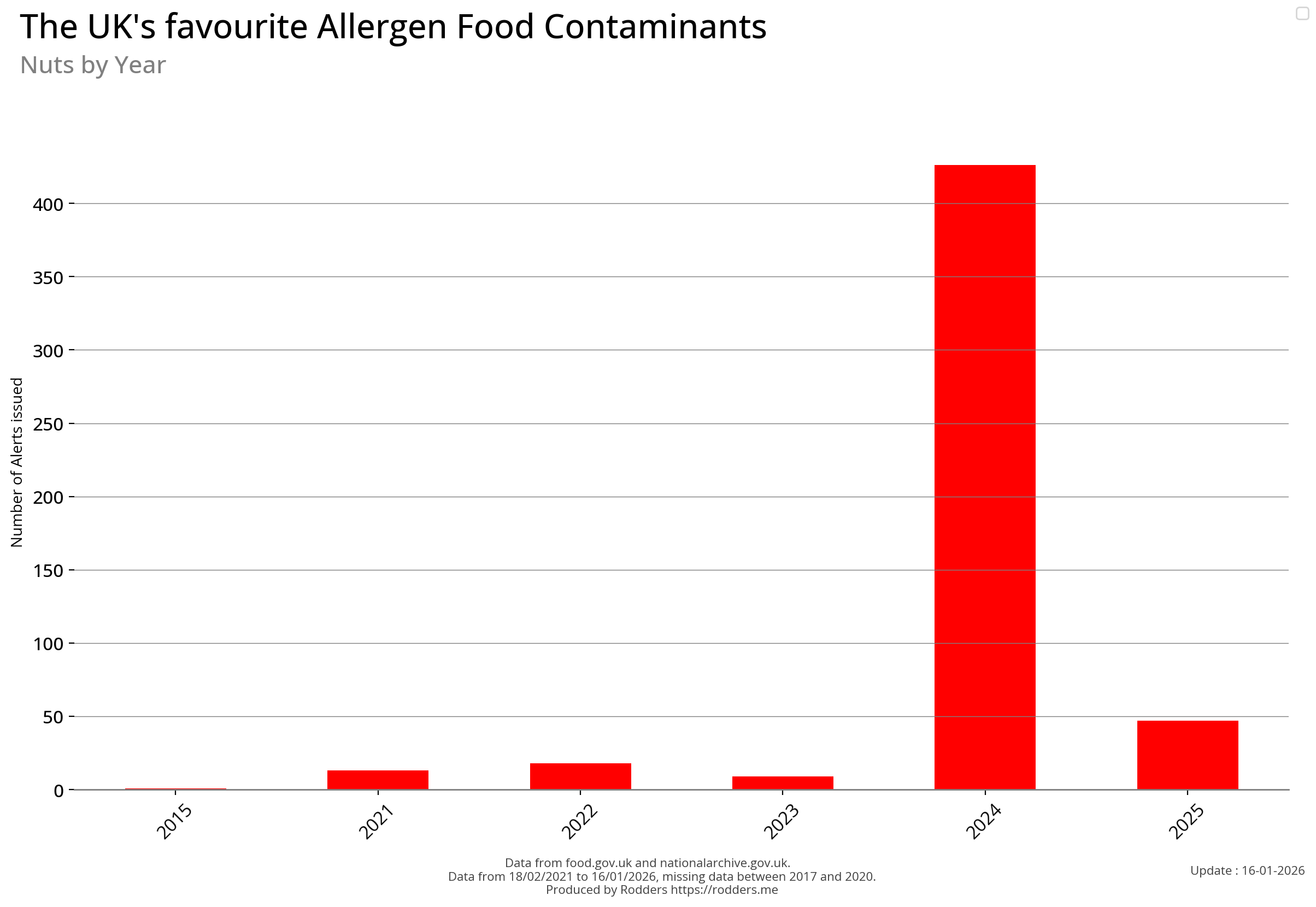
| Nuts | 1 | 0 | 0 | 13 | 18 | 9 | 426 | 47 | 3 | 517 |
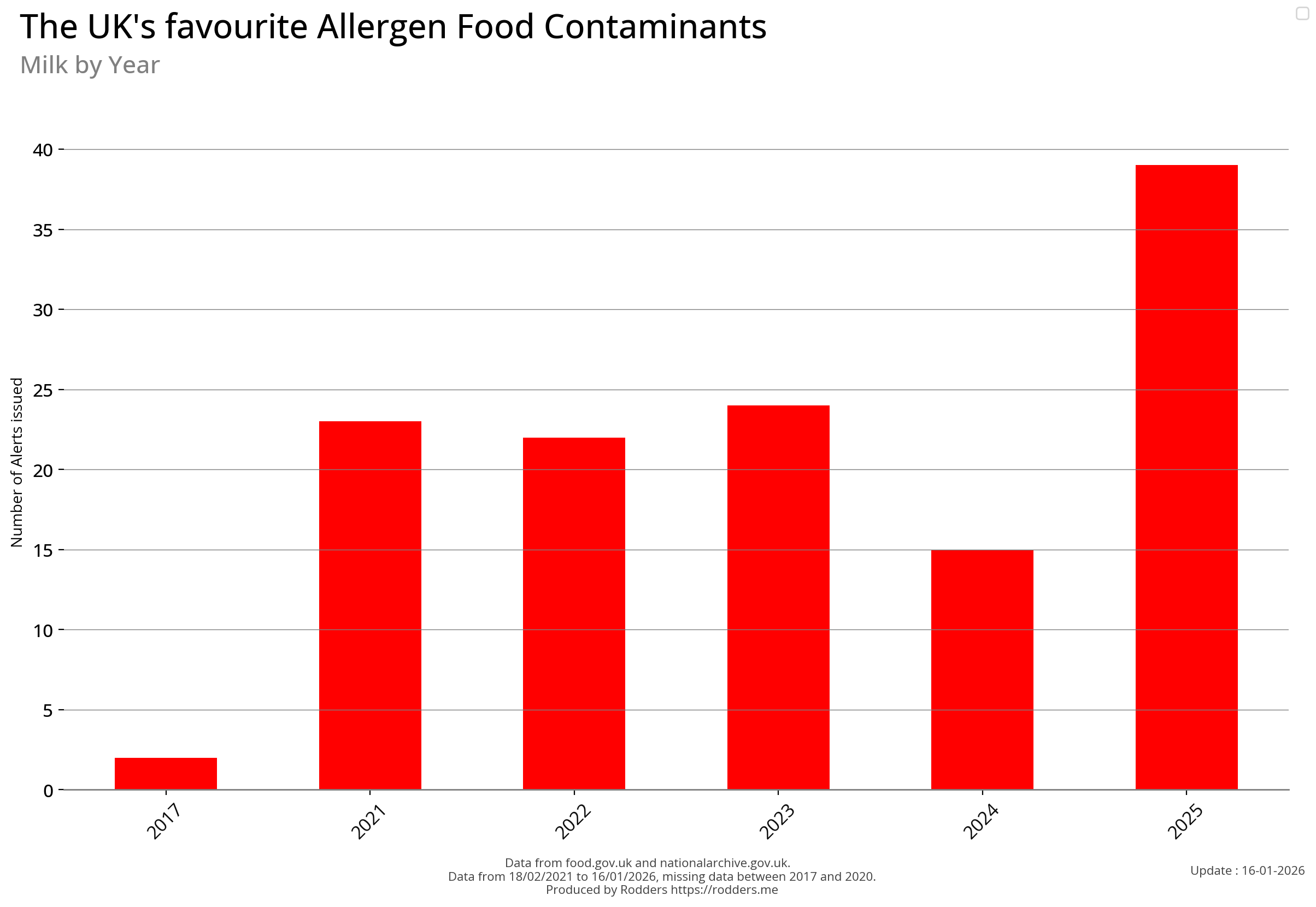
| Milk | 0 | 2 | 0 | 23 | 22 | 24 | 15 | 39 | 0 | 125 |
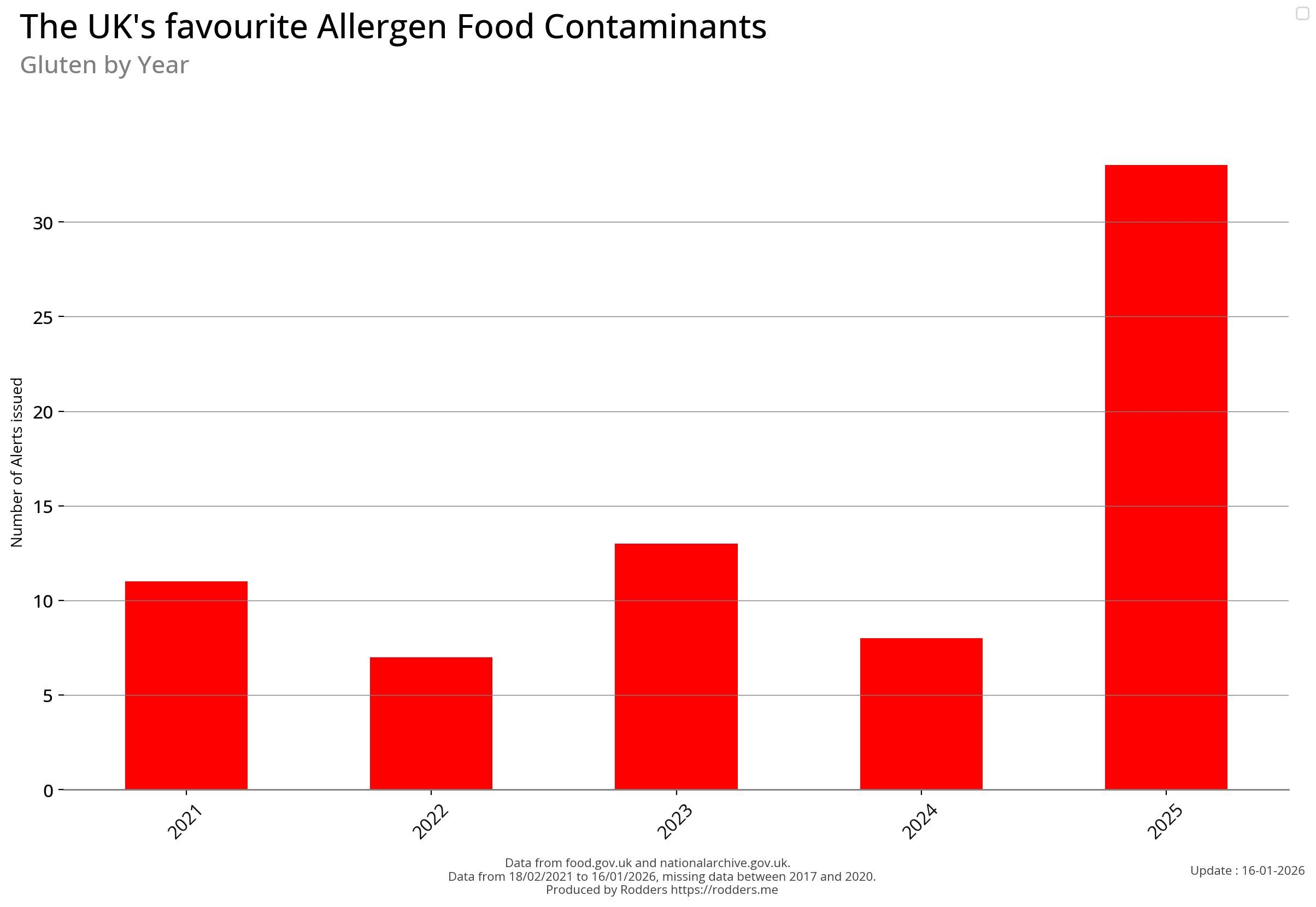
| Gluten | 0 | 0 | 0 | 11 | 7 | 13 | 8 | 33 | 2 | 74 |
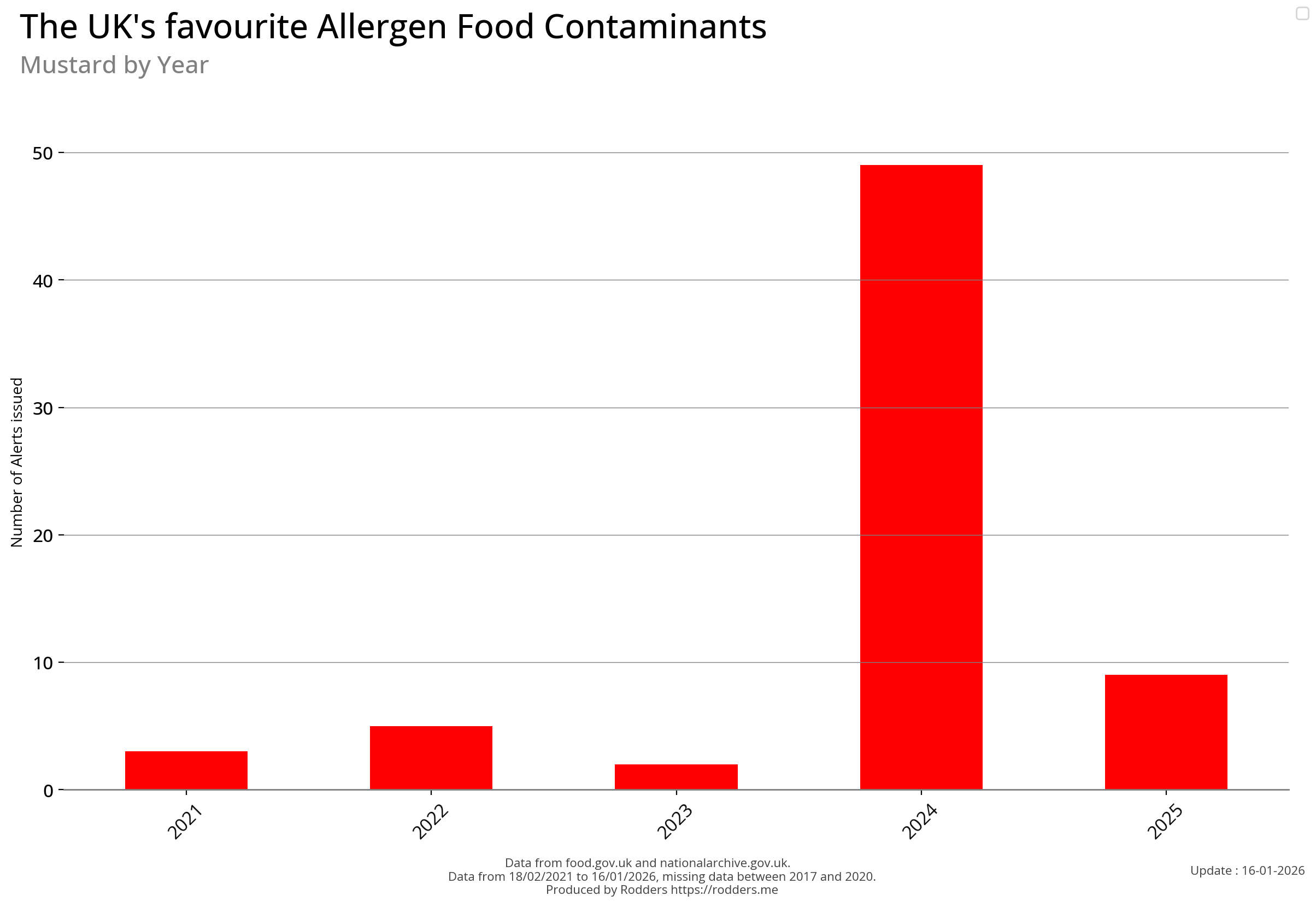
| Mustard | 0 | 0 | 0 | 3 | 5 | 2 | 49 | 9 | 0 | 68 |
| wheat | 0 | 0 | 0 | 0 | 0 | 0 | 0 | 0 | 55 | 55 |
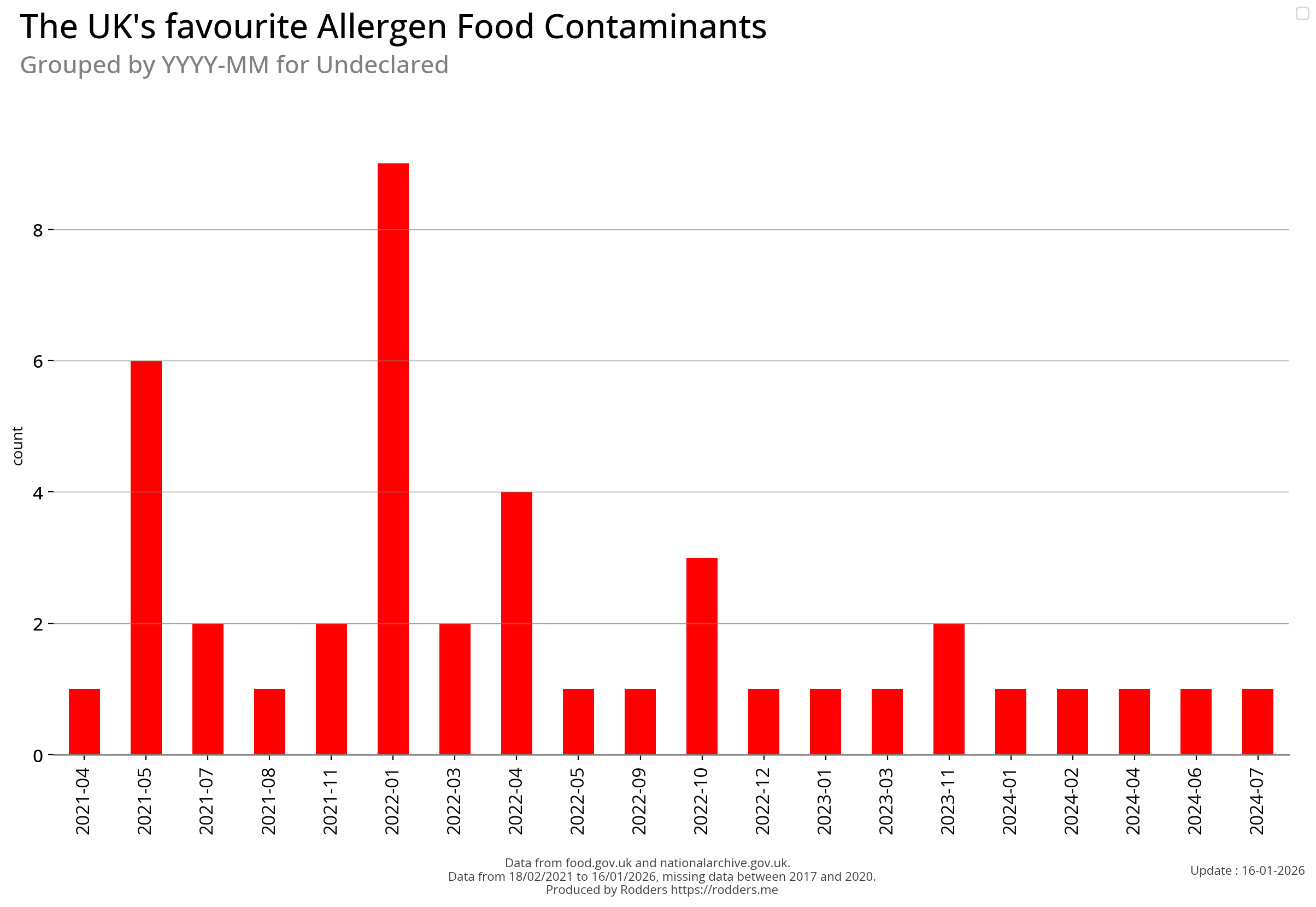
| Undeclared | 0 | 0 | 0 | 12 | 21 | 4 | 5 | 0 | 0 | 42 |
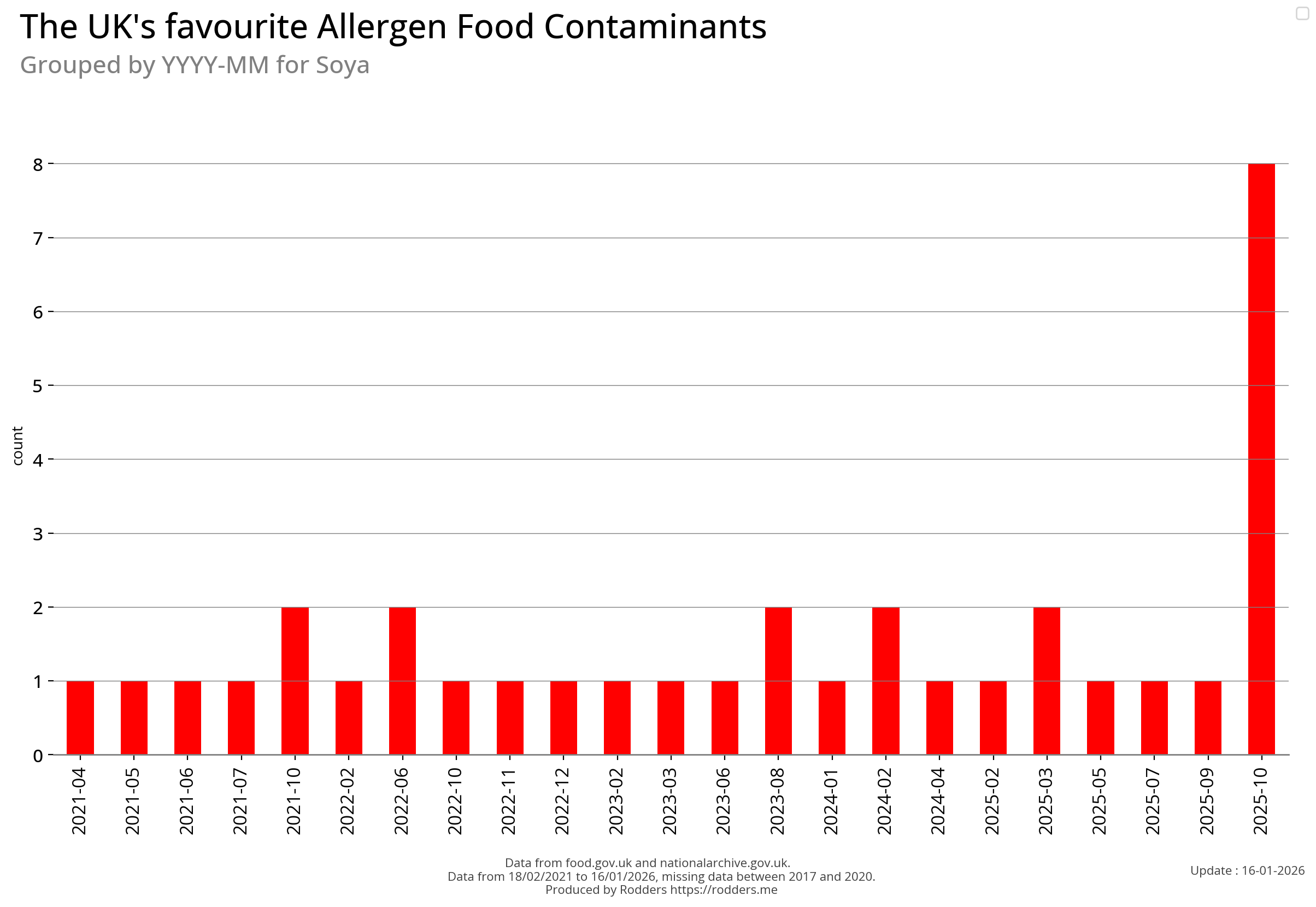
| Soya | 0 | 0 | 0 | 6 | 6 | 5 | 4 | 14 | 1 | 36 |
| Multiple | 0 | 0 | 0 | 0 | 0 | 0 | 2 | 26 | 0 | 28 |
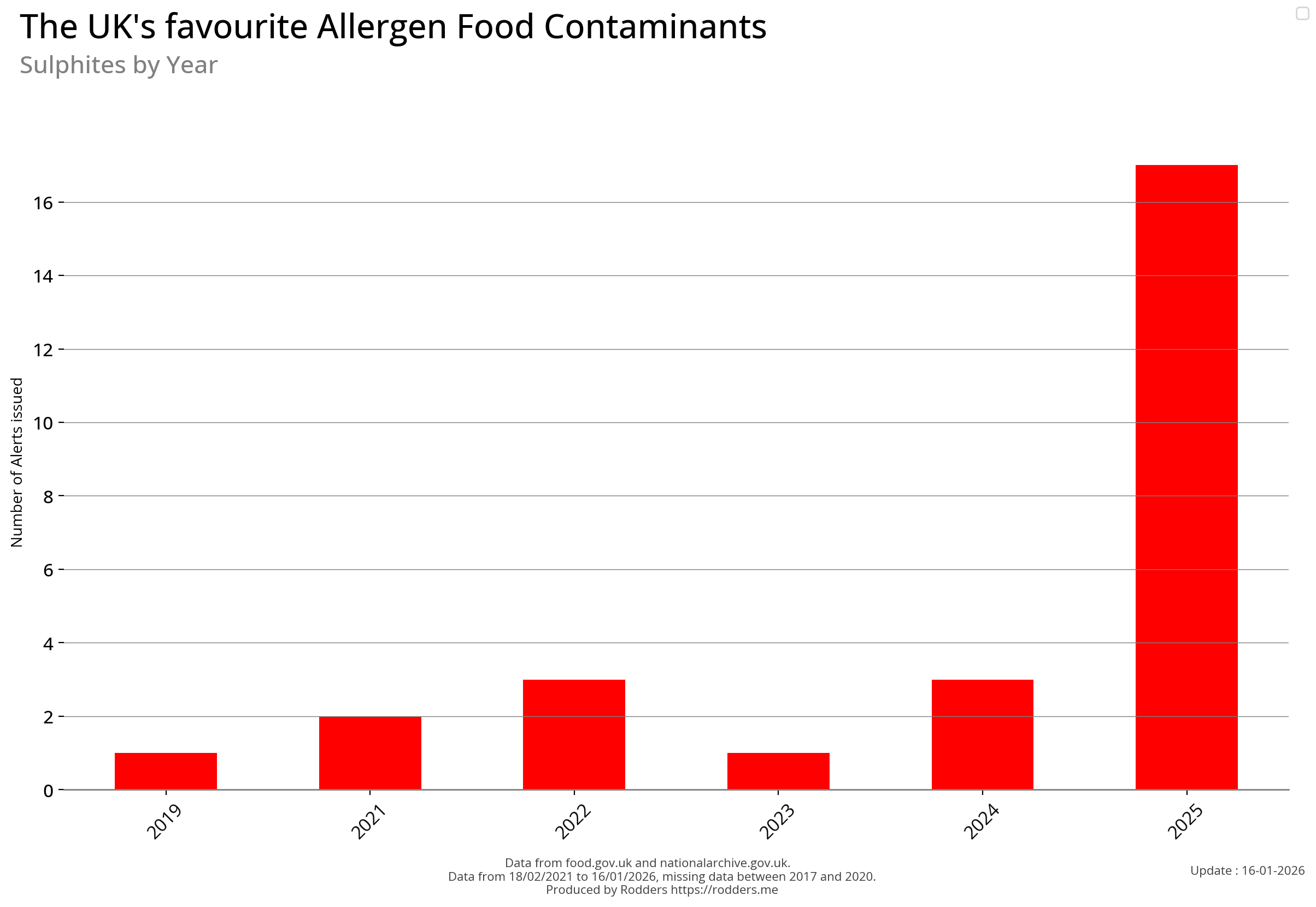
| Sulphites | 0 | 0 | 1 | 2 | 3 | 1 | 3 | 17 | 0 | 27 |
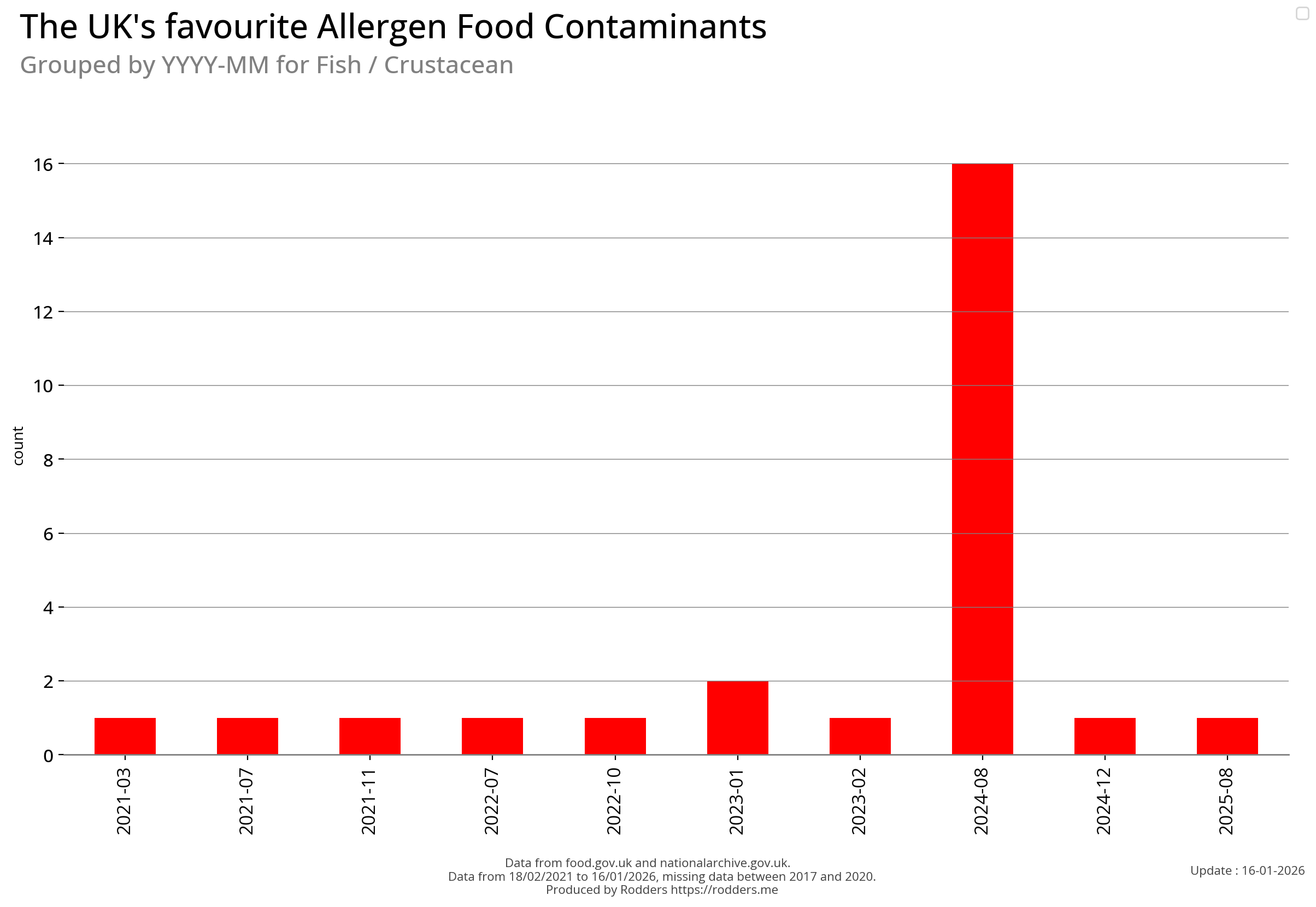
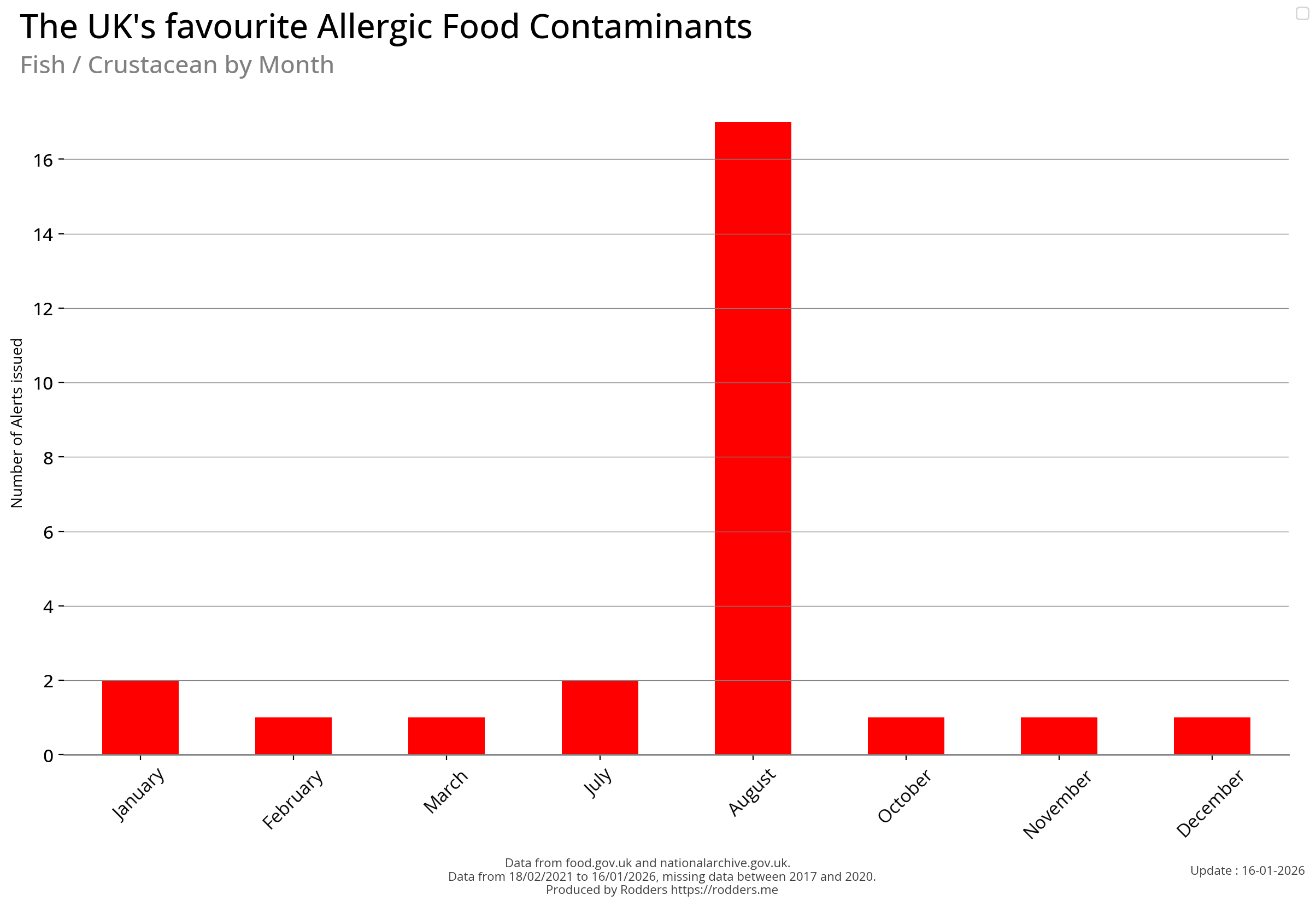
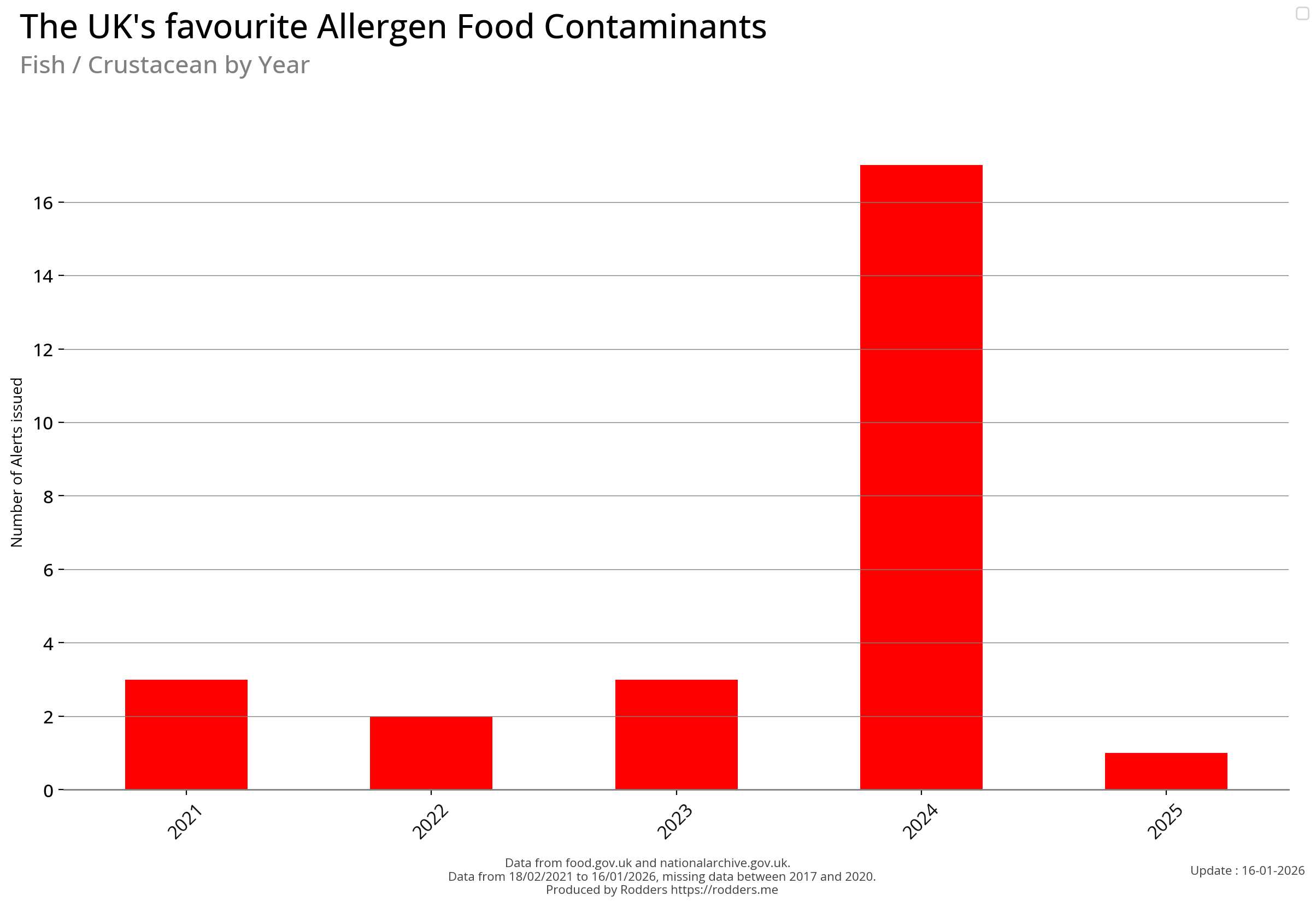
| Fish / Crustacean | 0 | 0 | 0 | 3 | 2 | 3 | 17 | 1 | 0 | 26 |
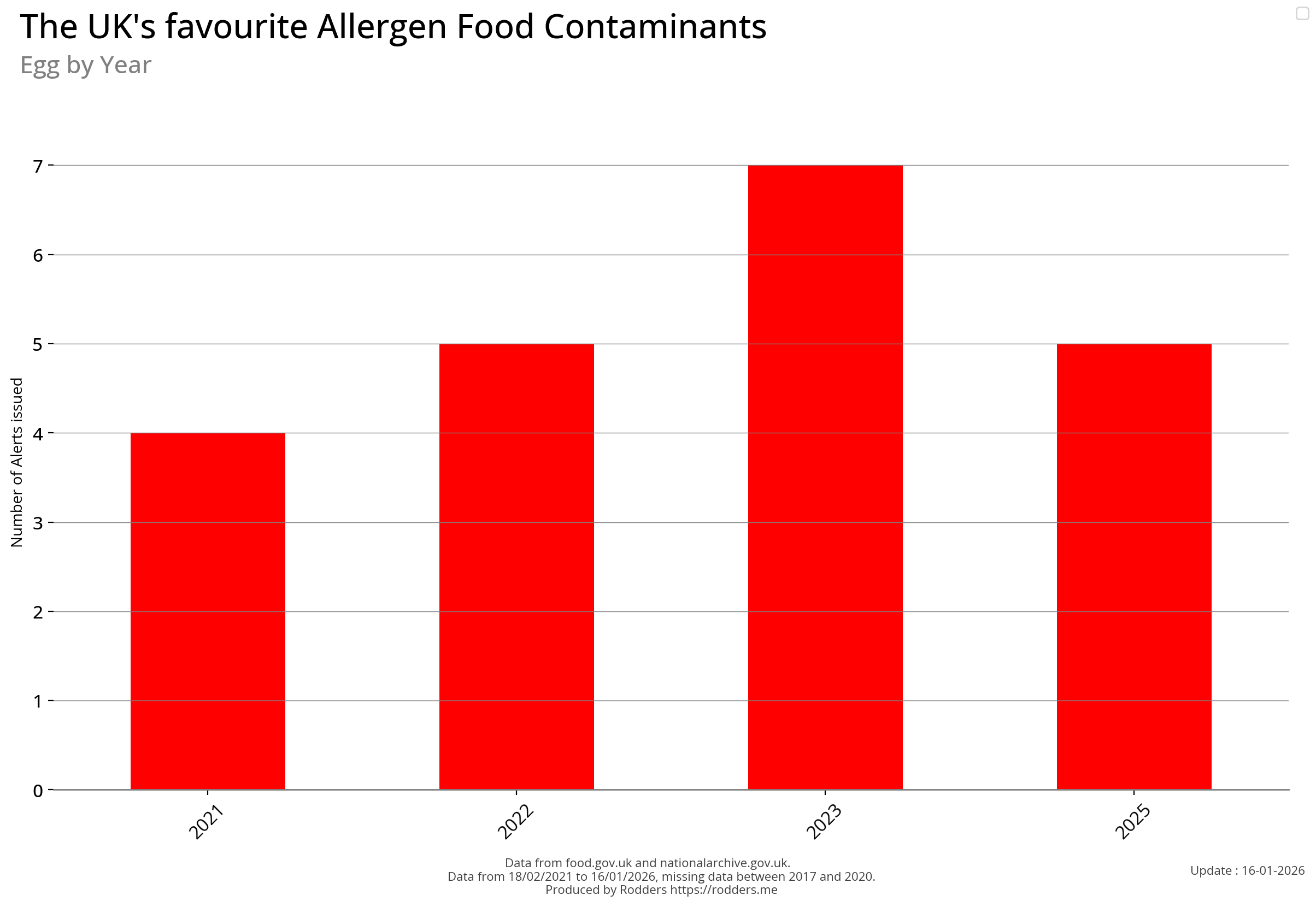
| Egg | 0 | 0 | 0 | 4 | 5 | 7 | 0 | 5 | 0 | 21 |
| Dairy | 0 | 0 | 0 | 0 | 0 | 0 | 0 | 14 | 4 | 18 |
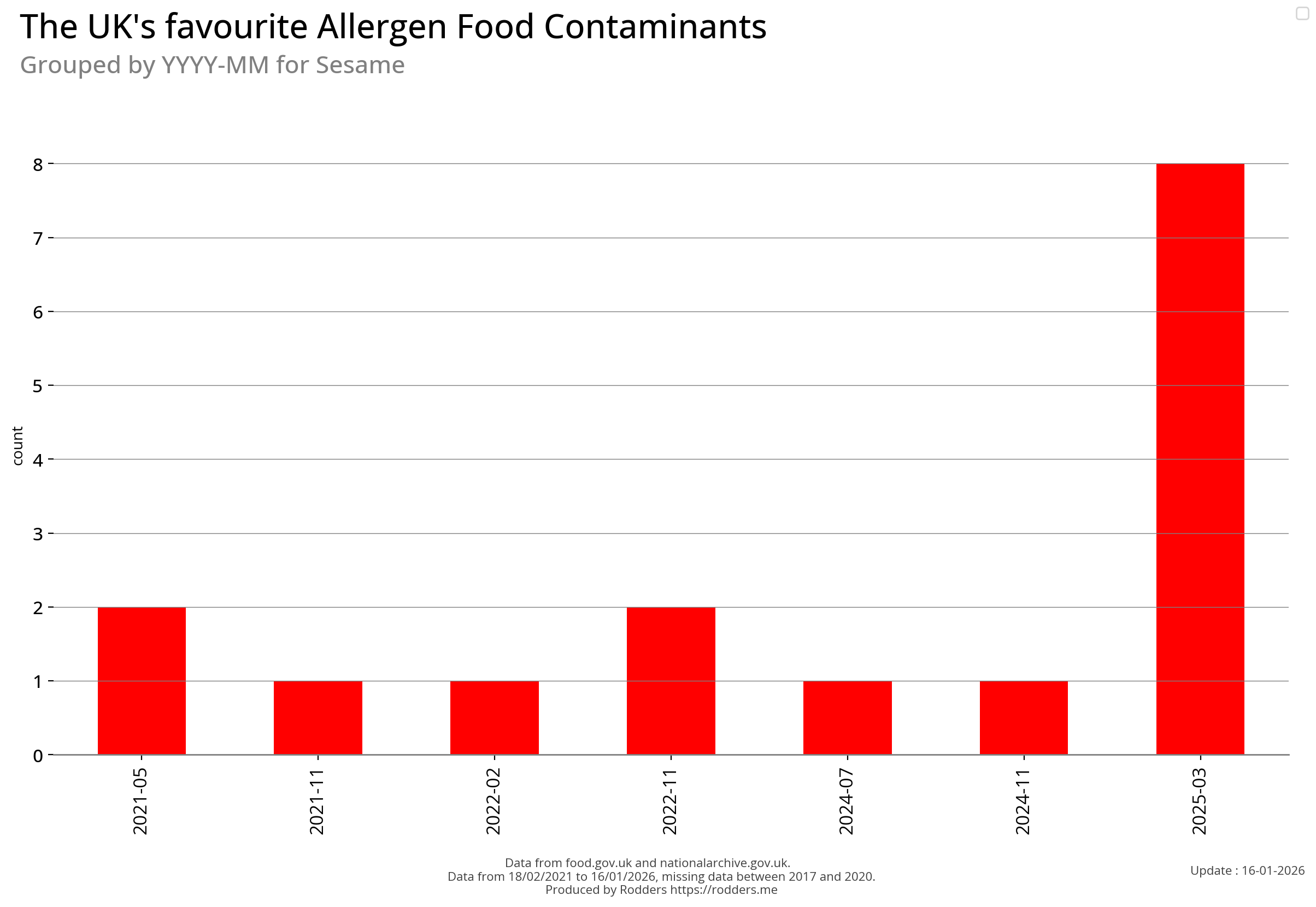
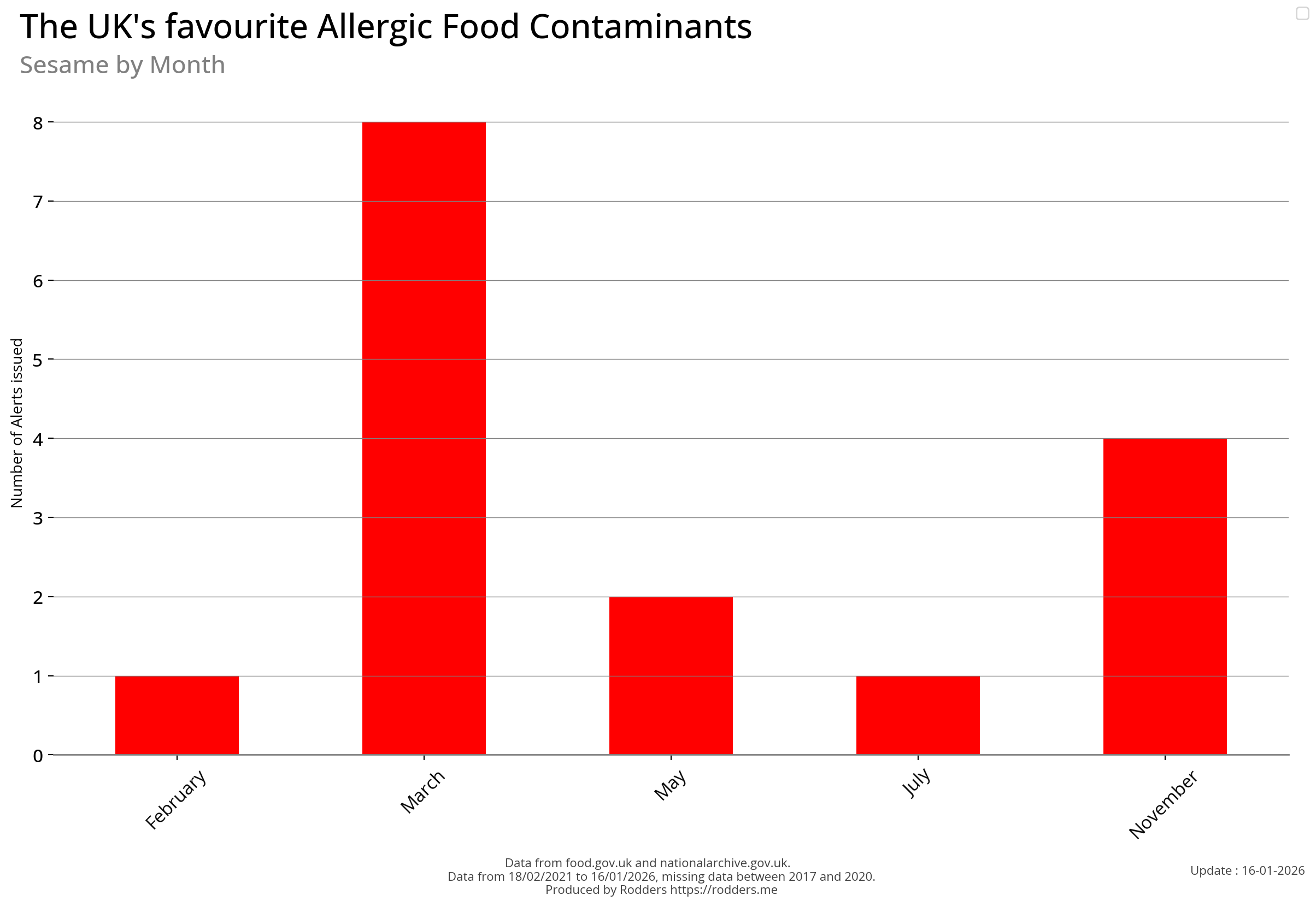
| Sesame | 0 | 0 | 0 | 3 | 3 | 0 | 2 | 8 | 0 | 16 |
| soya | 0 | 0 | 0 | 0 | 0 | 0 | 0 | 0 | 10 | 10 |
| Celery | 0 | 0 | 0 | 1 | 1 | 0 | 0 | 6 | 1 | 9 |
| Sessame | 0 | 0 | 0 | 0 | 0 | 0 | 0 | 6 | 0 | 6 |
| Sulphur Dioxide | 0 | 0 | 0 | 1 | 1 | 0 | 0 | 1 | 0 | 3 |
| nuts | 0 | 0 | 0 | 0 | 0 | 0 | 0 | 0 | 2 | 2 |
| Crustaceans | 0 | 0 | 0 | 0 | 0 | 0 | 0 | 1 | 0 | 1 |
| Fish / Crustaceans | 0 | 0 | 0 | 0 | 0 | 0 | 0 | 1 | 0 | 1 |
| Eggs | 0 | 0 | 0 | 0 | 0 | 0 | 0 | 1 | 0 | 1 |
| egg | 0 | 0 | 0 | 0 | 0 | 0 | 0 | 0 | 1 | 1 |
| milk | 0 | 0 | 0 | 0 | 0 | 0 | 0 | 0 | 1 | 1 |
Top
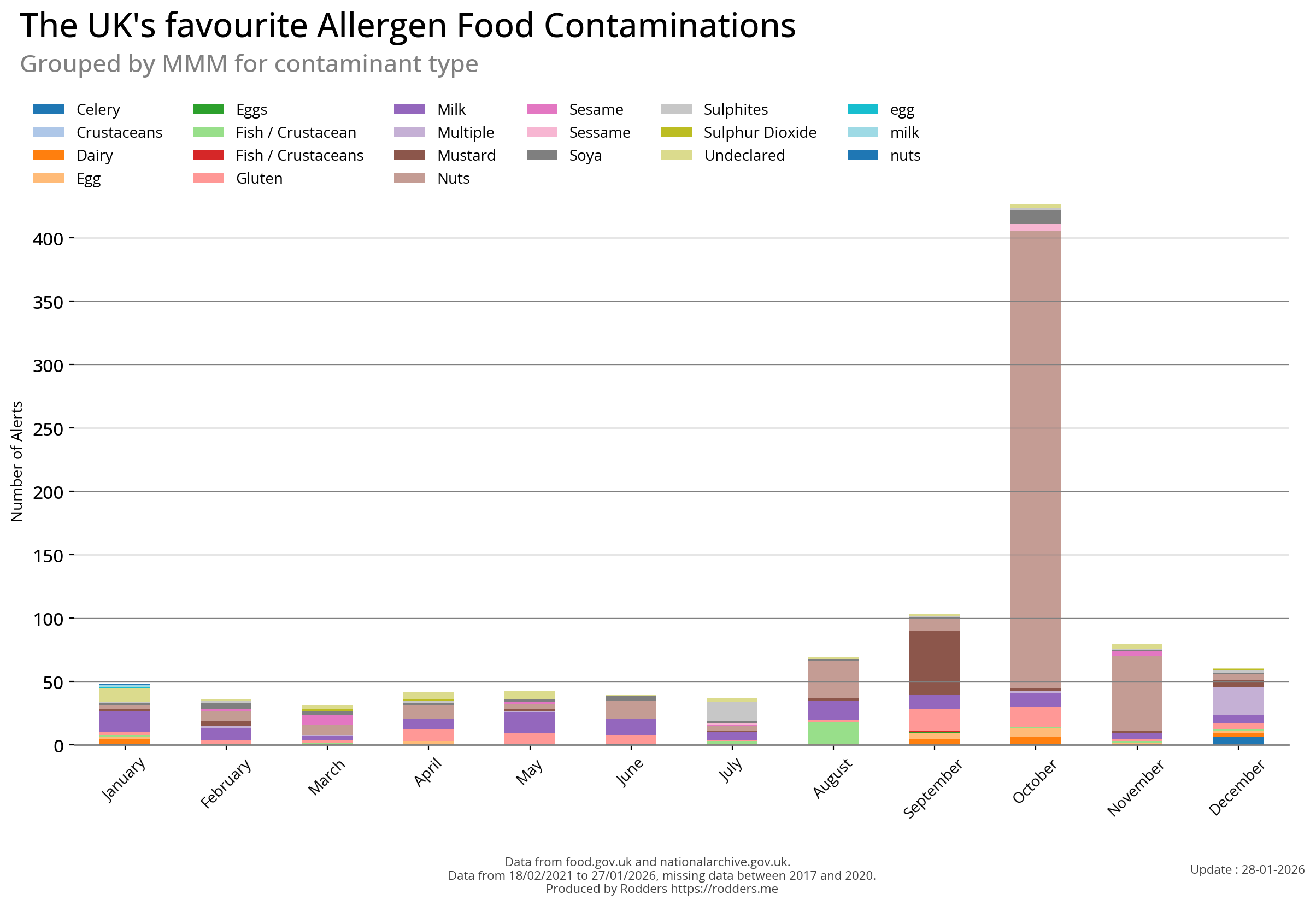
Time Series Cross-Sectional Visualisations of Allergen Types
 |
|
 |
 |
Top
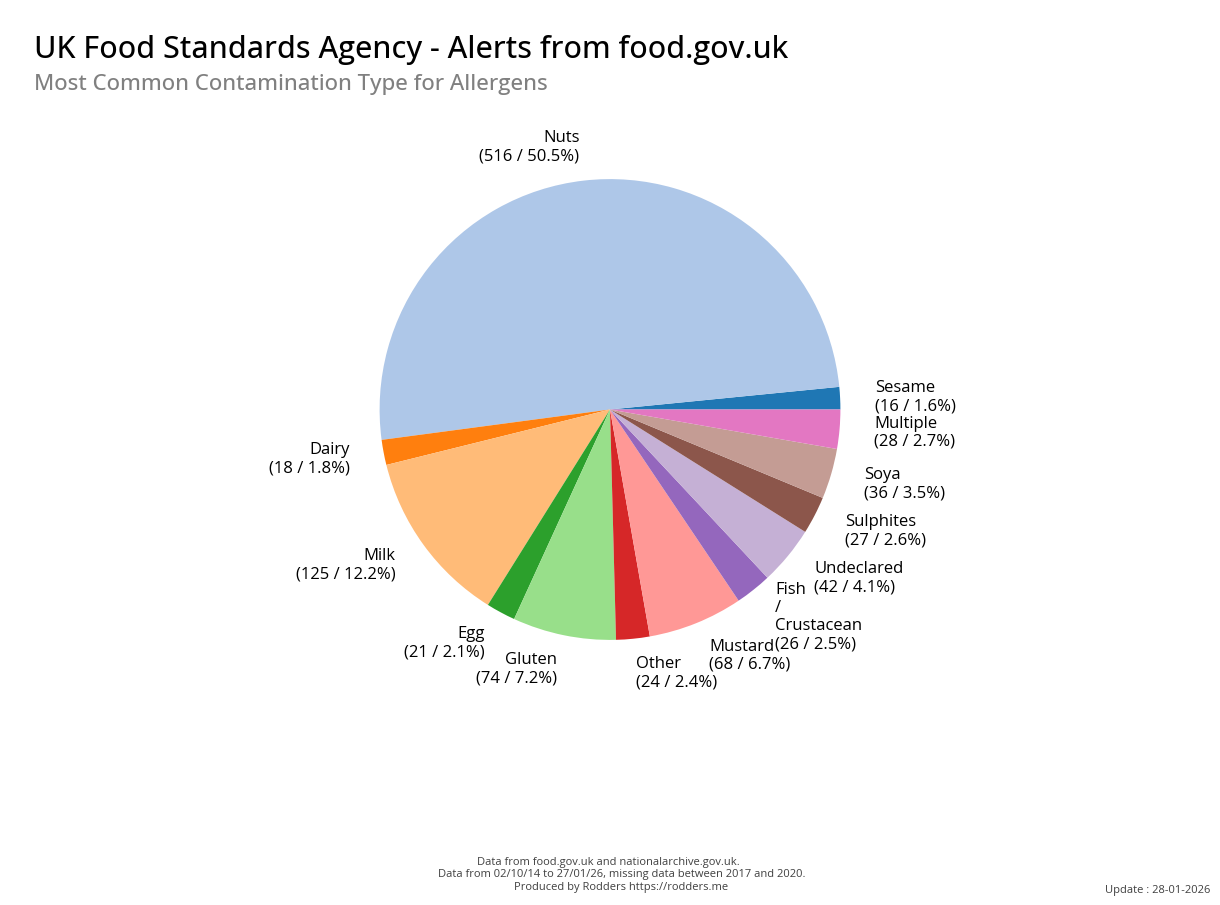
Safety Alert Distribution by Allergen Type
 |
Top
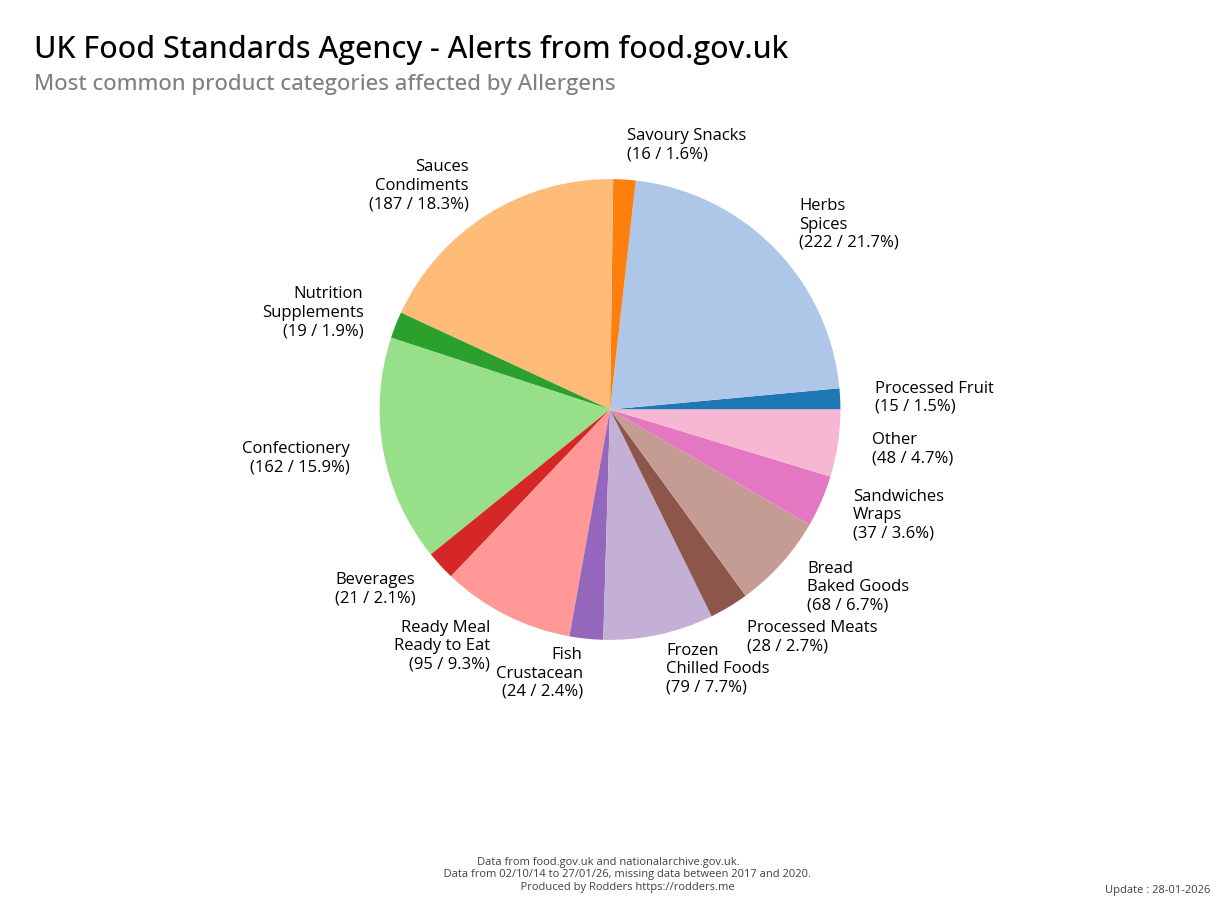
Safety Alert Distribution by Product Category
 |
Top
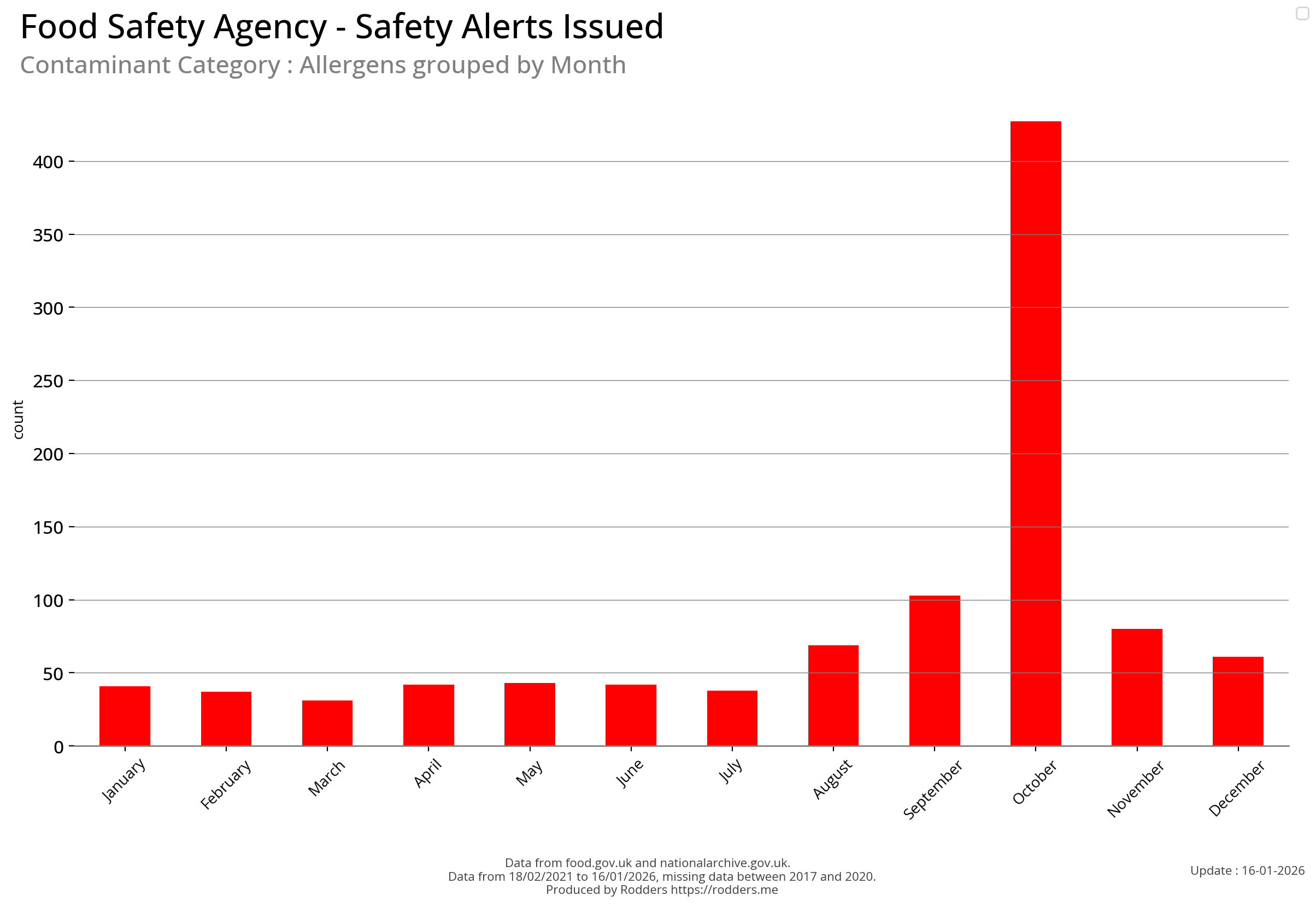
Time Series Visualisations of Allergen Safety Alerts
 |
|
 |
|
Top
Time Series Visualisations of Allergens and Common Affected Foods
Milk
Milk allergy is an immune system reaction to one or more proteins in milk, typically casein or whey. This reaction can cause a range of symptoms, including hives, itching, swelling, stomach cramps, diarrhoea, and vomiting. In severe cases, milk allergy can lead to anaphylaxis, a life-threatening allergic reaction that requires immediate medical attention. According to Food Allergy Research & Education (FARE), milk is one of the most common food allergies in children, affecting about 2.5% of infants under the age of three.
Processed foods can increase the risk of exposure to milk allergens due to hidden ingredients or cross-contamination. Many processed foods contain milk-derived products like whey, casein, lactose, and milk fat, which can be difficult to identify on labels. Even small amounts of these allergens can trigger a reaction in individuals with milk allergy. Additionally, the increased use of shared equipment and facilities in food manufacturing can lead to cross-contamination between milk-based and non-milk-based products. Some people may also experience symptoms after consuming lactose-containing foods due to lactose intolerance.
https://www.allergyuk.org/resources/adult-cows-milk-allergy/
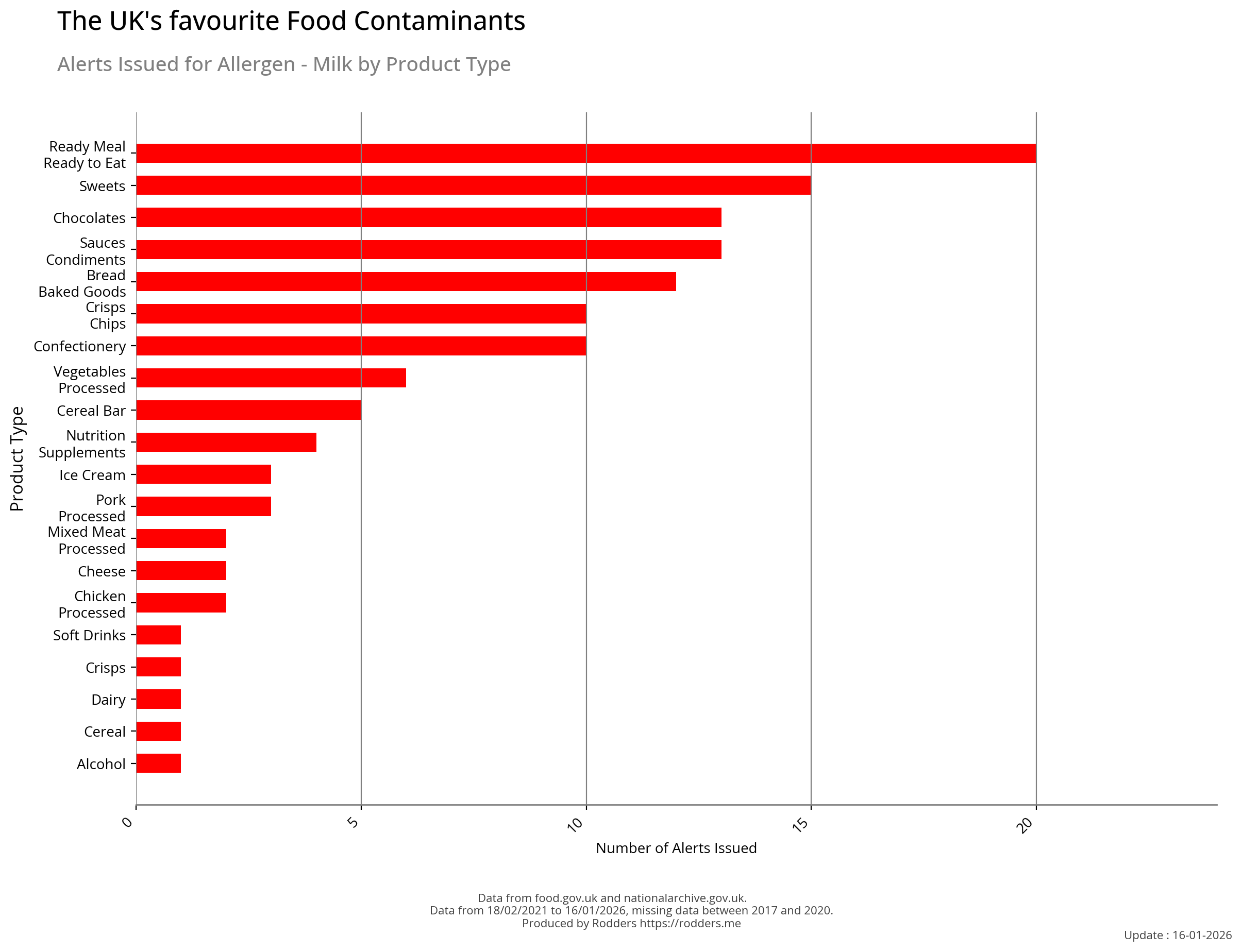
Most Common Foods Contaminated with Milk
Top
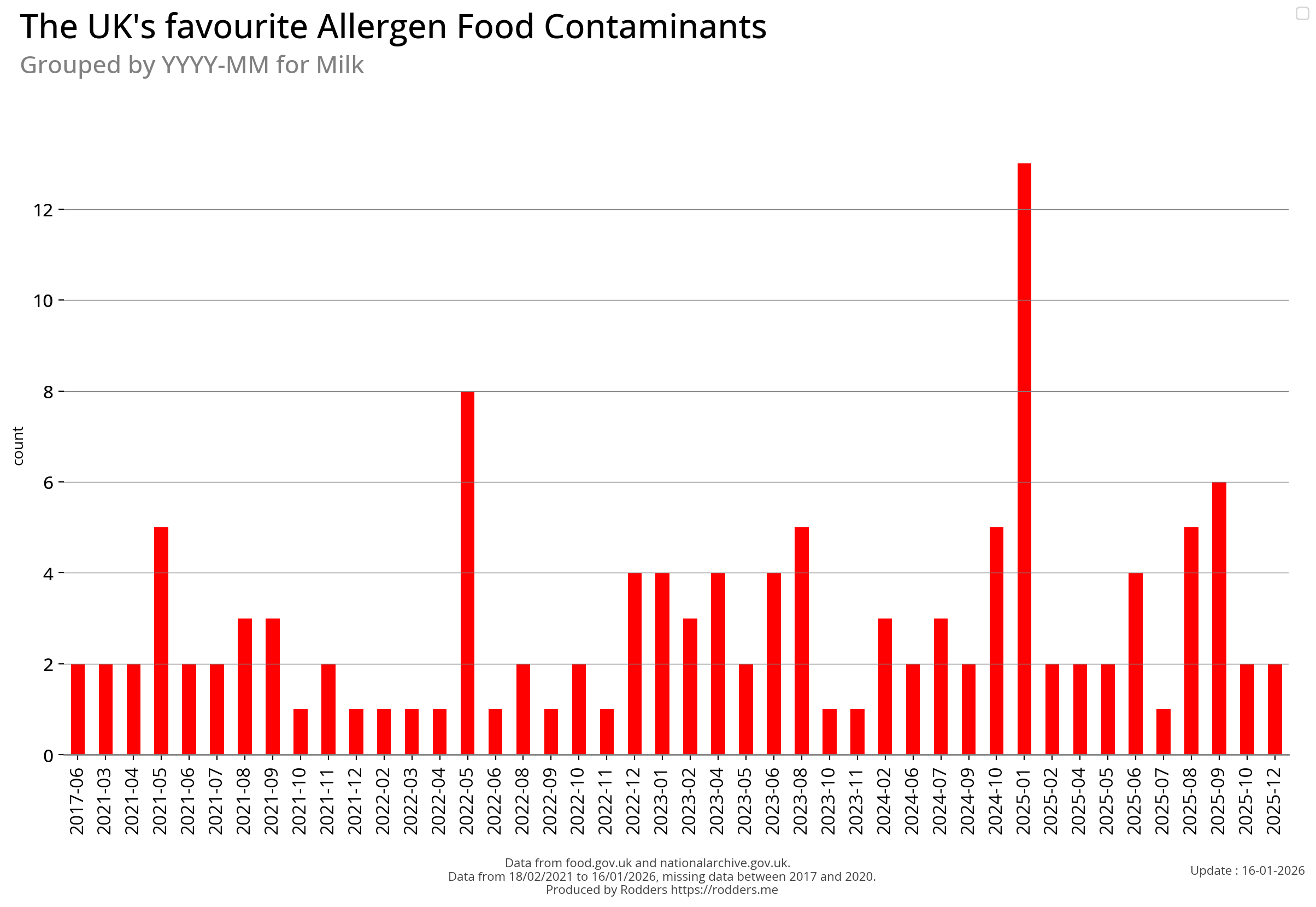
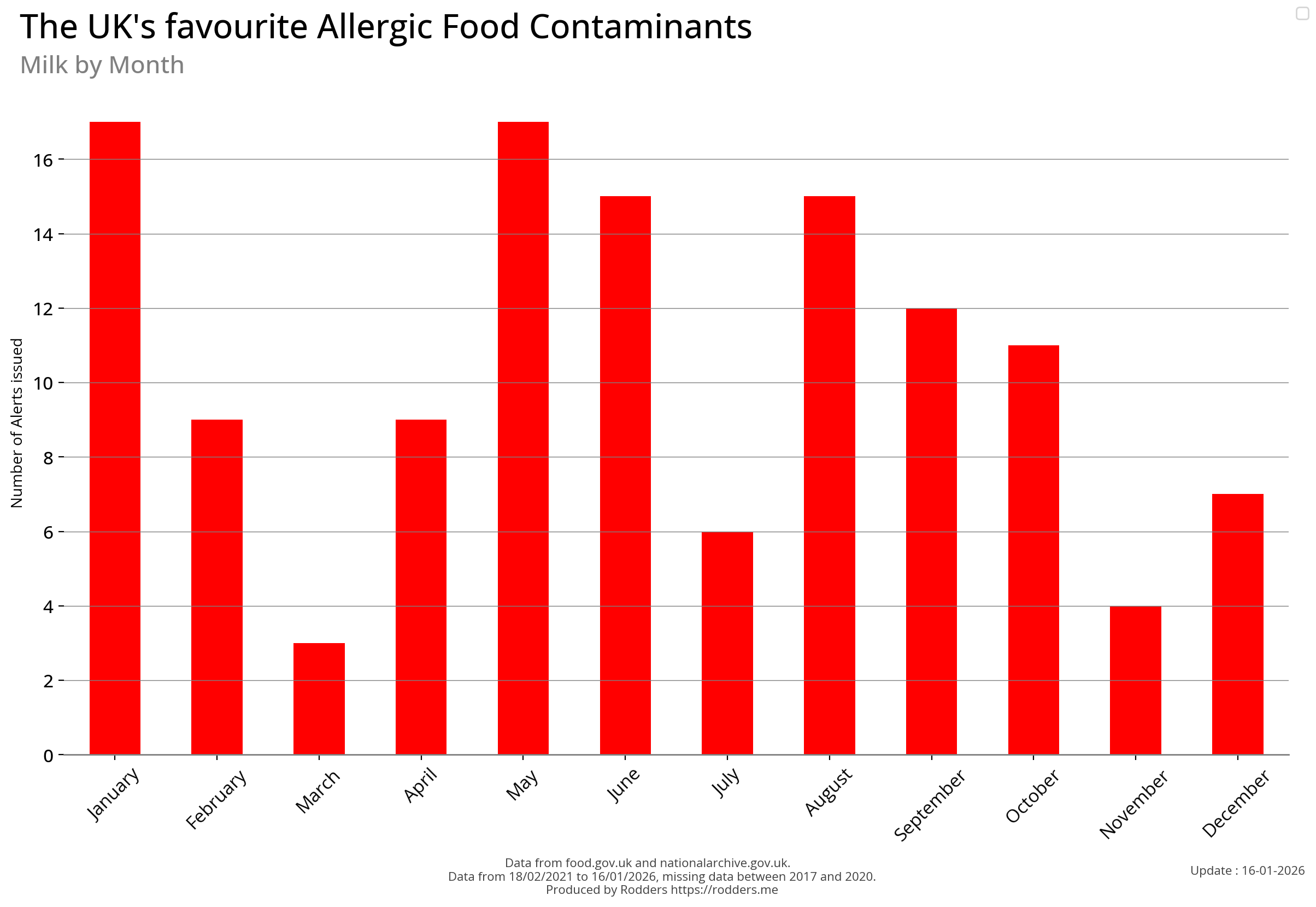
Temporal Visualisations
 |
|
 |
 |
Top
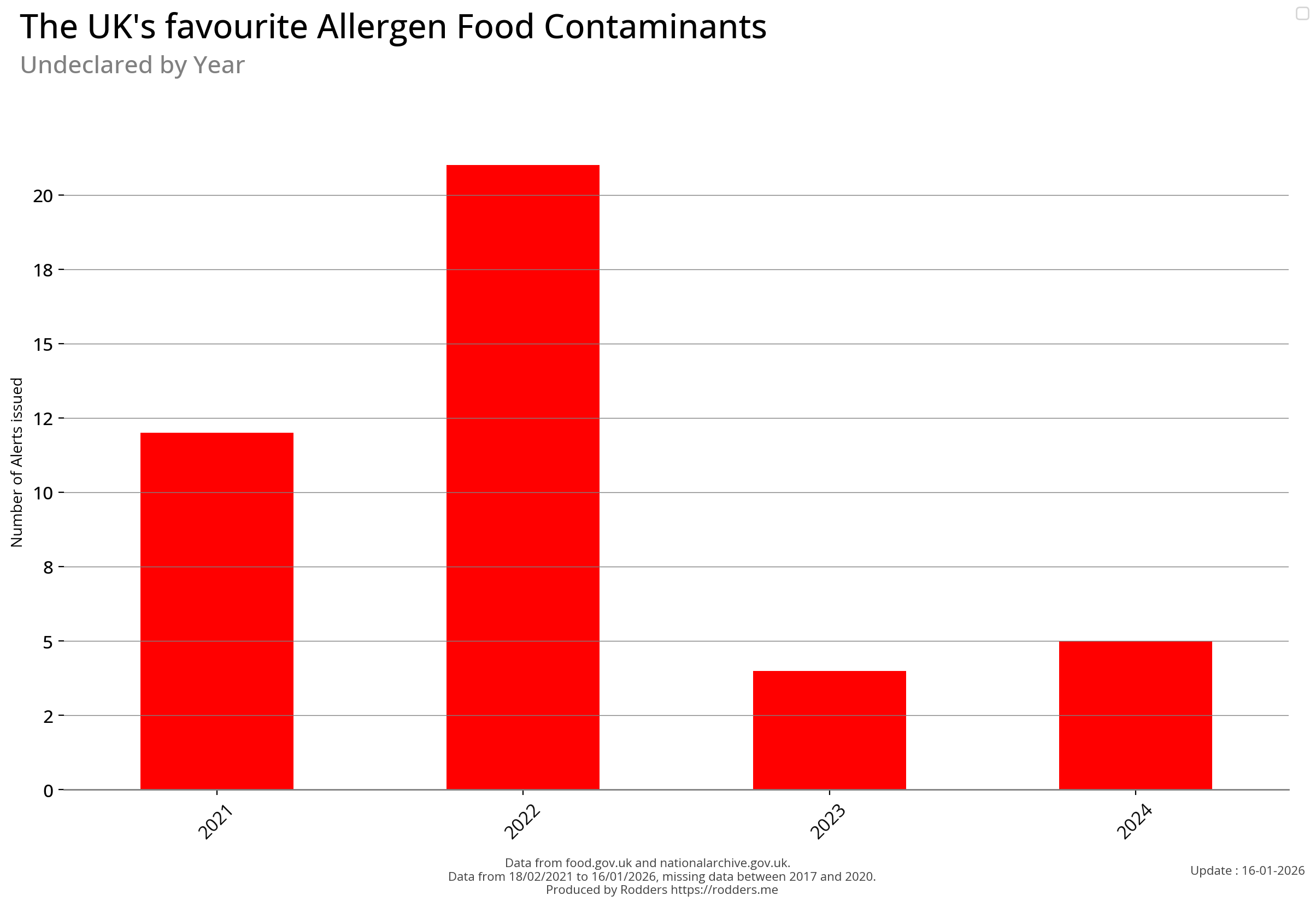
Undeclared Allergens
Undeclared allergens can cause severe reactions, including anaphylaxis, in individuals with food allergies.
A number of regulations apply to food labelling and the declaration of allergens including :
- Food Labelling Regulations 1996: These regulations require food businesses to provide accurate and clear labeling of their products, including information on ingredients, allergens, and nutritional content.
- The Food Information (Amendment) (England) Regulations 2014: This regulation amends the Food Labelling Regulations 1996 to implement EU legislation on food labeling, including requirements for allergen information.
- Food Information Regulation 2011: This regulation requires food businesses to provide consumers with accurate and clear information about their products, including allergens and nutritional content.
Specific legislation enforcing mandatory labeling of high-risk foods containing common allergens (e.g., peanuts, tree nuts, milk, eggs, fish, shellfish, soy, and wheat) include
- The Food Labelling Regulations 2014 (SI 2014/1852): This regulation requires food businesses to provide accurate and clear labeling of their products, including information on ingredients, allergens, and nutritional content.
- The Food Information (Amendment) (England) Regulations 2016 (SI 2016/373): This regulation amends the Food Labelling Regulations 2014 to implement EU legislation on food labeling, including requirements for allergen information.
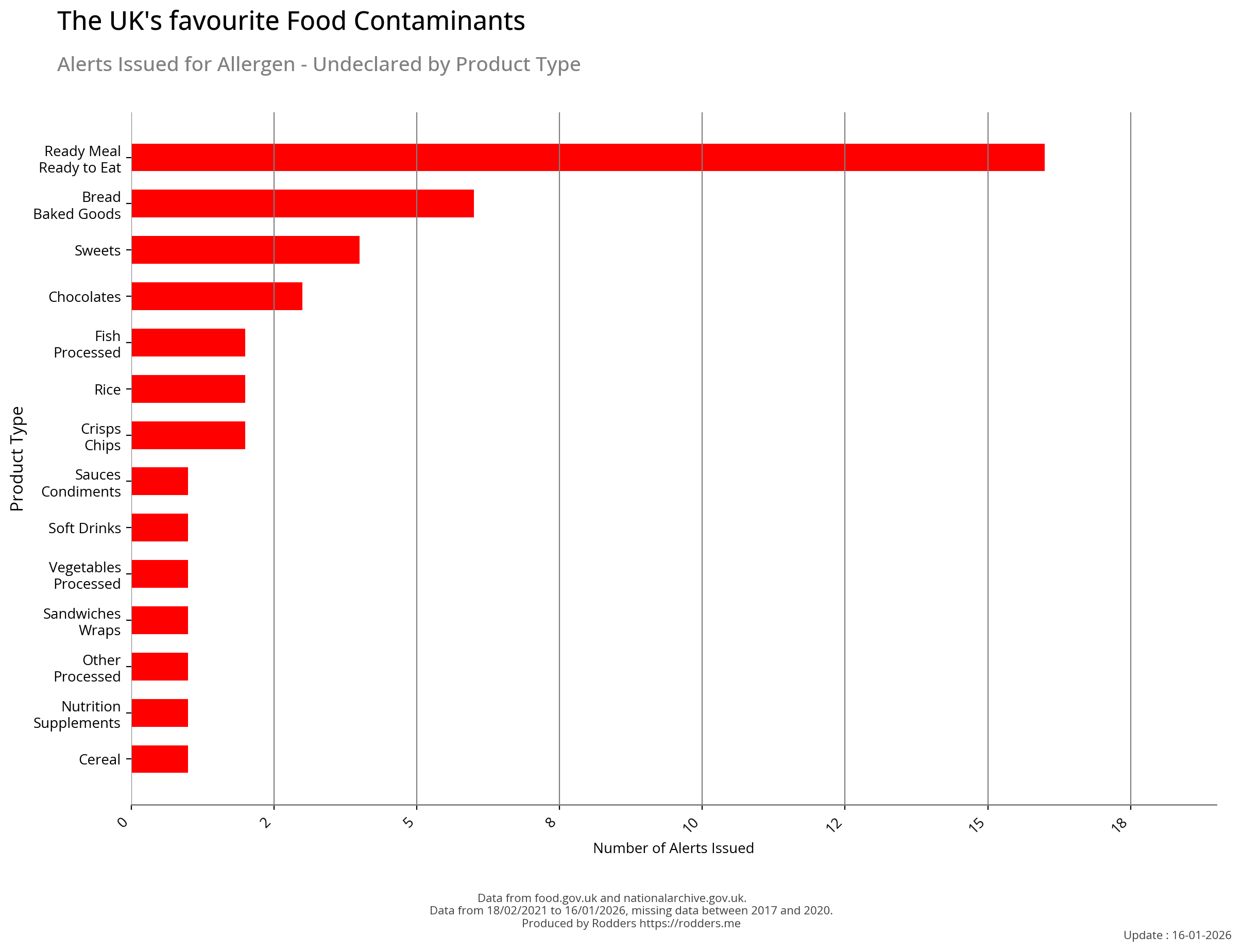
In the dataset being analysed, these undeclared allergens are largely unknown, no further information is available in the data.
Most Common Foods Contaminated with Undeclared Allergens
Top
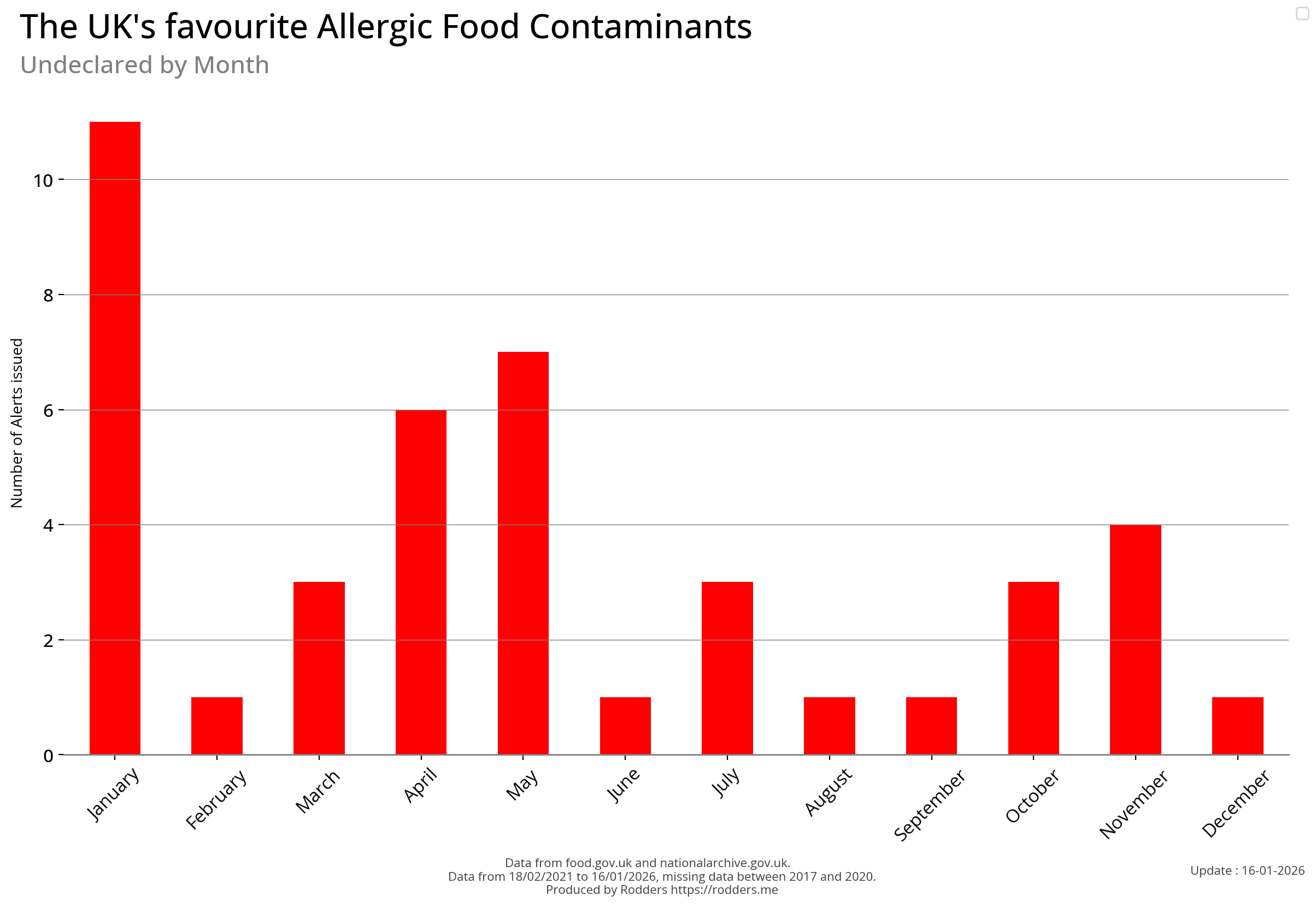
Temporal Visualisations
 |
|
 |
 |
Top
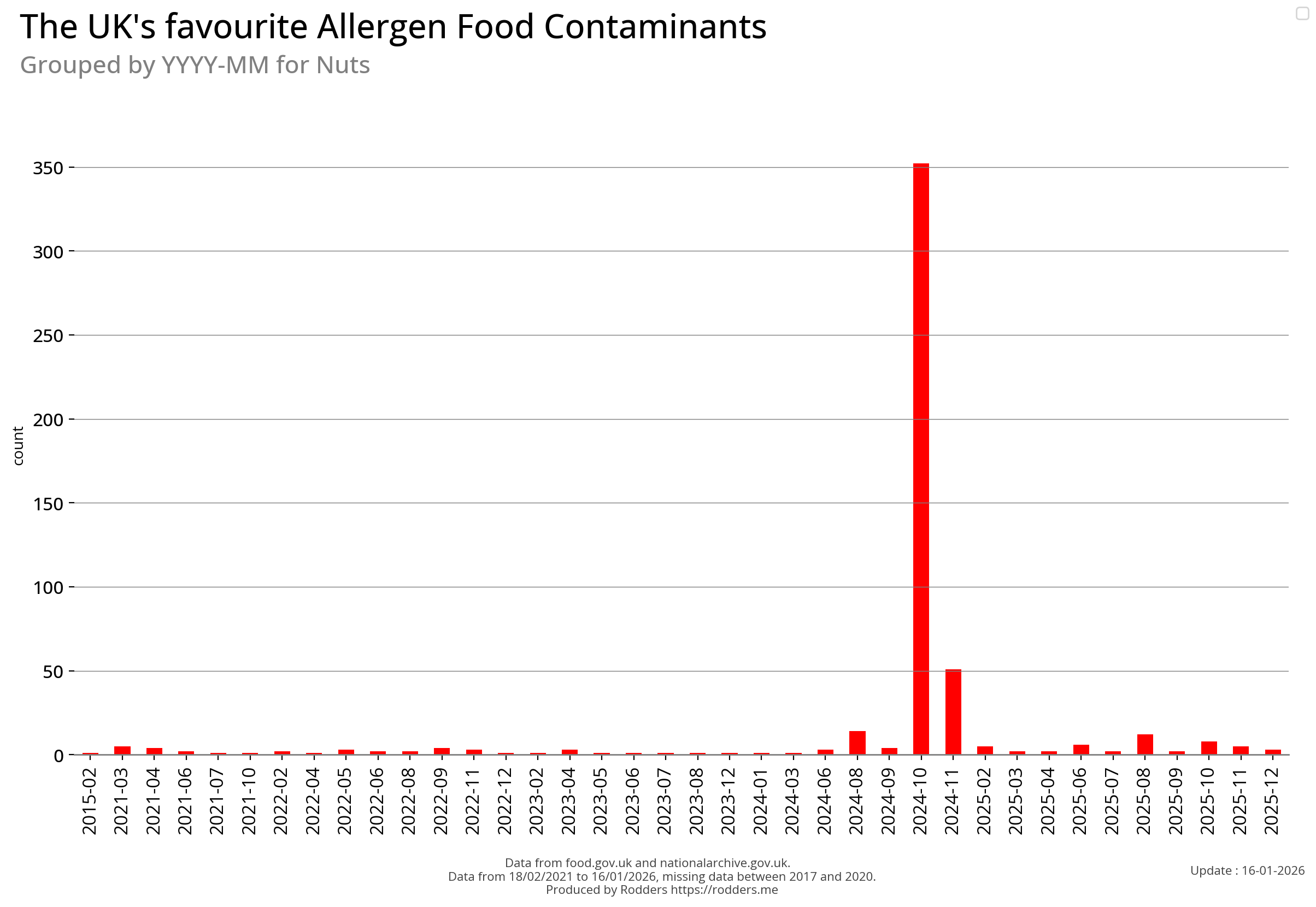
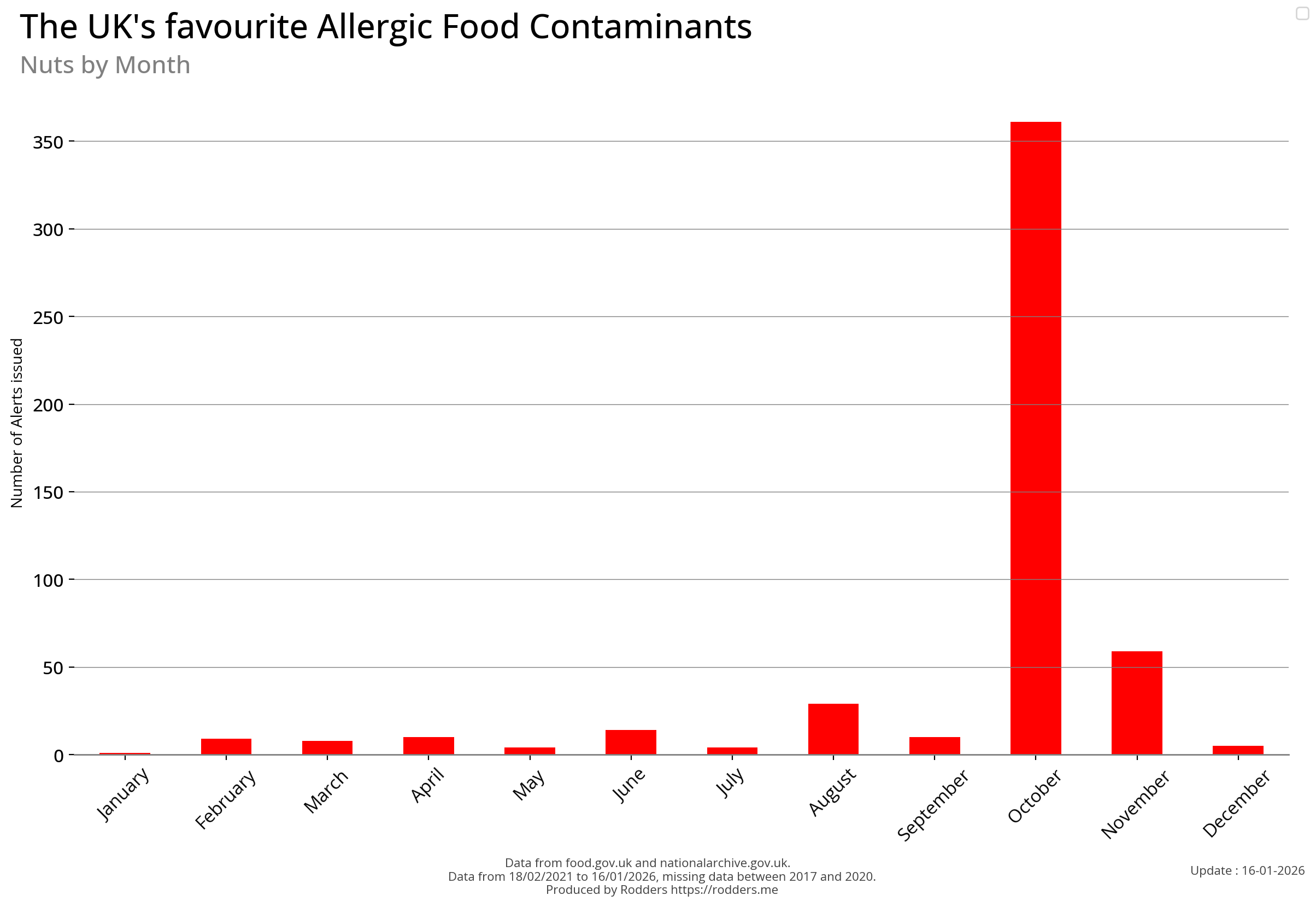
Nuts
Risks of Nut Allergies
Nut allergies can be severe and even life-threatening. Peanuts and tree nuts are one of the most common causes of food allergy-related deaths in the UK. Symptoms can range from mild, such as hives or itching, to severe, including difficulty breathing, swelling of the face and lips, and a drop in blood pressure.
Processed Foods and Cross Contamination
Processed foods may increase the risk of cross-contamination with nuts, particularly if they are made on shared equipment or in facilities where nuts are present. This can be a significant risk for individuals with nut allergies, as even small amounts of nut residue can trigger an allergic reaction. Food manufacturers and retailers have a responsibility to minimize the risk of cross-contamination through good manufacturing practices and proper labeling.
https://www.allergyuk.org/resources/tree-nut-allergy-factsheet/
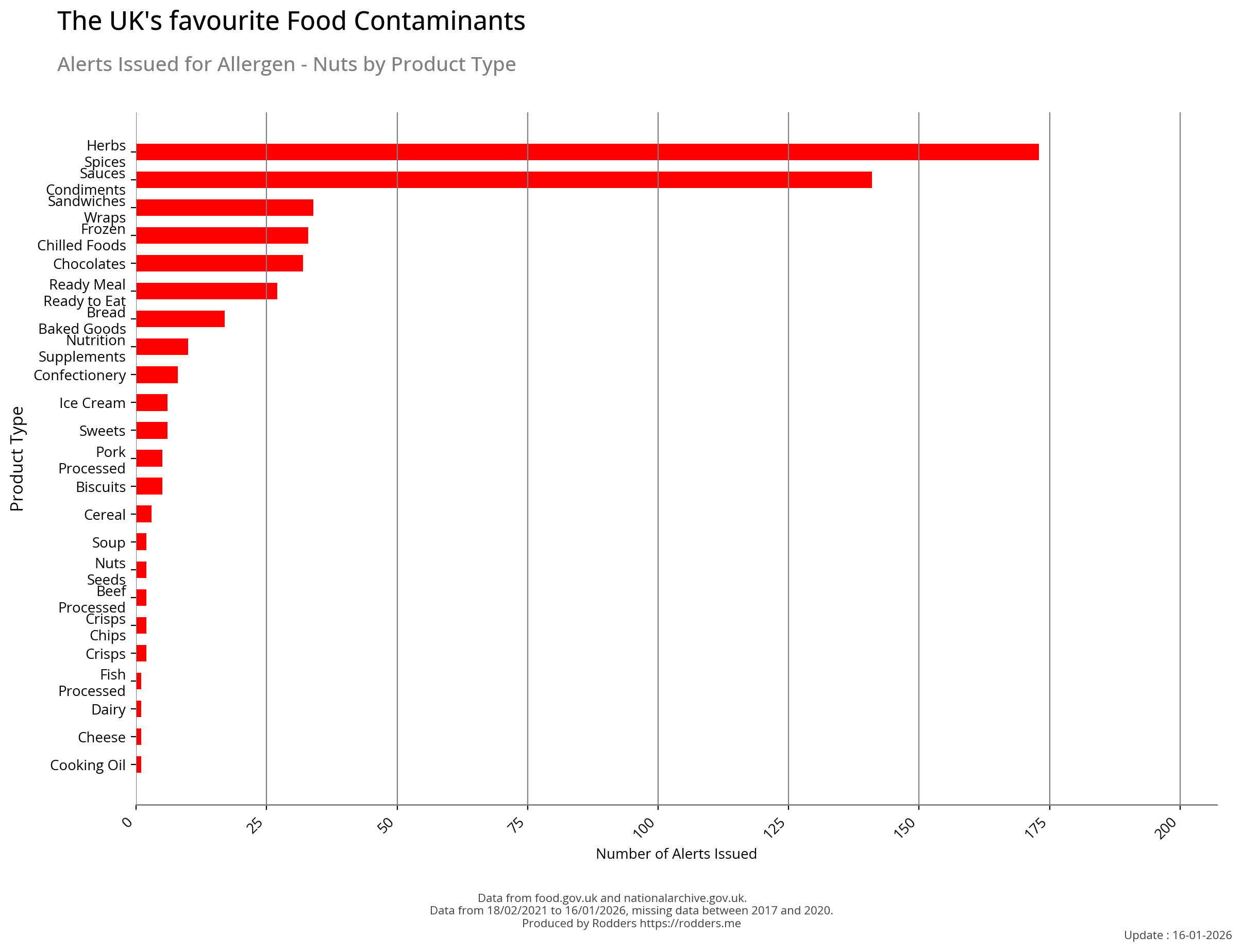
Most Common Foods Contaminated with Nuts
Top
Temporal Visualisations
 |
|
 |
 |
Top
Gluten
Gluten allergy, also known as Coeliac disease or non-Coeliac gluten sensitivity (NCGS), is a medical condition that occurs when the body's immune system reacts to the protein gluten, which is found in wheat, barley, and rye. This reaction can cause inflammation and damage to the lining of the small intestine, leading to symptoms such as Diarrhoea, abdominal pain, fatigue, and weight loss. In severe cases, untreated Coeliac disease can lead to malnutrition, anaemia, and even increased risk of certain cancers.
Processed foods can potentially increase the risk of cross-contamination with gluten due to the use of shared equipment, facilities, or ingredients in food manufacturing. This is particularly concerning for individuals with Coeliac disease or NCGS, as even small amounts of gluten can cause a reaction. Some common processed foods that may contain gluten include breaded meats, sauces, and seasoning's, which are often made from wheat-based products like breadcrumbs or maltodextrin.
According to the Food Safety Act 1990 (link), food manufacturers must clearly label products containing gluten or other allergens, but it's still essential for consumers with gluten allergies to be vigilant in checking labels and contacting manufacturers if they have concerns.
Source: The Coeliac Disease Foundation (CDF) https://www.coeliac.org.uk/home/
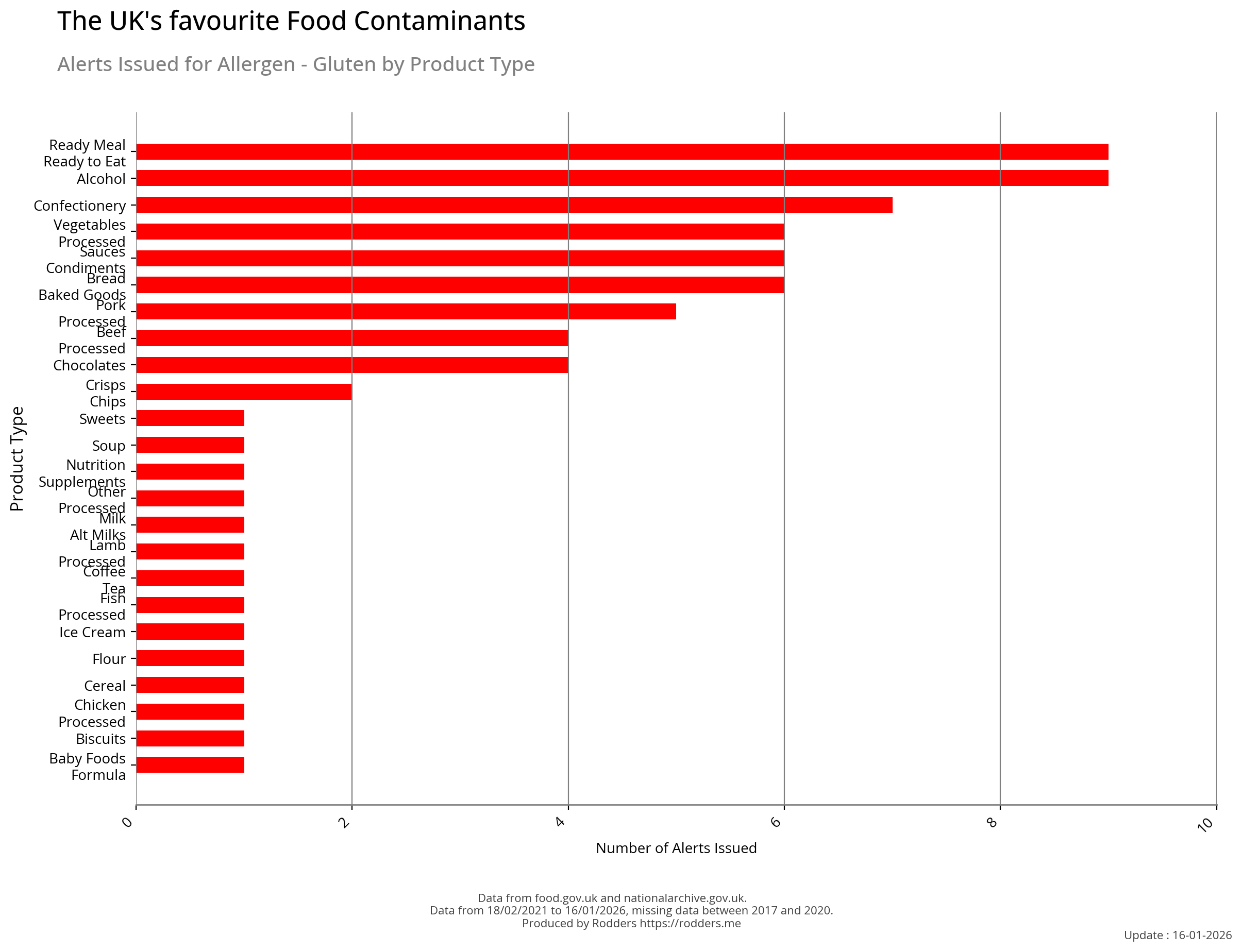
The Most Common Foods Alerts for Products Contaminated with Gluten
Top
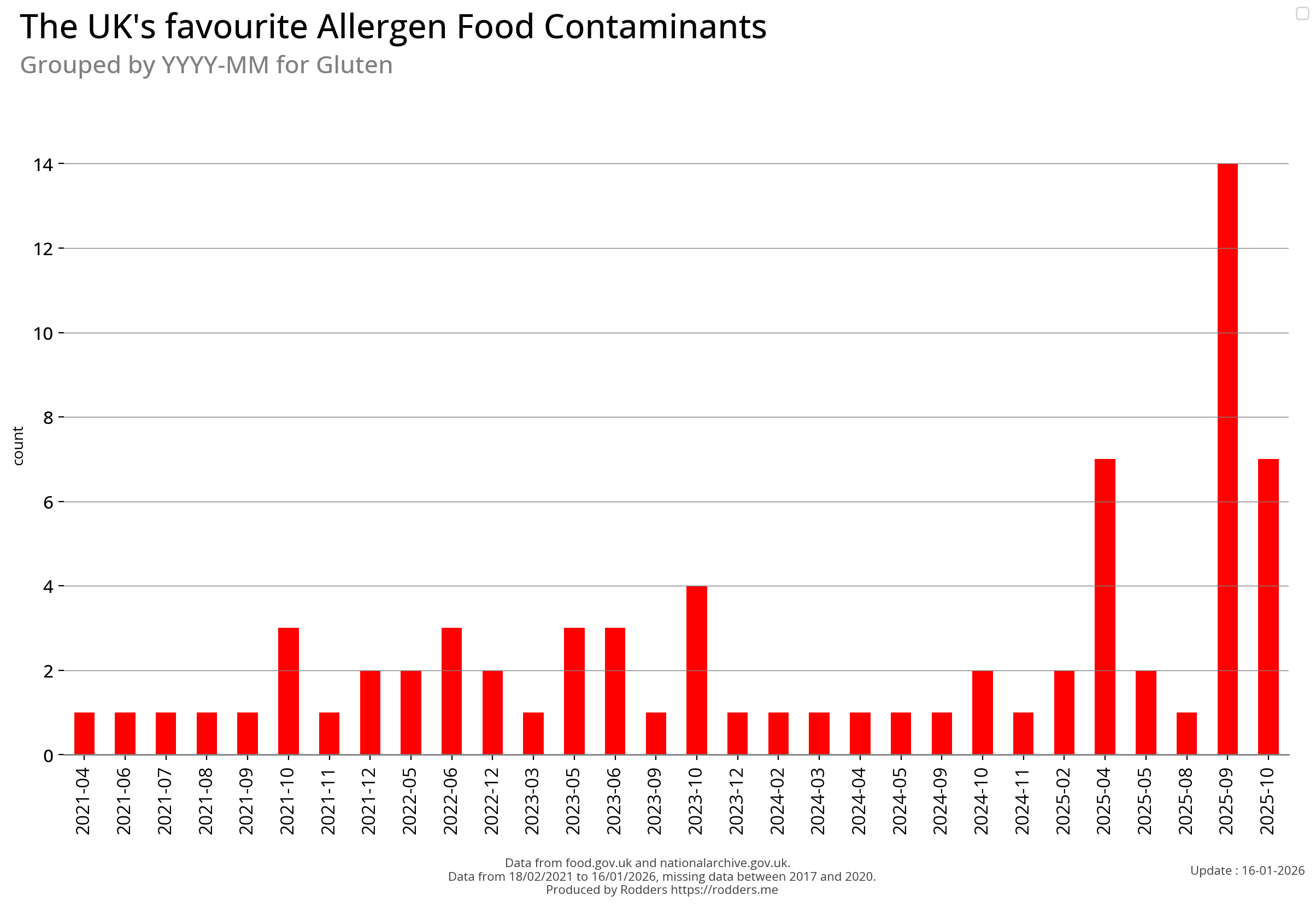
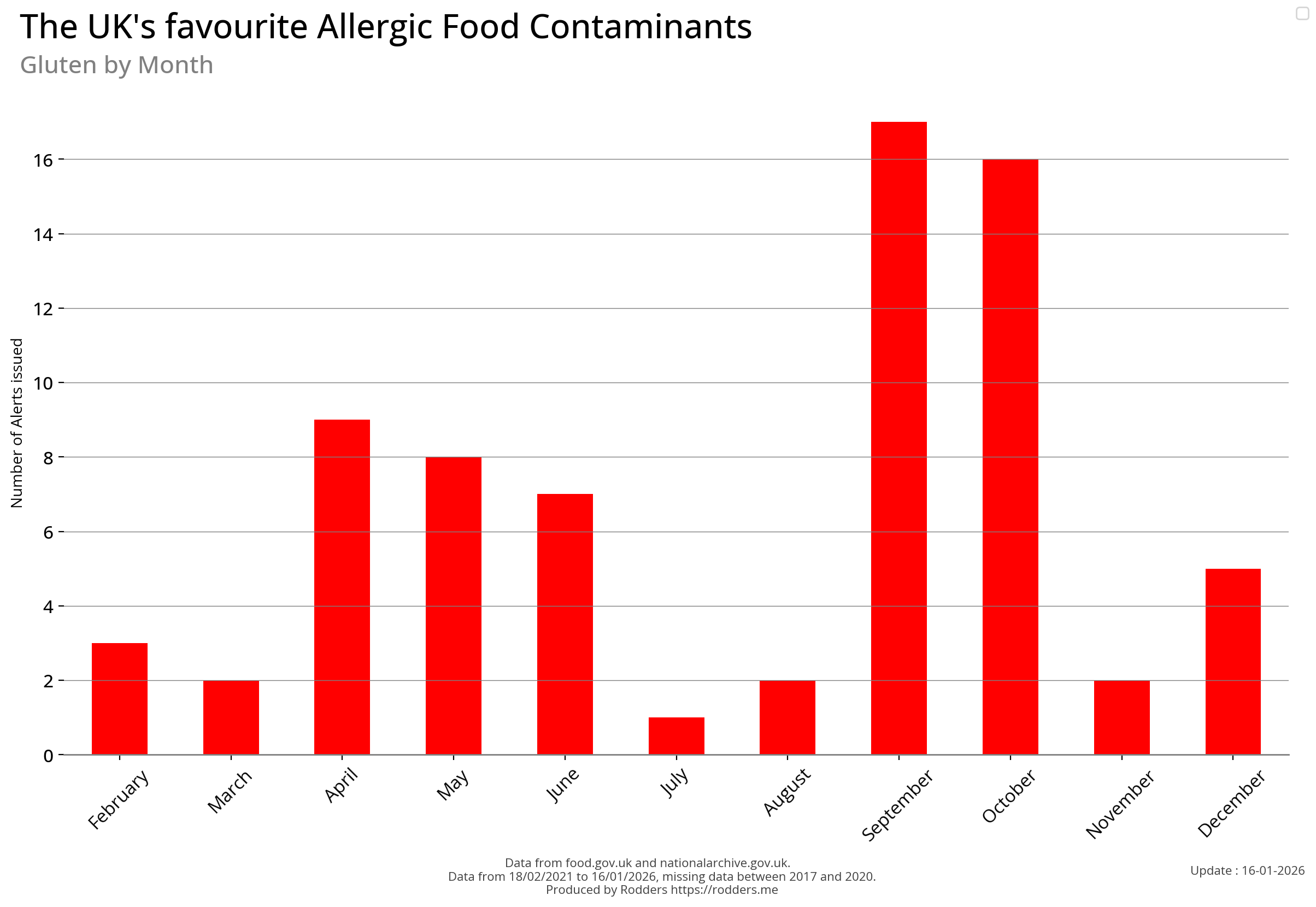
Temporal Analysis
|
|
 |
 |
Top
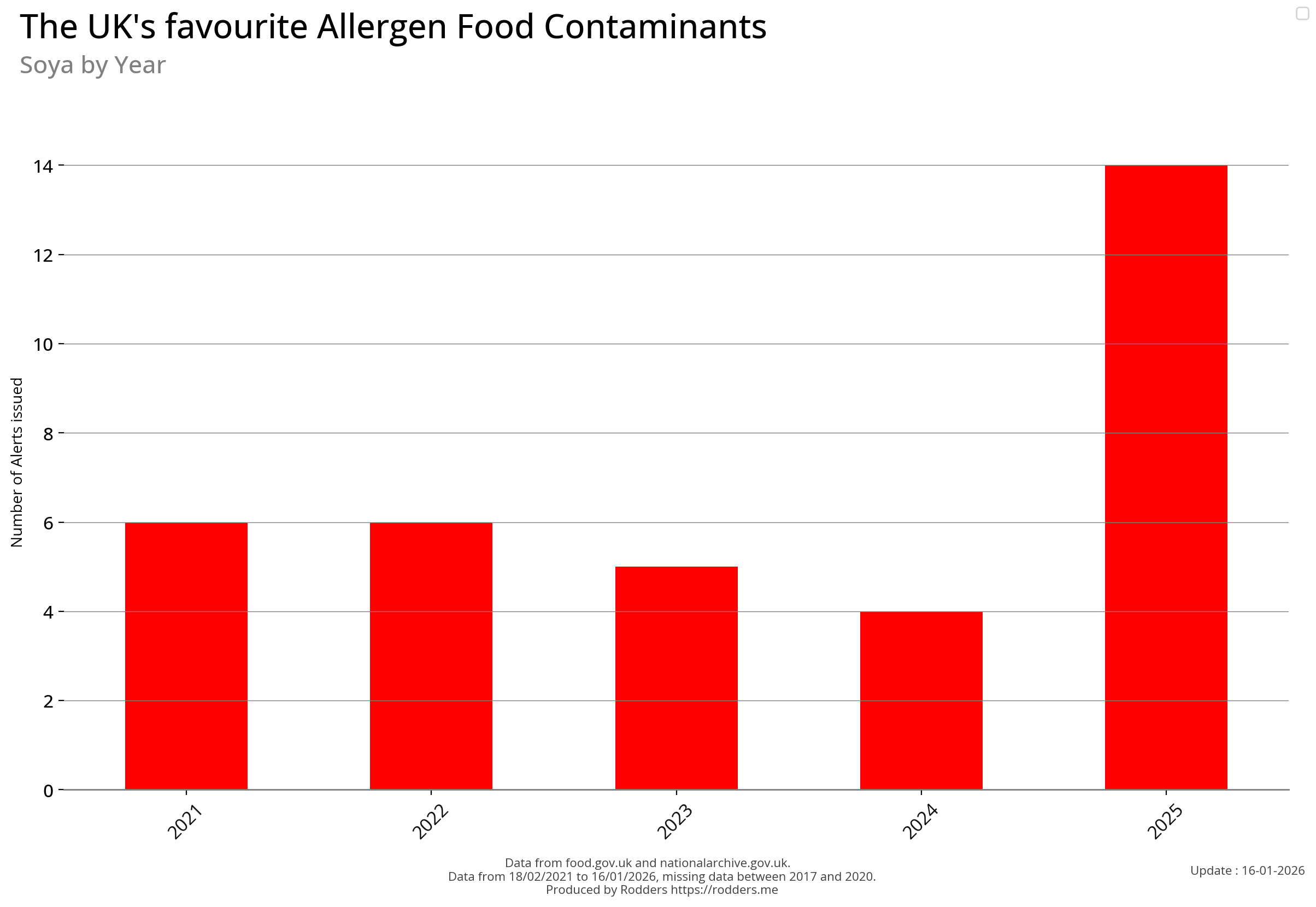
Soya
The soya bean belongs to the legume family, which includes fresh and dried peas, beans, carob, liquorice and peanut. Research has shown that a symptomatic reaction to more than one member of the legume family is rare. It is therefore in most cases not necessary to avoid all foods from this plant family.
Soya is widely used in foods and is difficult to avoid. As many as 60% of manufactured foods contain
soya. Soy comes from soybeans and immature soybeans are called edamame beans. Soya can be ingested as whole
beans, soya flour, soya sauce or soya oil. Soya can also be used in foods as a texturiser
(texturised vegetable protein), emulsifier (soya lecithin) or protein filler. Soya flour is widely used
in foods including; breads, cakes, processed foods (ready meals, burgers and sausages) and baby foods.
https://www.allergyuk.org/resources/soya-allergy-factsheet/
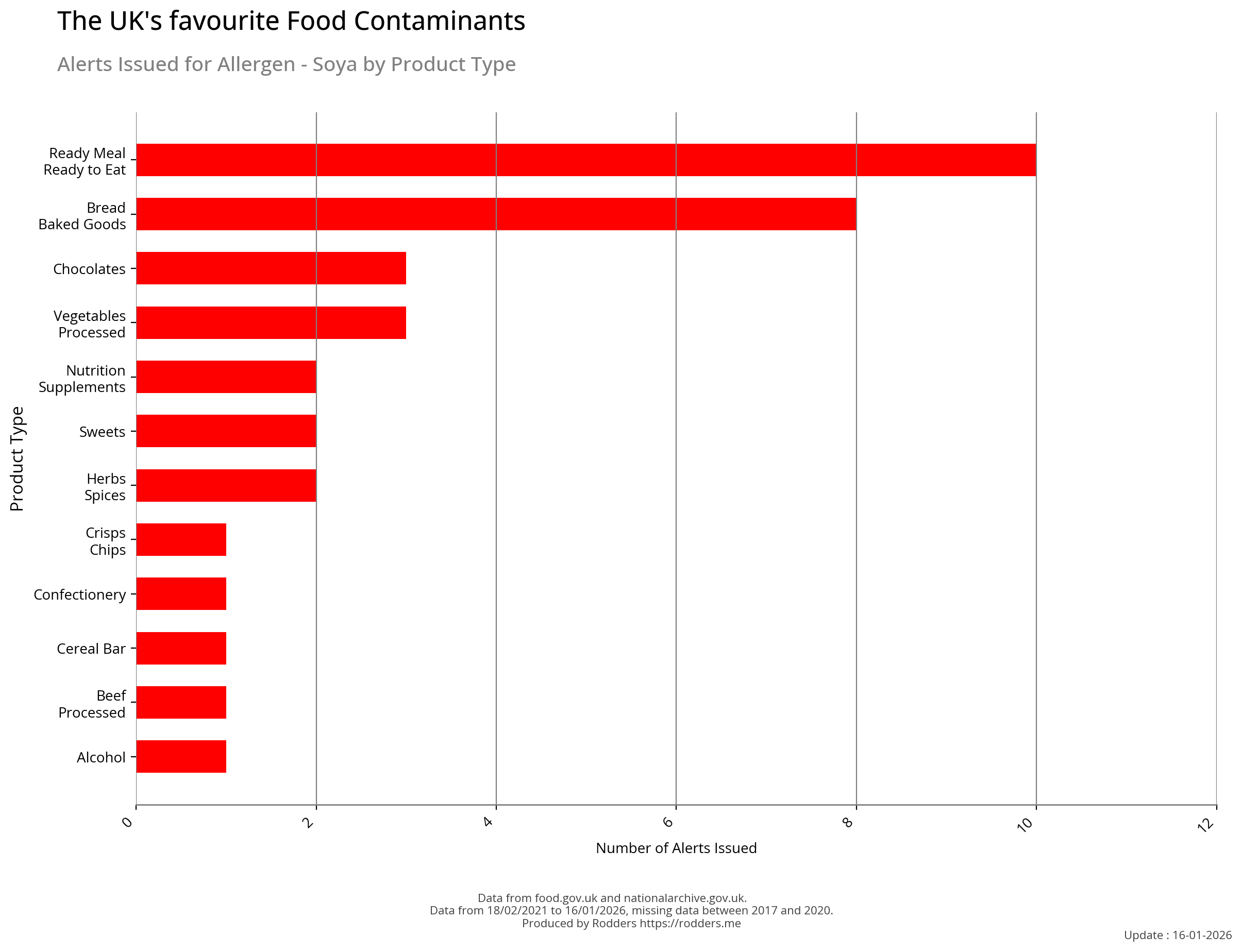
The Most Common Foods Alerts for Products Contaminated with Soya
Top
Temporal Visualisations
 |
|
 |
 |
Top
Egg
Eggs are one of the most common foods to trigger allergic symptoms in babies and young children. Most children with an egg allergy will start to outgrow it by the time they go to school but in some it will persist into later childhood or in rare cases, adulthood. Egg allergy can occasionally develop in adult life.
Reactions to egg are usually triggered by the protein part of the egg (mainly in the egg white). Babies who have eczema are at an increased likelihood of developing an egg allergy. Having another type of food allergy for example to cow’s milk or a family history of allergy (atopy) also increases the risk.
https://www.allergyuk.org/resources/egg-allergy-factsheet/
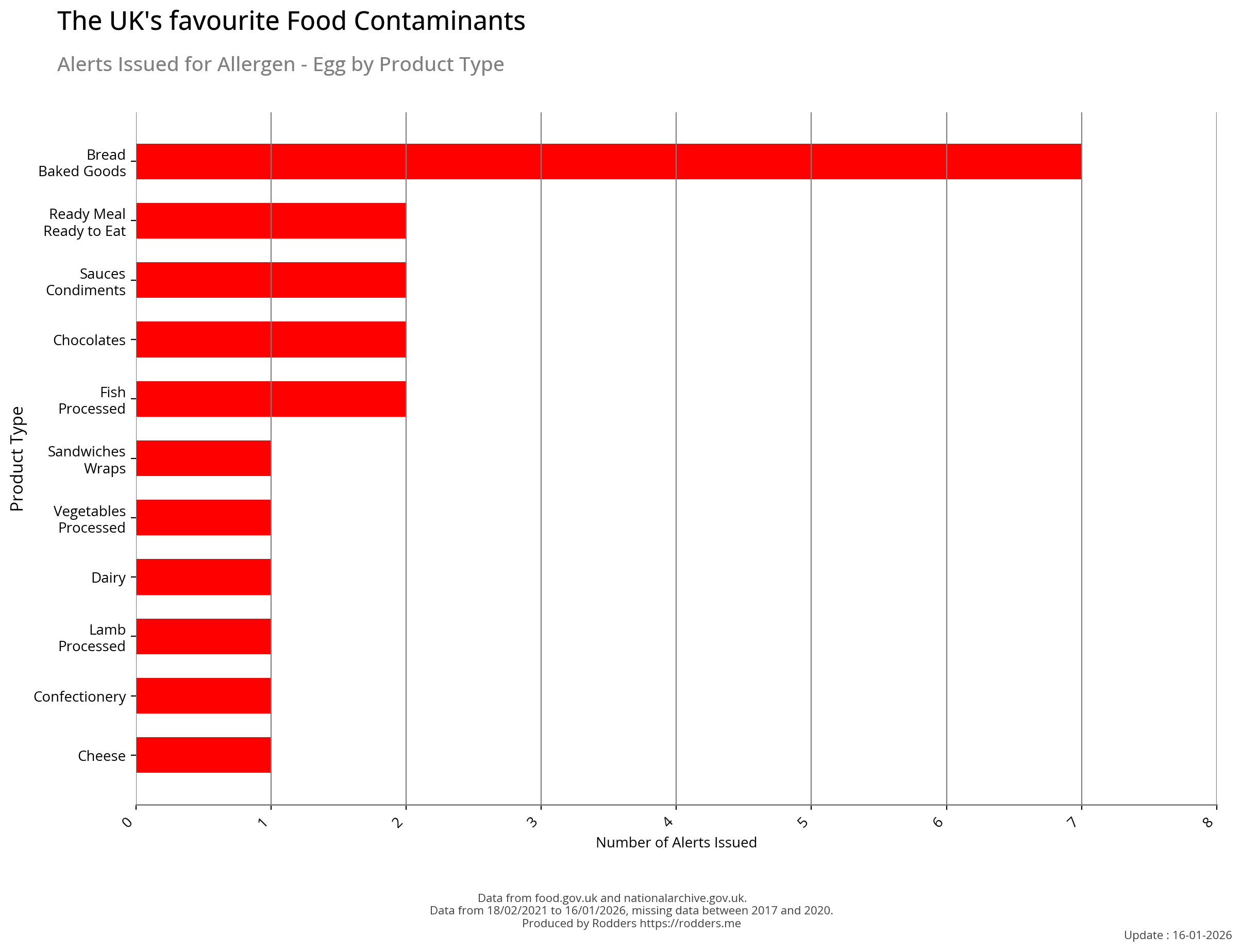
The Most Common Foods Alerts for Products Contaminated with Egg
Top
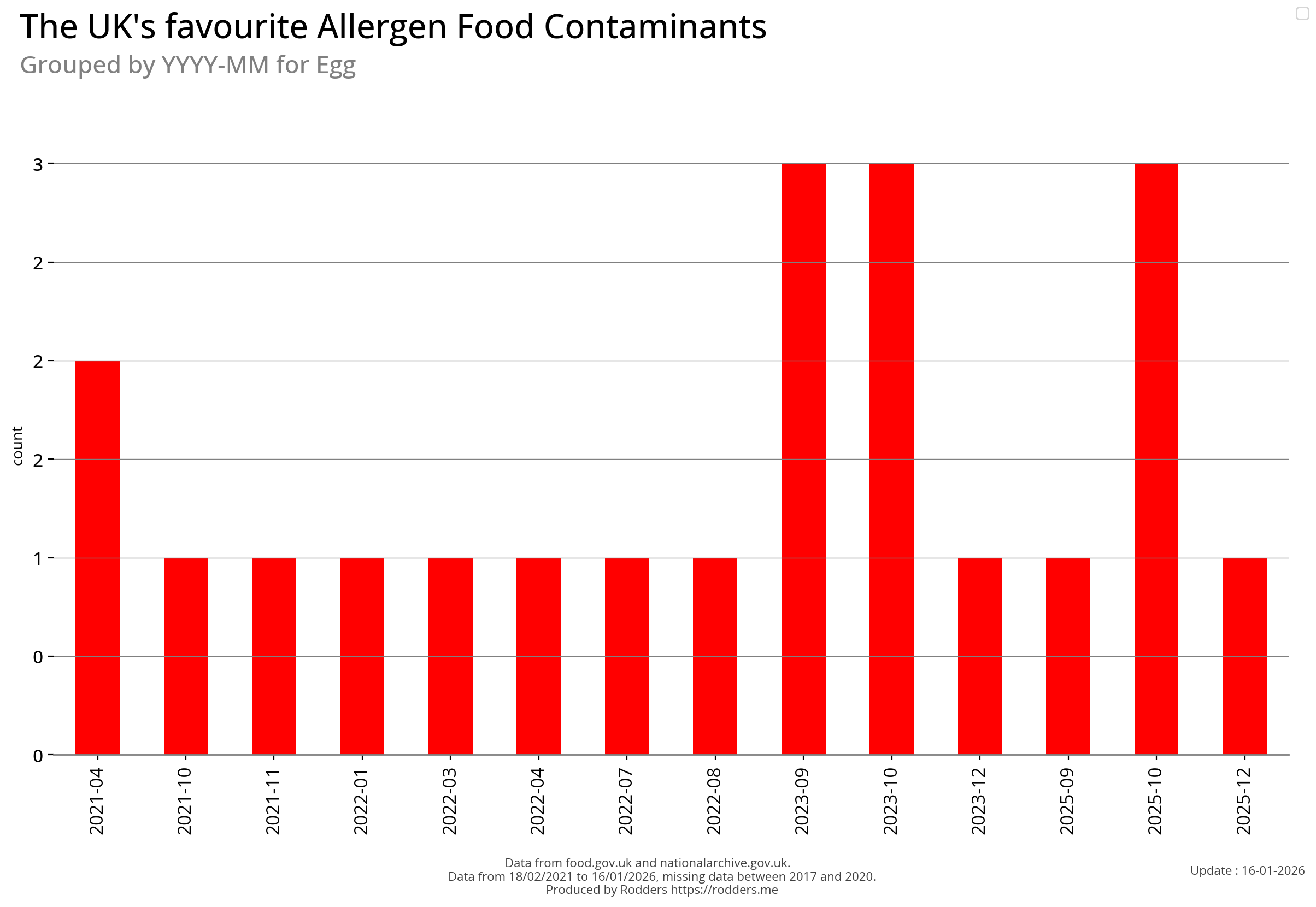
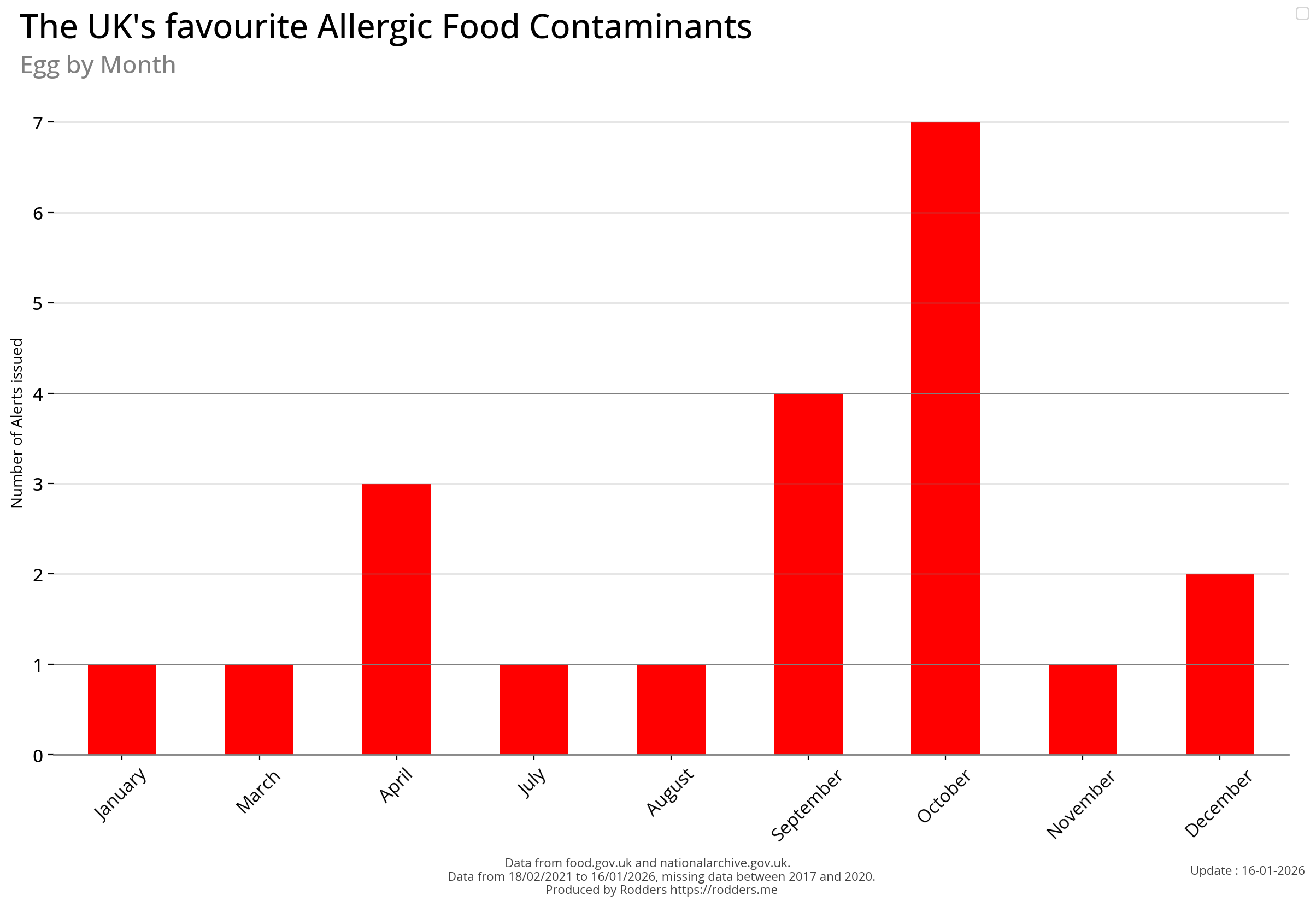
Temporal Visualisations
 |
|
 |
 |
Top
Mustard
Mustard is one of the 14 major allergens (food types). It must be mentioned either on a label or through information provided, such as a menu, when it is used as an ingredient in any food. Because mustard is sometimes a masked or hidden allergen in foods it is important to know that it may not be obvious by sight, taste or smell.
Prevalence
Mustard allergy is more prevalent where mustard plays a large part in the diet, in countries such as France. It is unknown how common mustard allergy is in the UK as there has been limited research or data collection. The number of people affected by mustard allergy is therefore unknown. However, what we do know is that mustard allergy has been reported for many years. In addition, there has been an increase in the use of spices, including mustard, in different food types in the last few years which increases the likelihood of being exposed to mustard in our diet.
https://www.allergyuk.org/resources/mustard-allergy-factsheet/
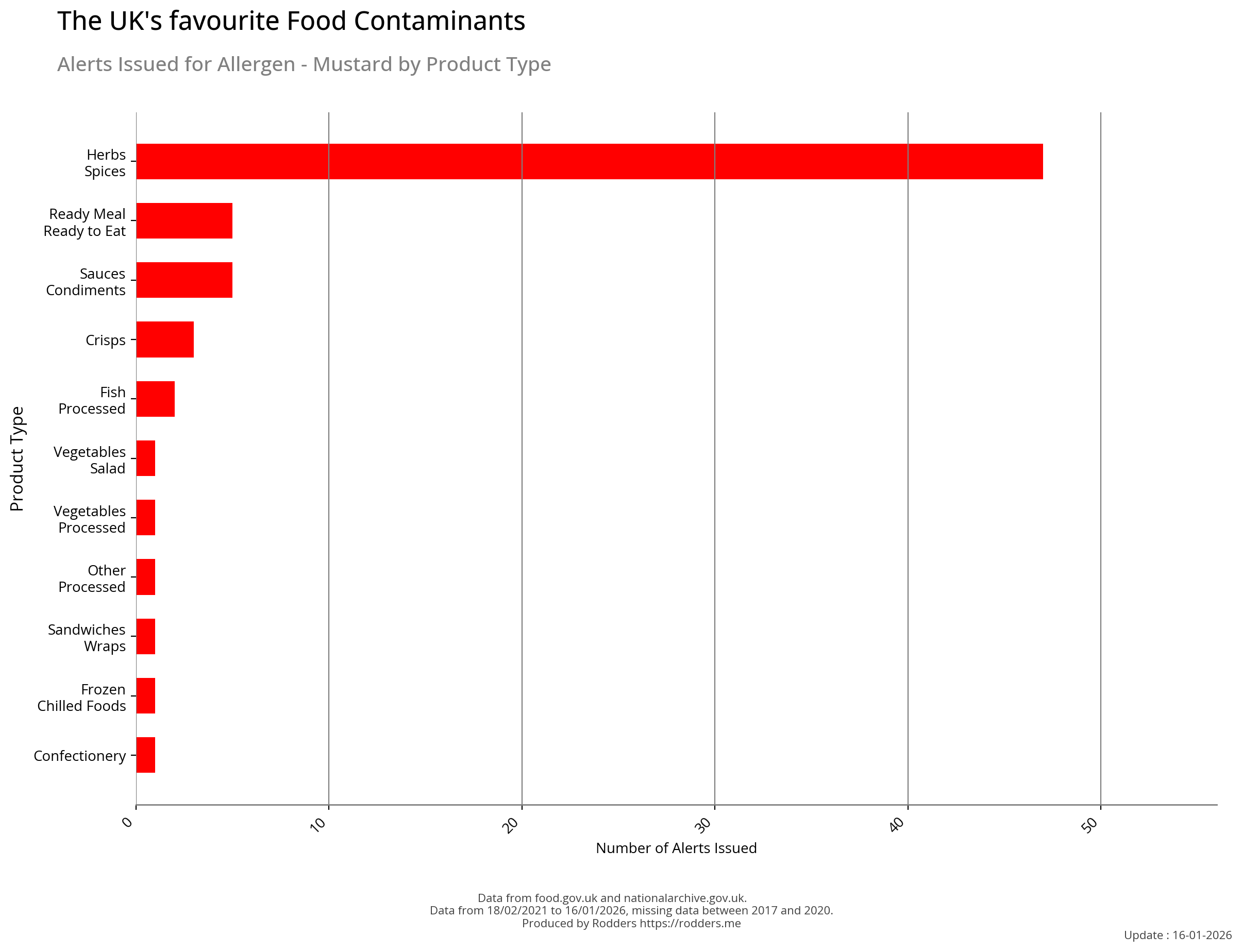
The Most Common Foods Alerts for Products Contaminated with Mustard
Top
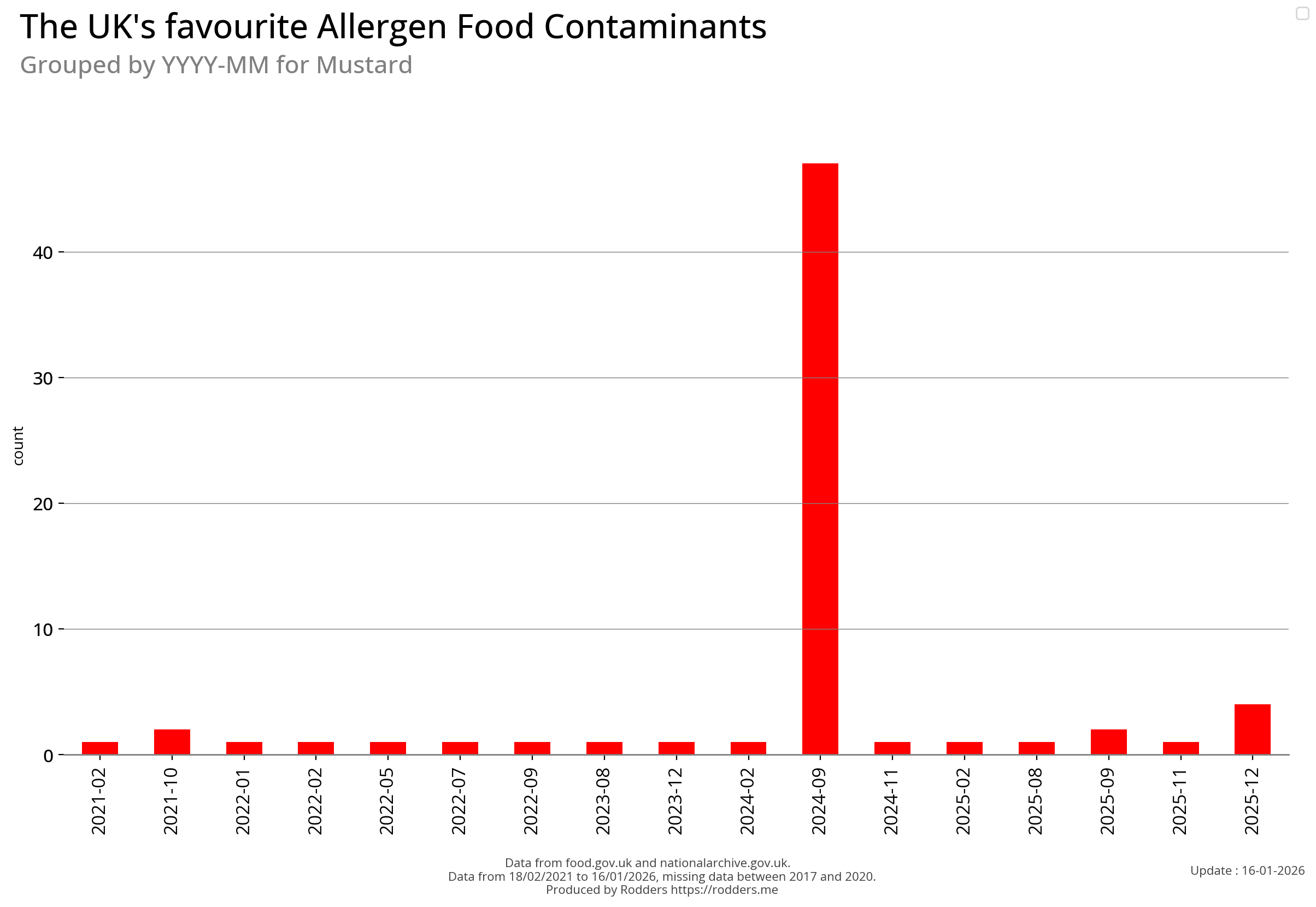
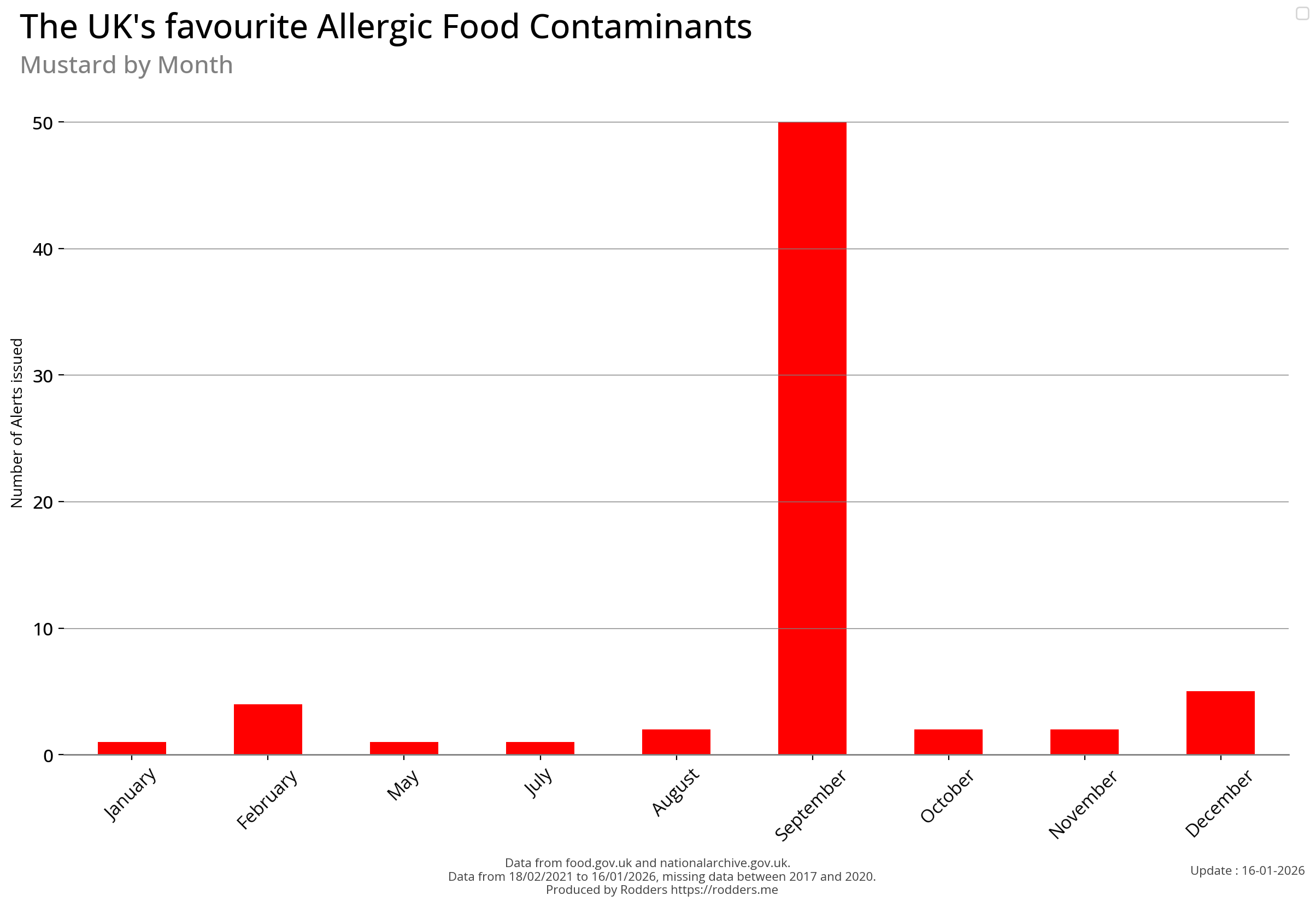
Temporal Visualisations
 |
|
 |
|
Top
Sulphites
What are sulphites?
Sulphites are preservatives used in the production of some foods and
drinks. The Romans first discovered that adding certain substances
(which we now know contain sulphites) to foods makes them last longer, and helps preserve their
colour and flavour.
Key facts
- Sulphites help preserve many foods and drinks
- Sulphite sensitivity affects up to 13% of people with asthma
Prevalence
How do sulphites cause symptoms?
Sulphites work as food preservatives by releasing sulphur dioxide, a gas. Sulphur dioxide is an
irritant gas that can cause the airway to become irritated and constricted.
It is thought that in most people sensitive to sulphites, the gas is released when sulphite
containing foods interact with acid in the stomach. The gas disperses into the
stomach but also back up and into the airway, causing symptoms. Rarely, some people can have IgE
antibody to sulphites, which can cause an allergic reaction.
https://www.allergyuk.org/resources/sulphites-and-airway-symptoms-factsheet/
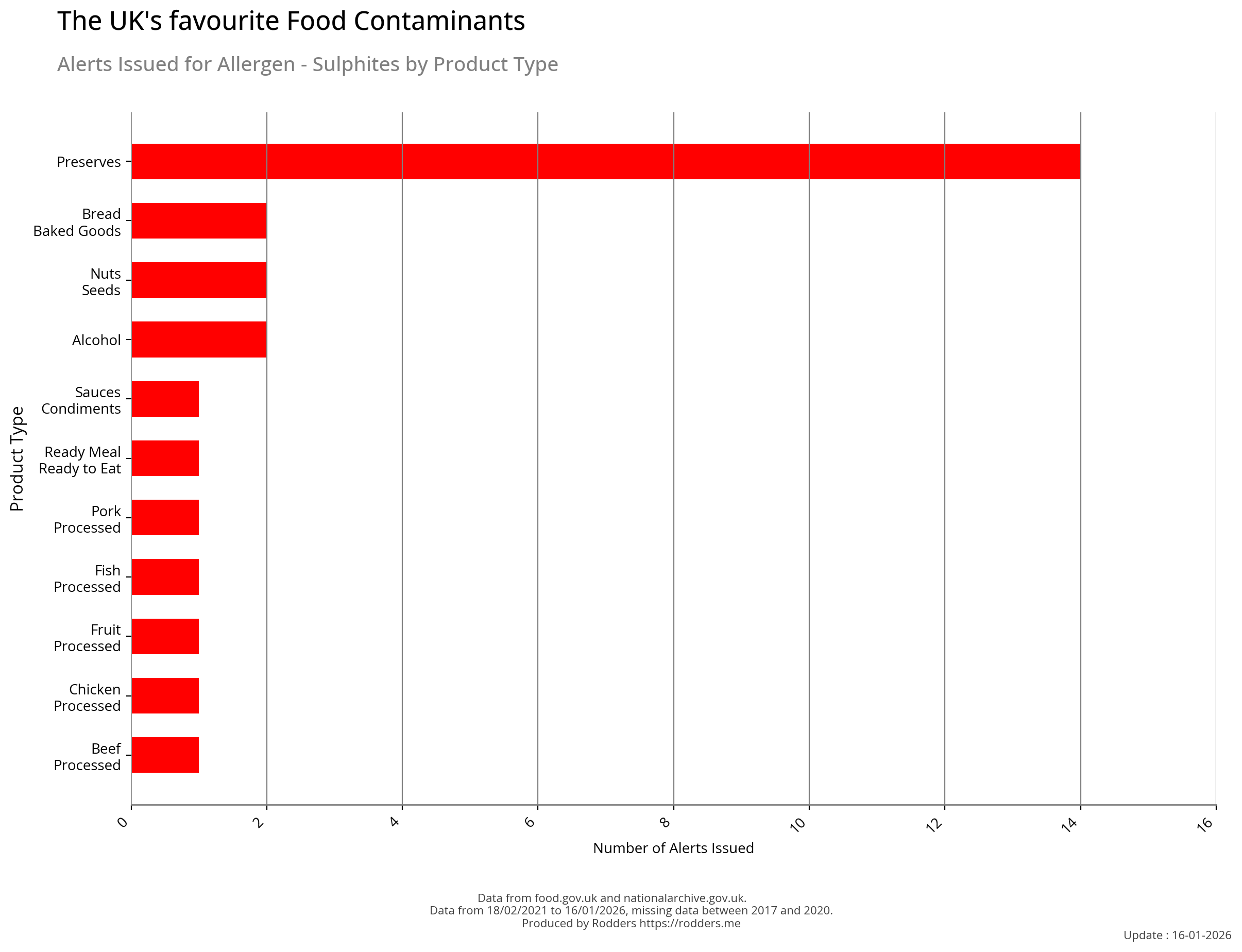
The Most Common Foods Alerts for Products Contaminated with Sulphites
Top
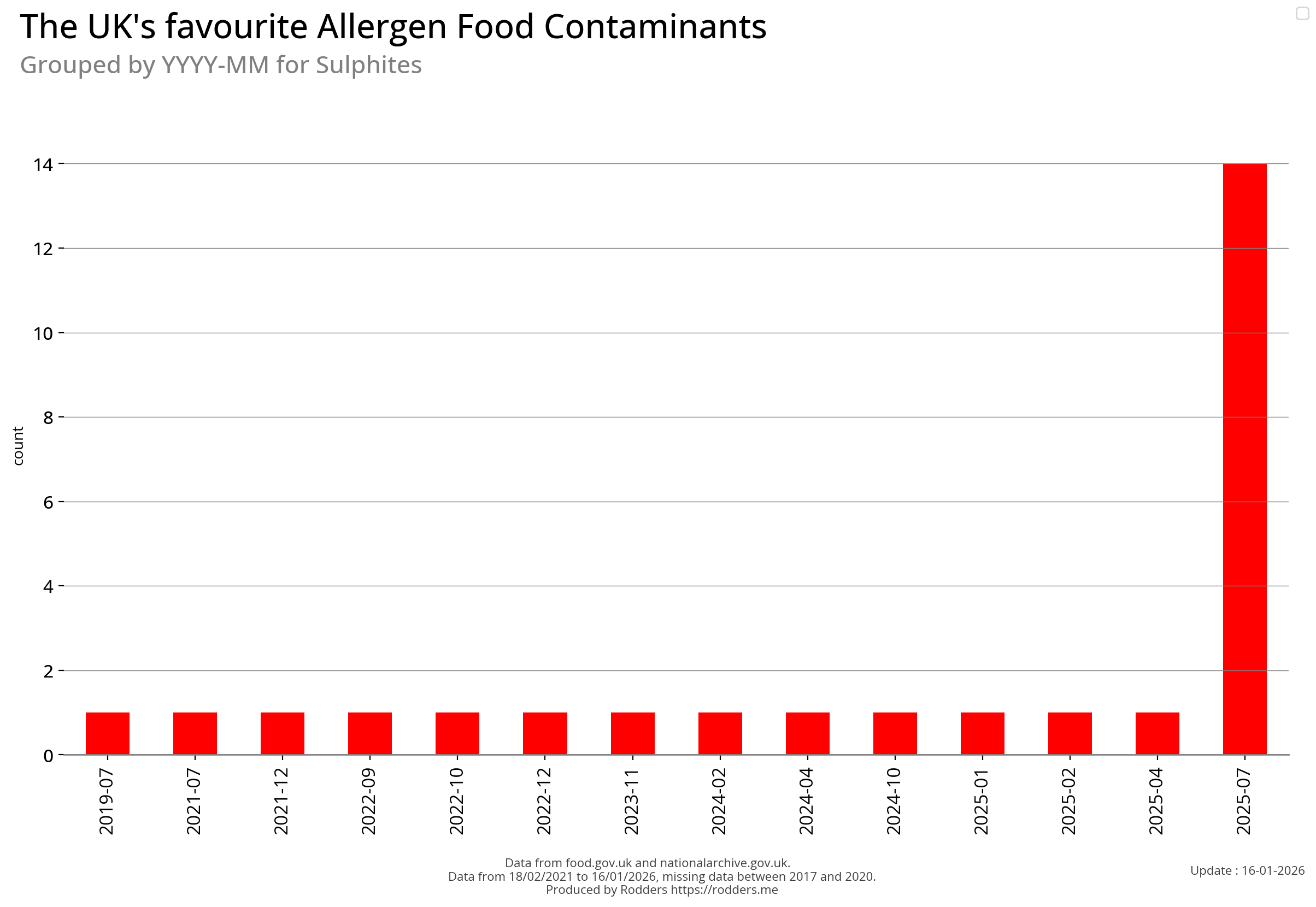
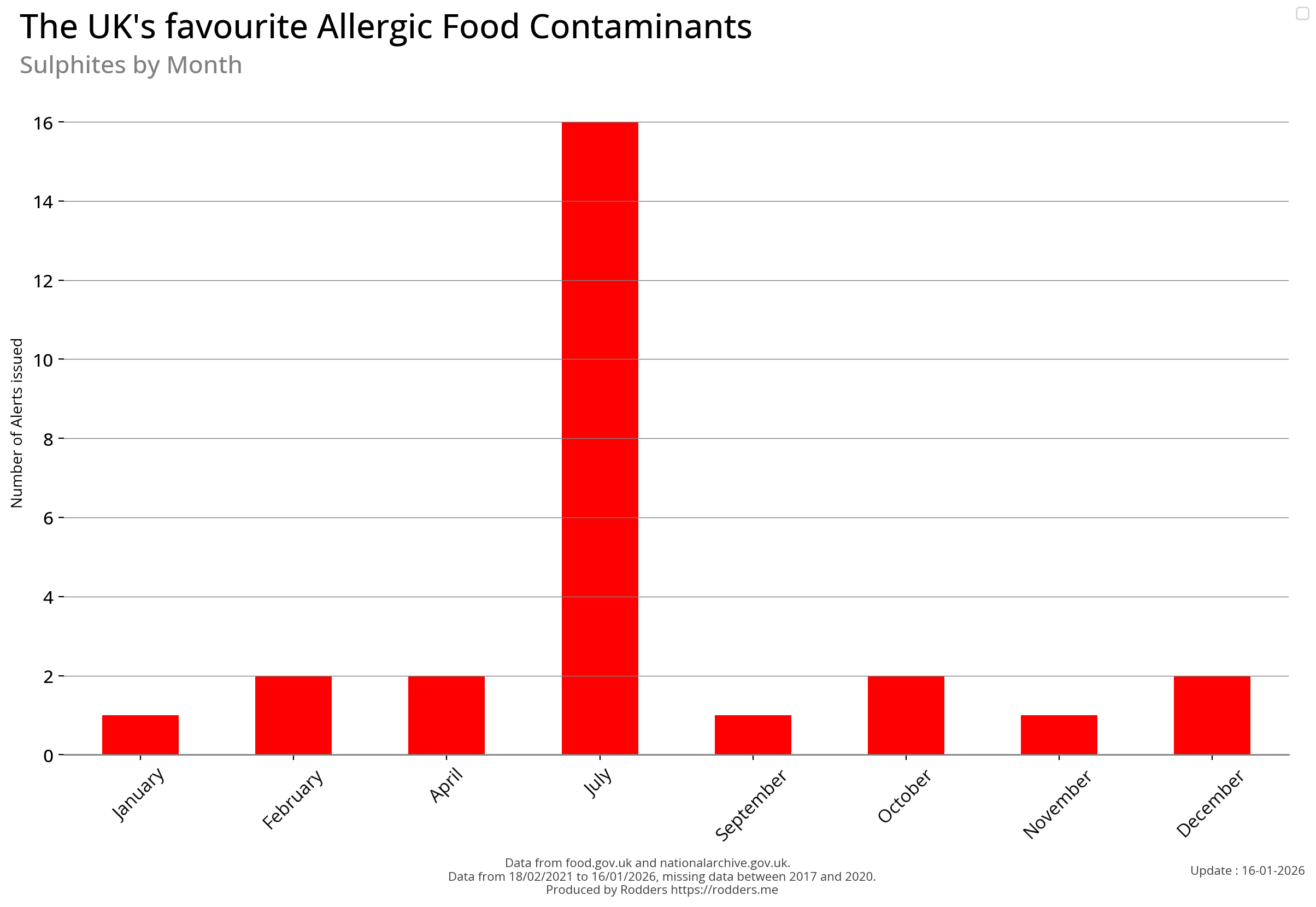
Temporal Visualisations
 |
|
|
 |
Top
Fish / Crustaceans
People with seafood allergy may react to fish and/or shellfish. It is one of the most common food allergies in adults, but can also affect children. It may develop at any point in a person's life. It can be caused by a fish or shellfish that has been eaten before with no previous signs of a food allergy.
An allergy to either fish or shellfish is likely to be lifelong and is rarely outgrown.
Fish and shellfish make up three of the 14 food allergens that are regulated by the Food Standards Agency and must be included on food labels
https://www.allergyuk.org/resources/sulphites-and-airway-symptoms-factsheet/
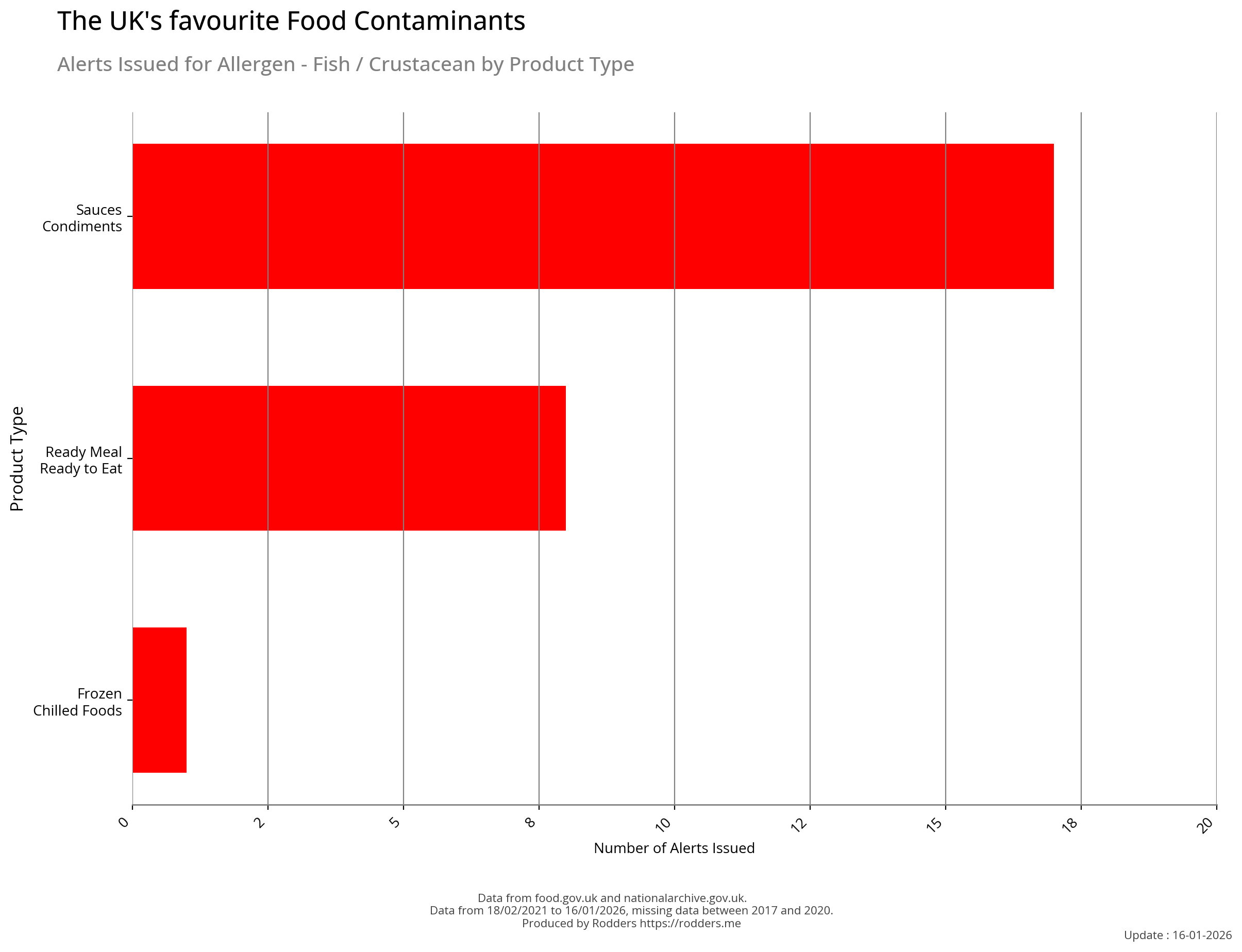
The Most Common Foods Alerts for Products Contaminated with Sulphites
Top
Temporal Visualisations
 |
|
 |
 |
Top
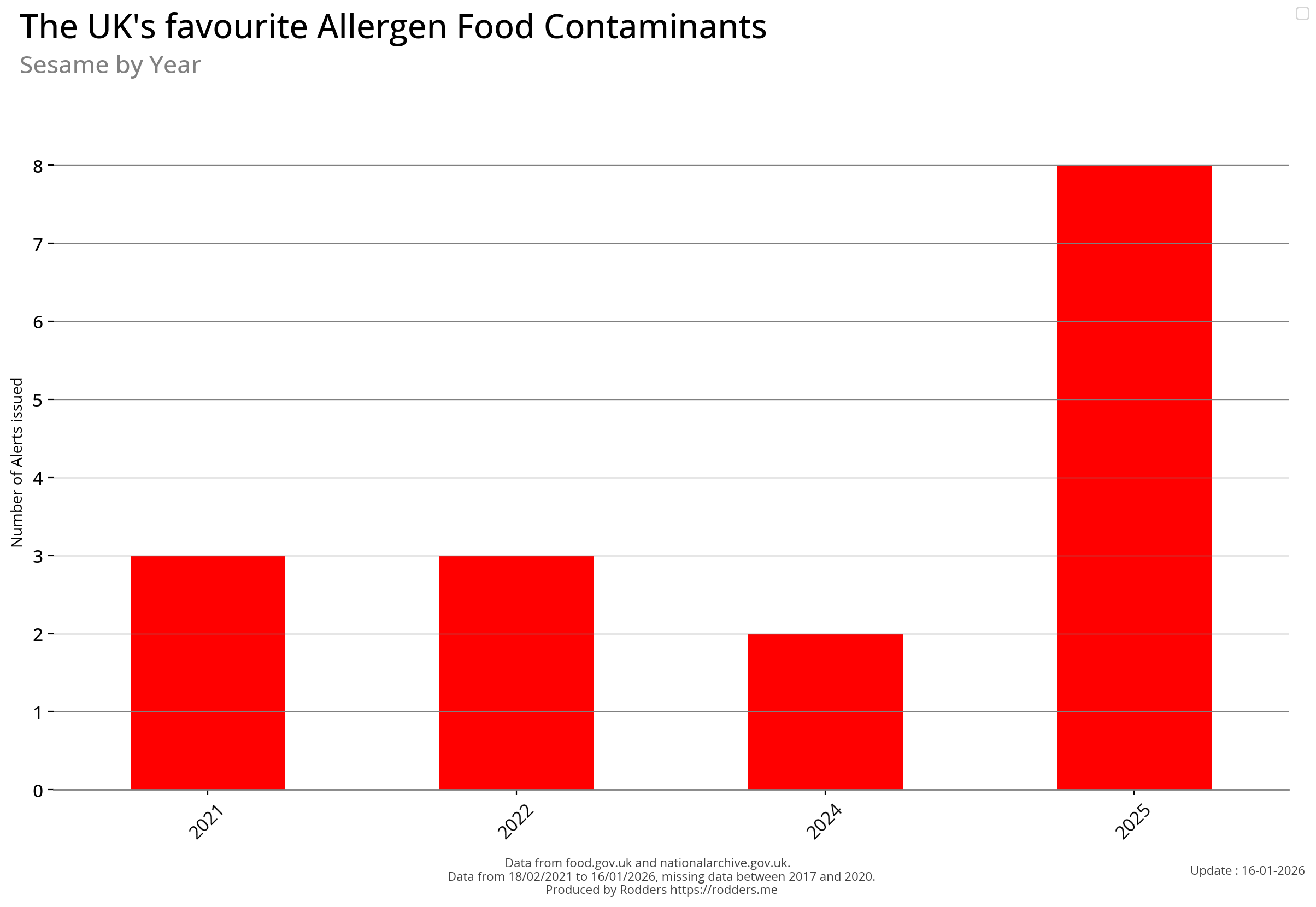
Sesame
Sesame seed allergy is not new (it was first reported in the 1950s), but it has become increasingly common and now is one of the top 10 causes of food allergies. Increasing consumption of sesame might explain why more and more children in the UK are developing this once rare allergy. In countries such as Israel, where sesame has been a very common food for decades, sesame allergy is very common. At this time, it is unknown exactly how often sesame allergy is outgrown or how long it may take for someone to outgrow sesame seed allergy.
Other seeds have also been reported to cause allergies, including sunflower seed, mustard seed and poppy seed, although these other types of allergies are much less common than sesame.
The distinction between tree nut and seed is not always clear. We often think of seeds as small in size - like sesame seed, sunflower seed, mustard seed, poppy seed or pumpkin seed. In fact, coconut (including the husk and inner white flesh that we eat) is also a seed, albeit a very large one! This may explain why coconut is considered to be a tree nut in USA but a seed elsewhere.
The most common type of allergy to seed is due to sesame.
Some people allergic to sesame are also allergic to peanut and tree nuts. It is therefore important that anyone with an allergy to seeds such as sesame is assessed by an Allergy Specialist, who can provide advice as to what foods an allergic person must avoid.
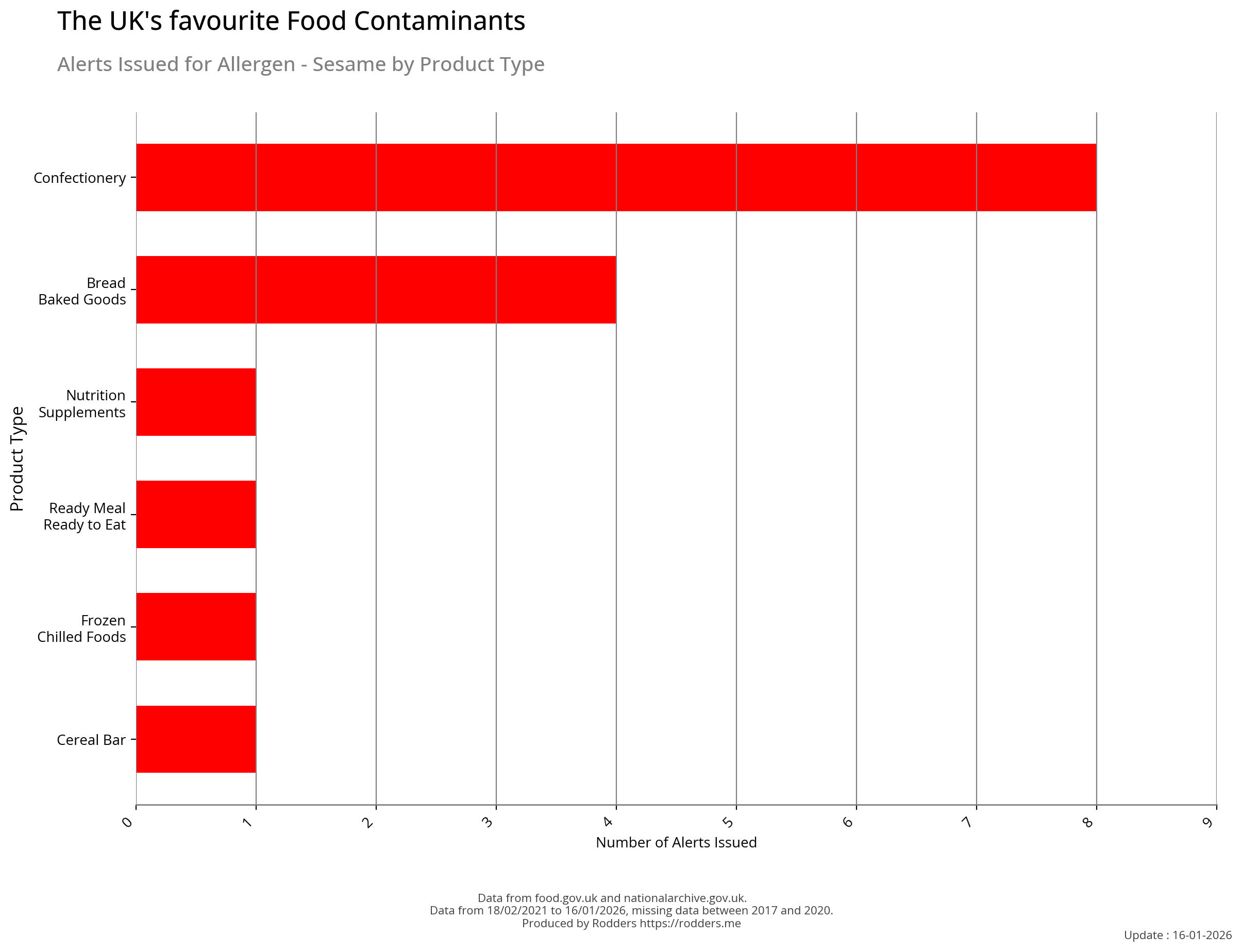
Sesame Seeds are extremely potent allergens capable of causing severe allergic reactions (anaphylaxis) in susceptible individuals. Sesame is becoming more common in the diet today and is used extensively in everyday foods, especially on bread and other bakery products. Products that are not intended to contain sesame may have traces of the allergen due to manufacturing or marketing practices.
https://www.allergyuk.org/resources/sesame-allergy-and-other-seeds/
The Most Common Foods Alerts for Products Contaminated with Sesame
Top
Temporal Visualisations
 |
|
 |
 |
Top
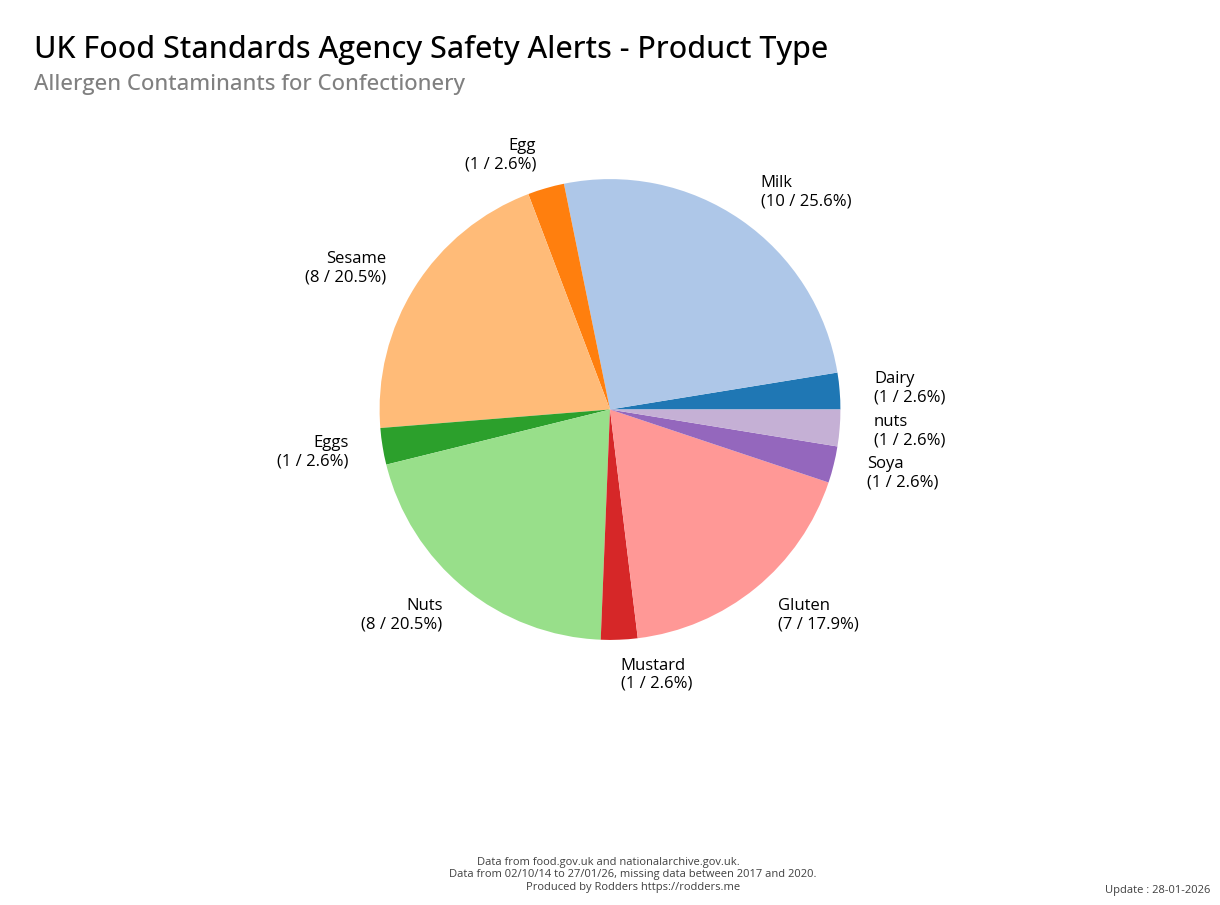
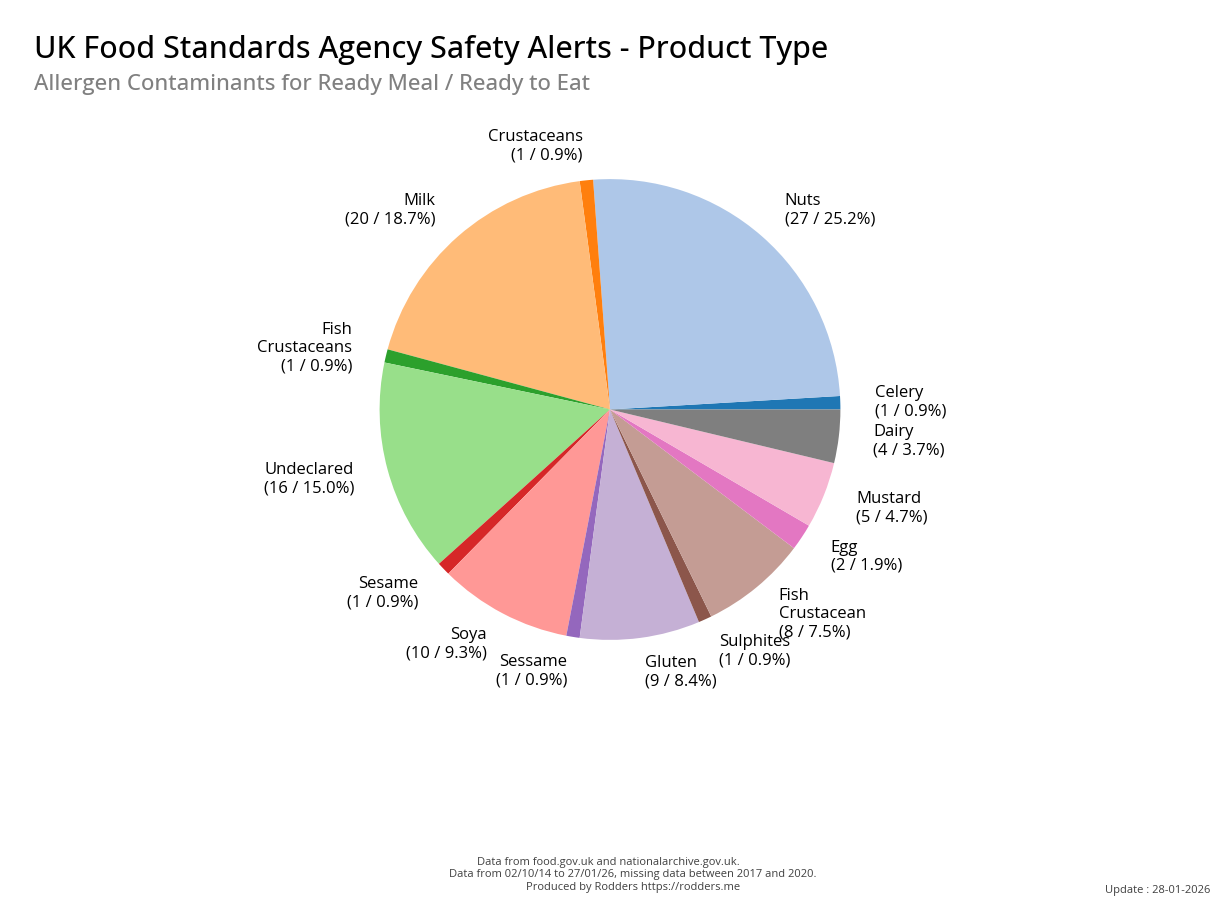
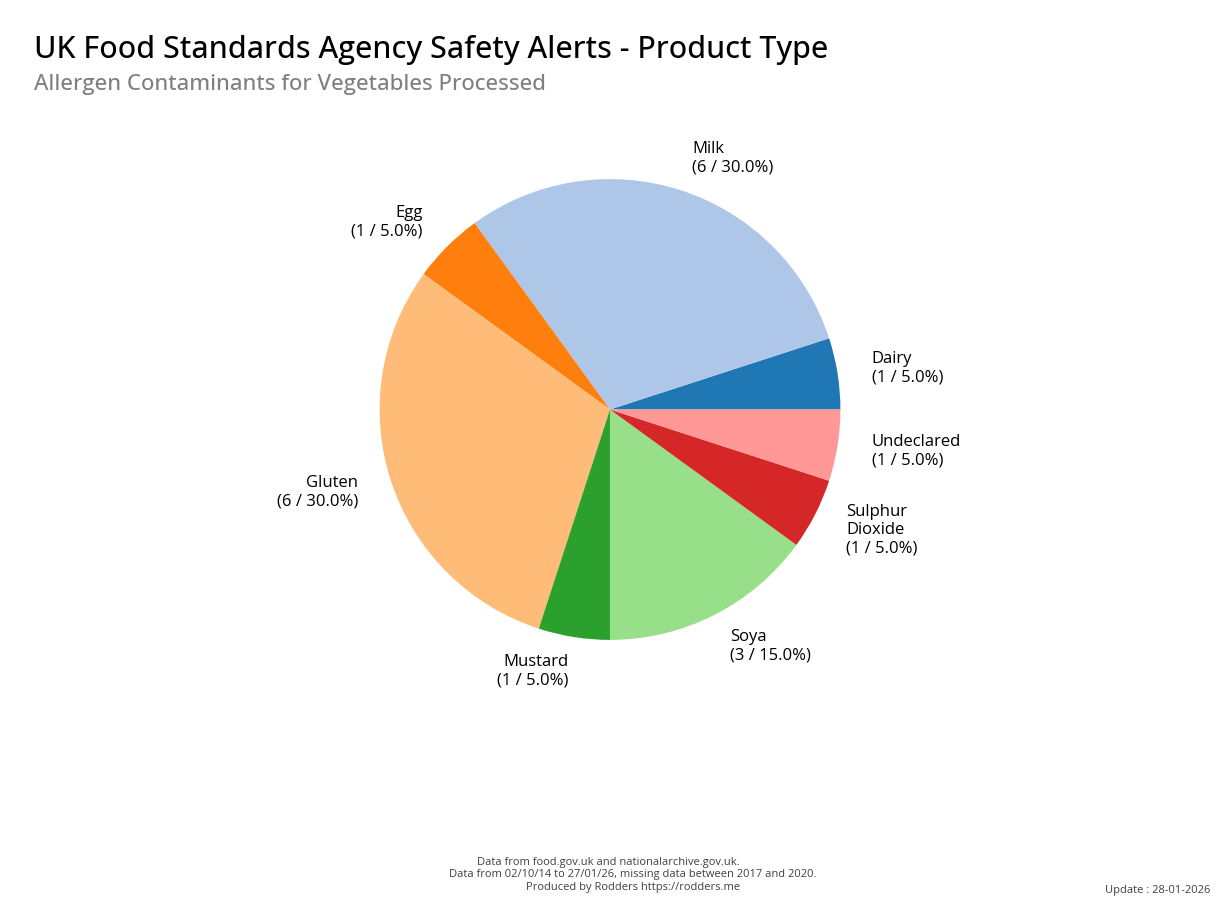
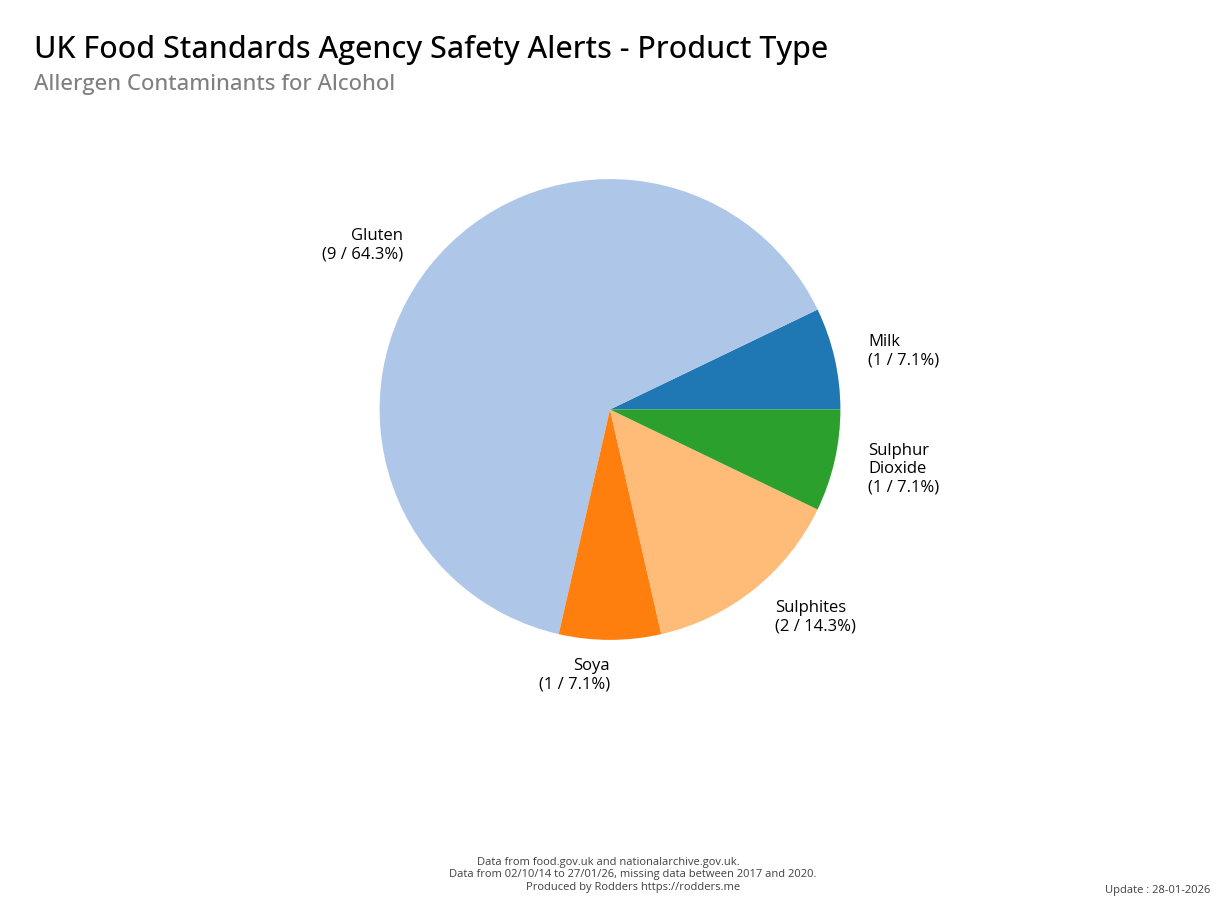
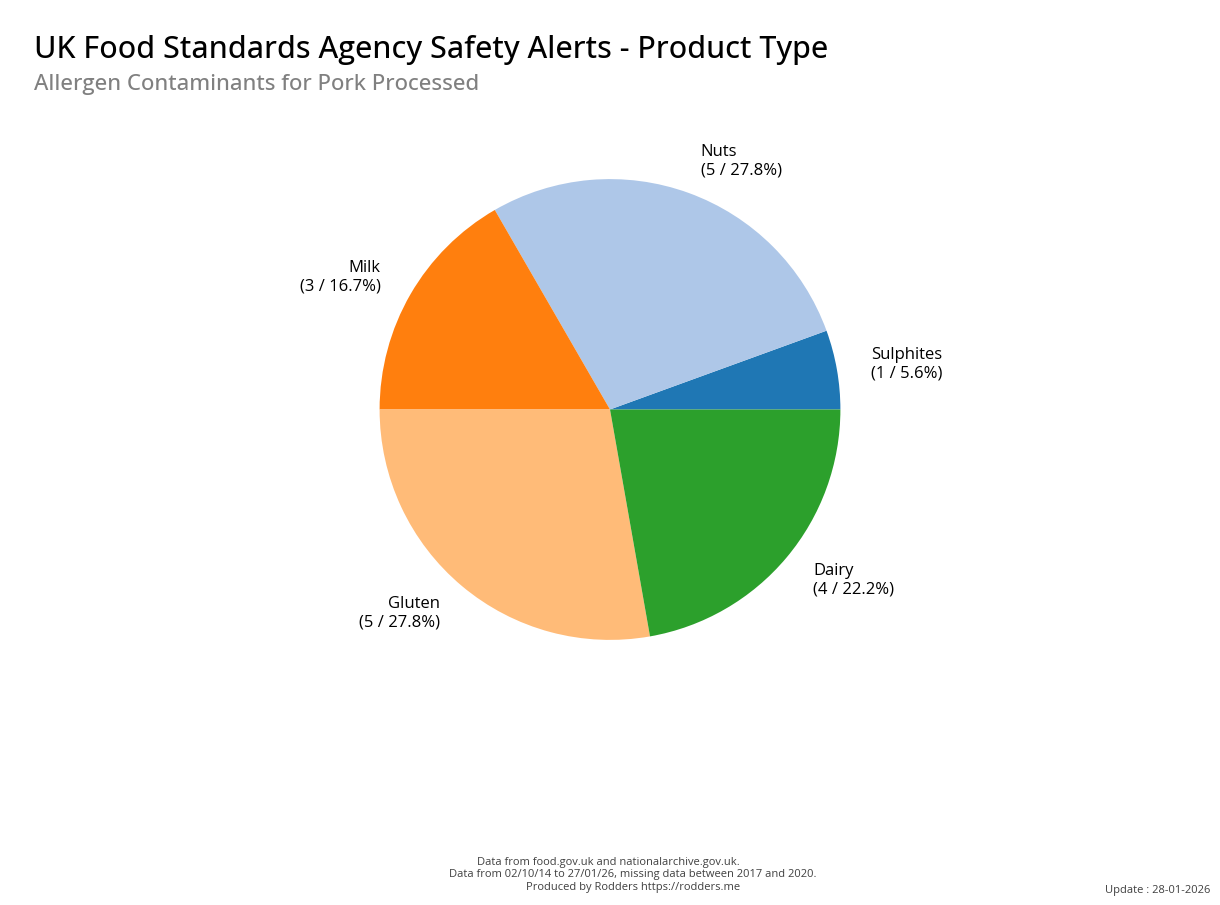
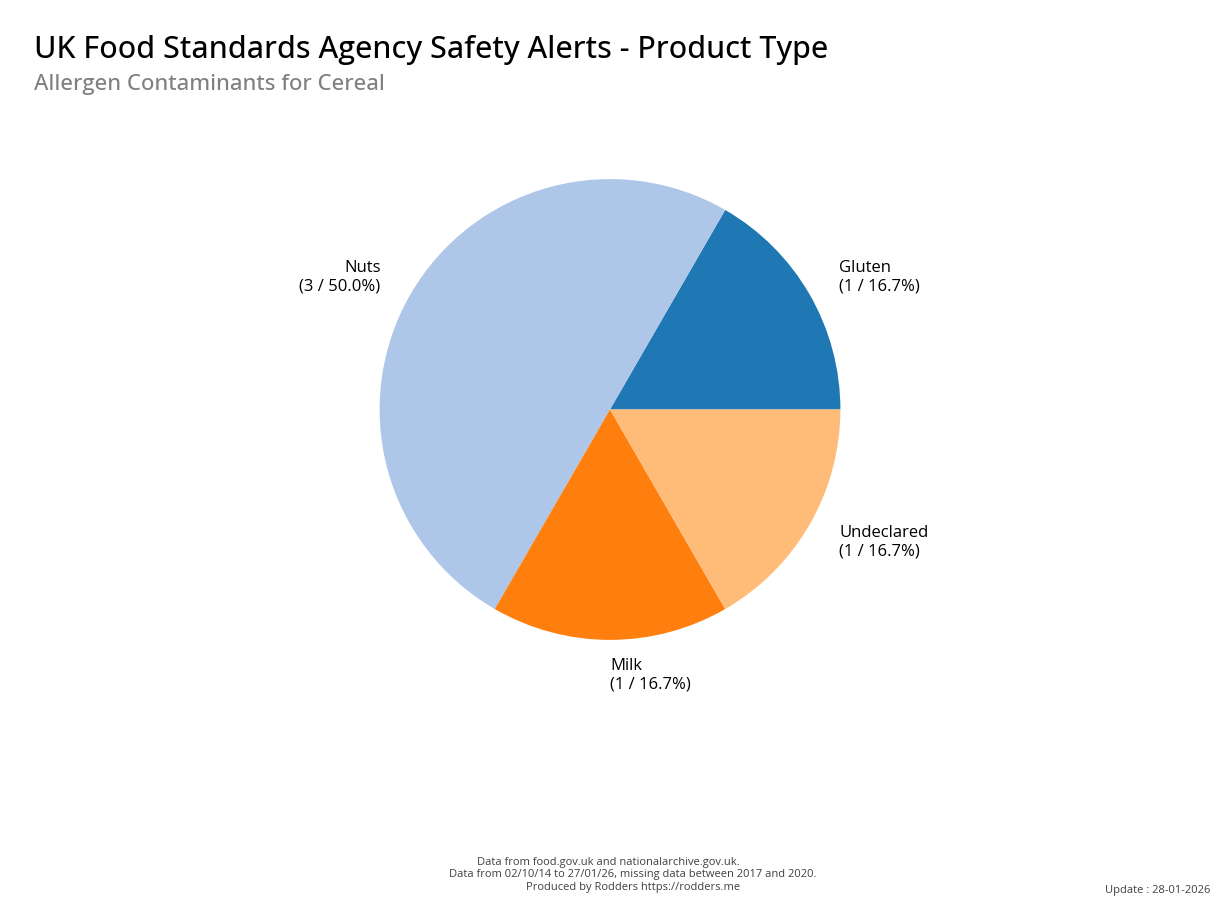
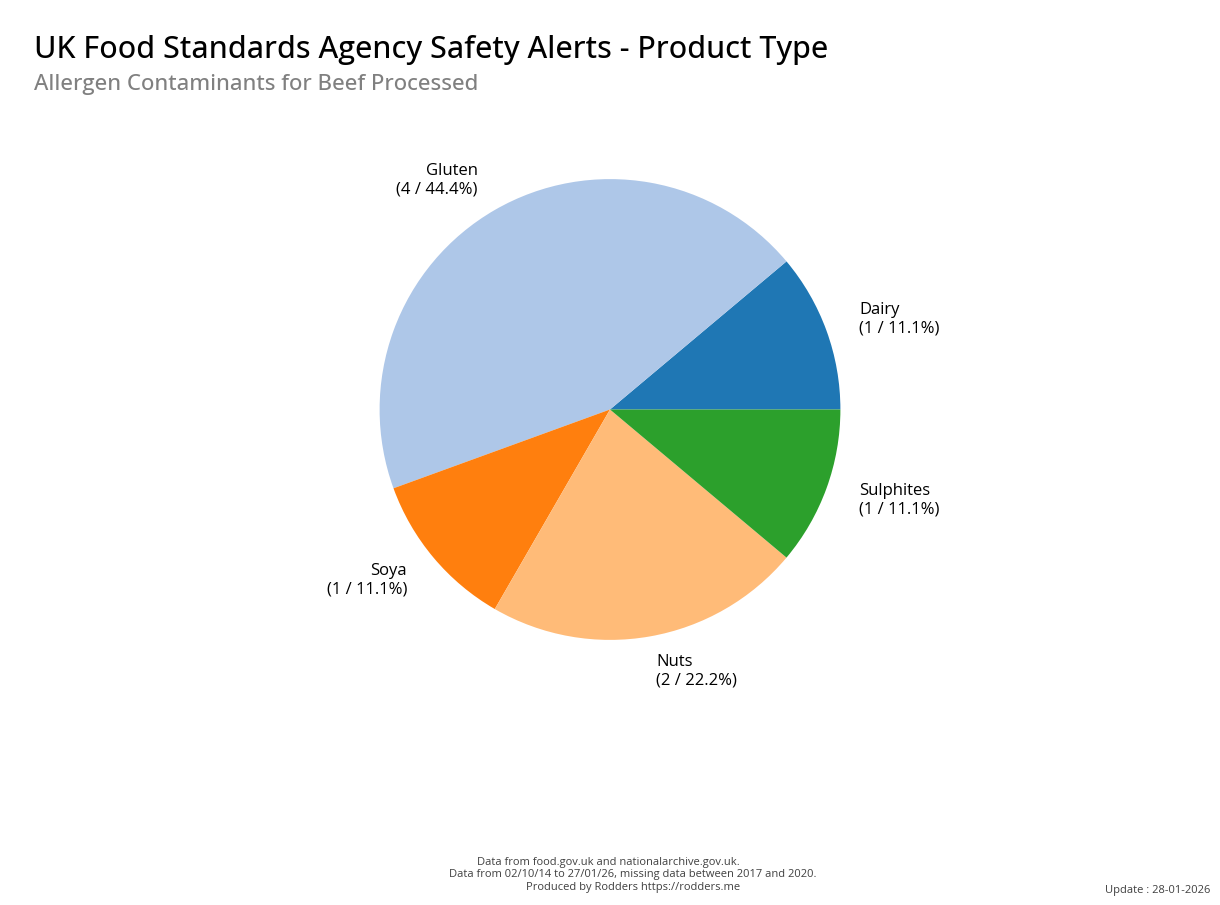
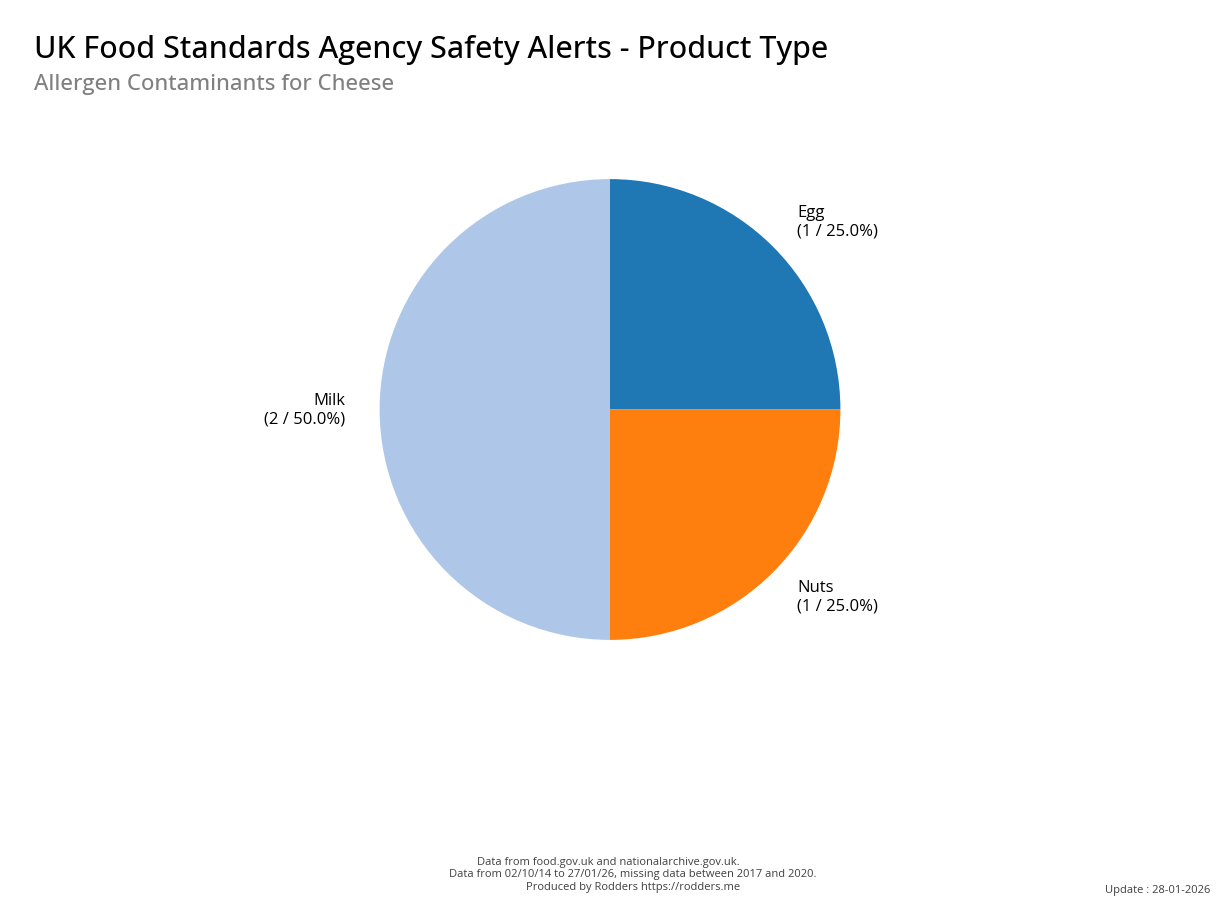
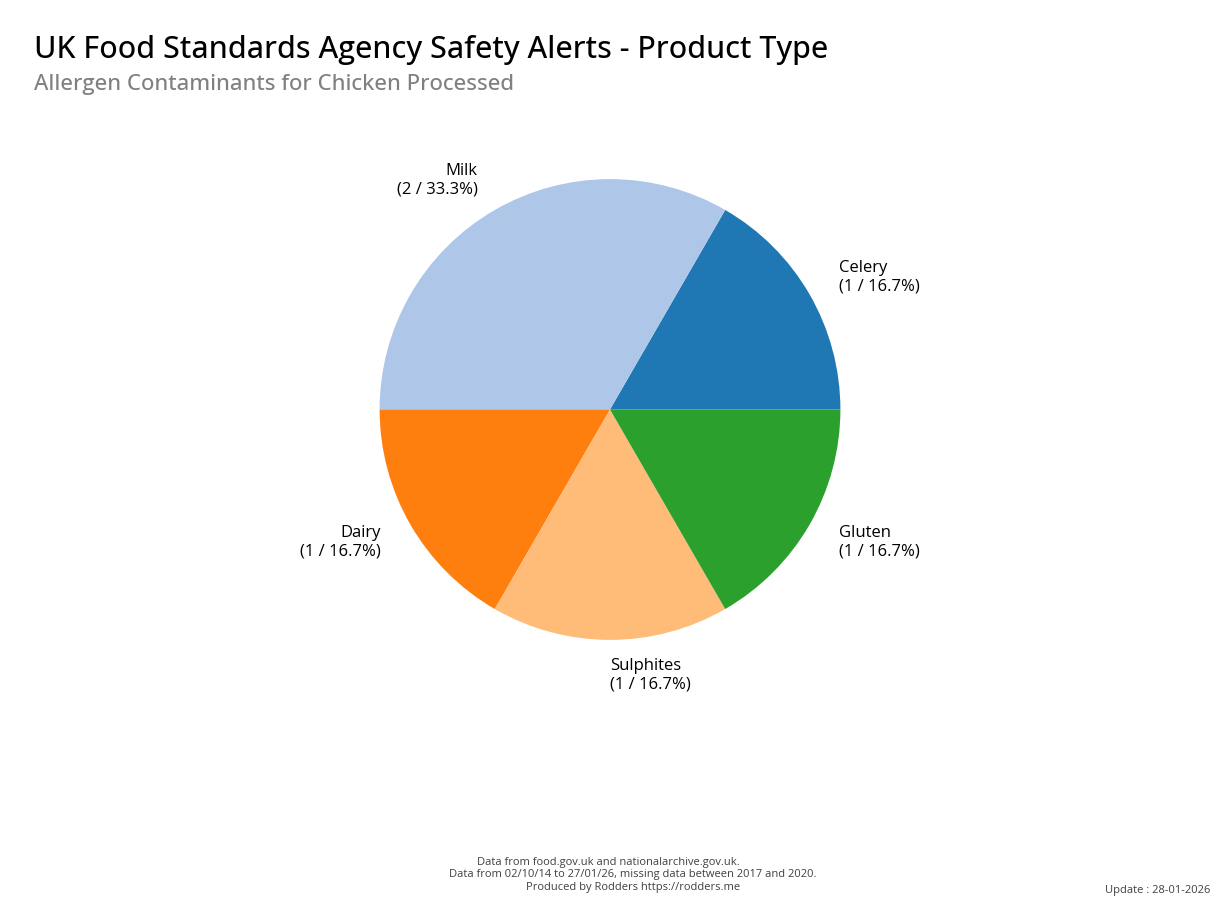
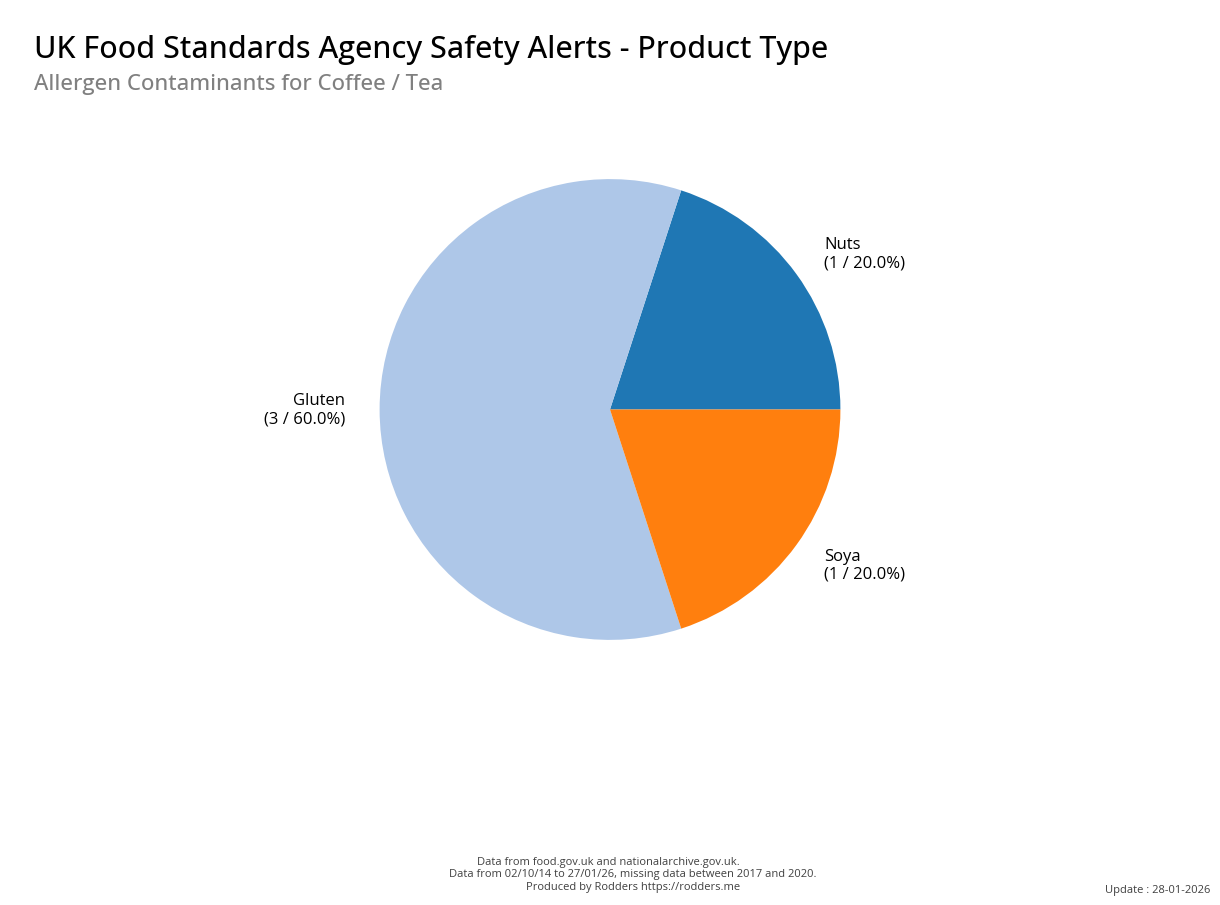
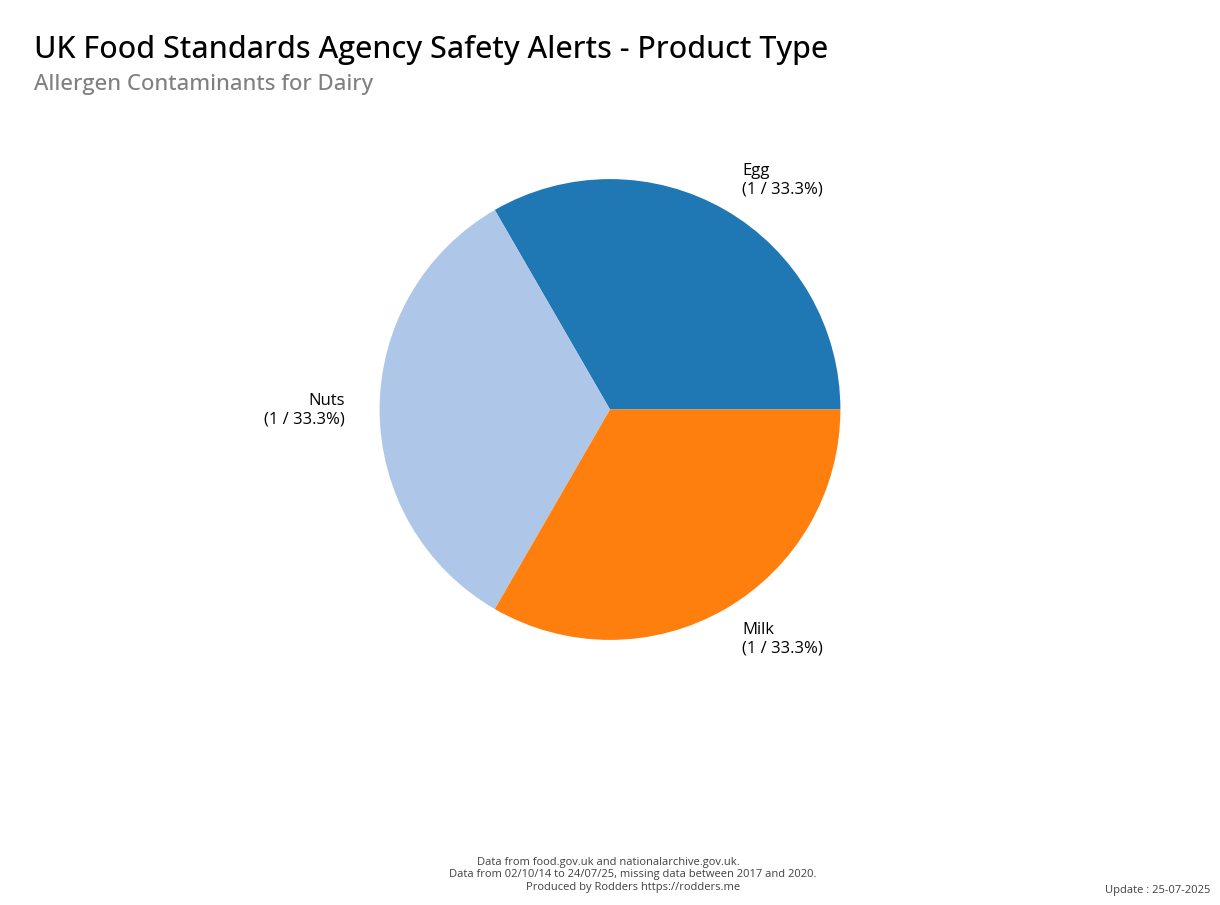
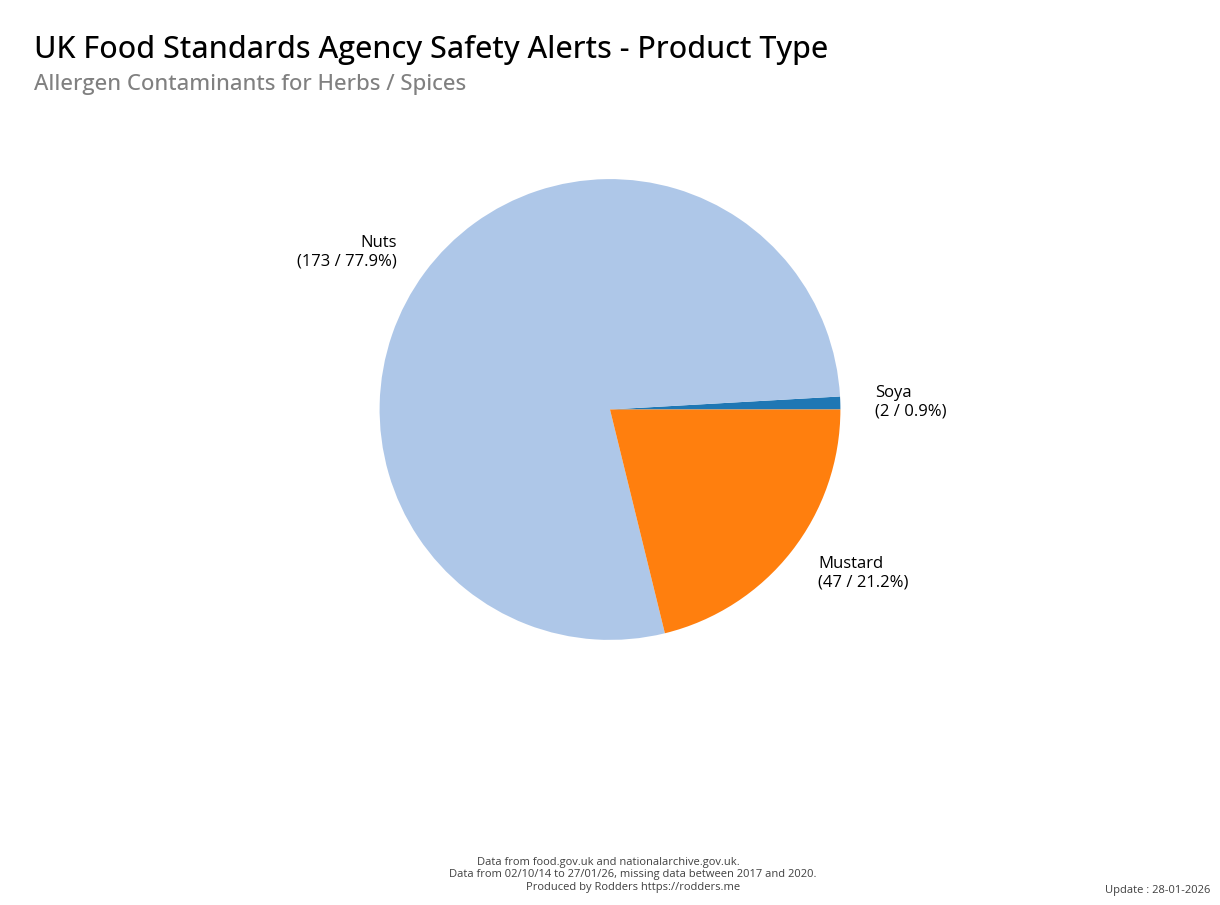
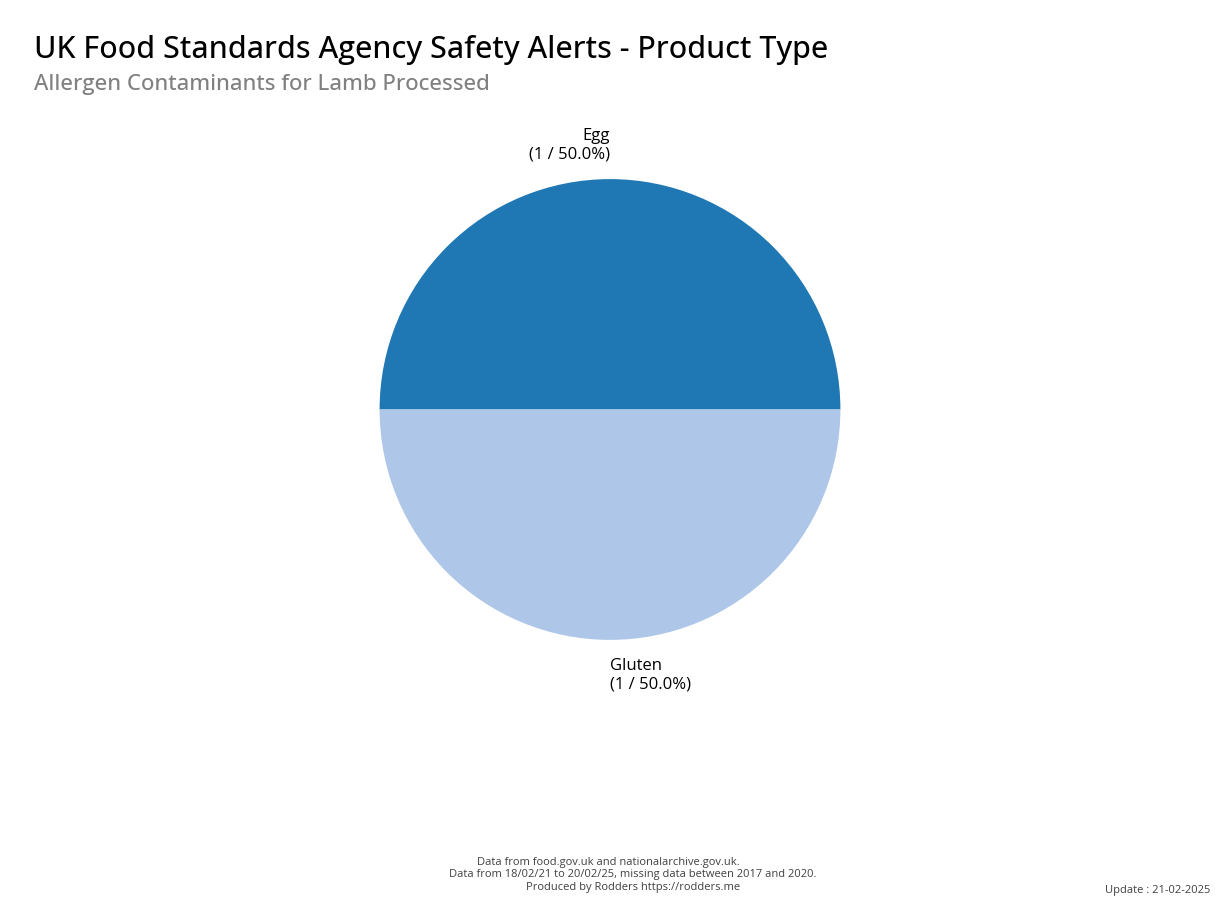
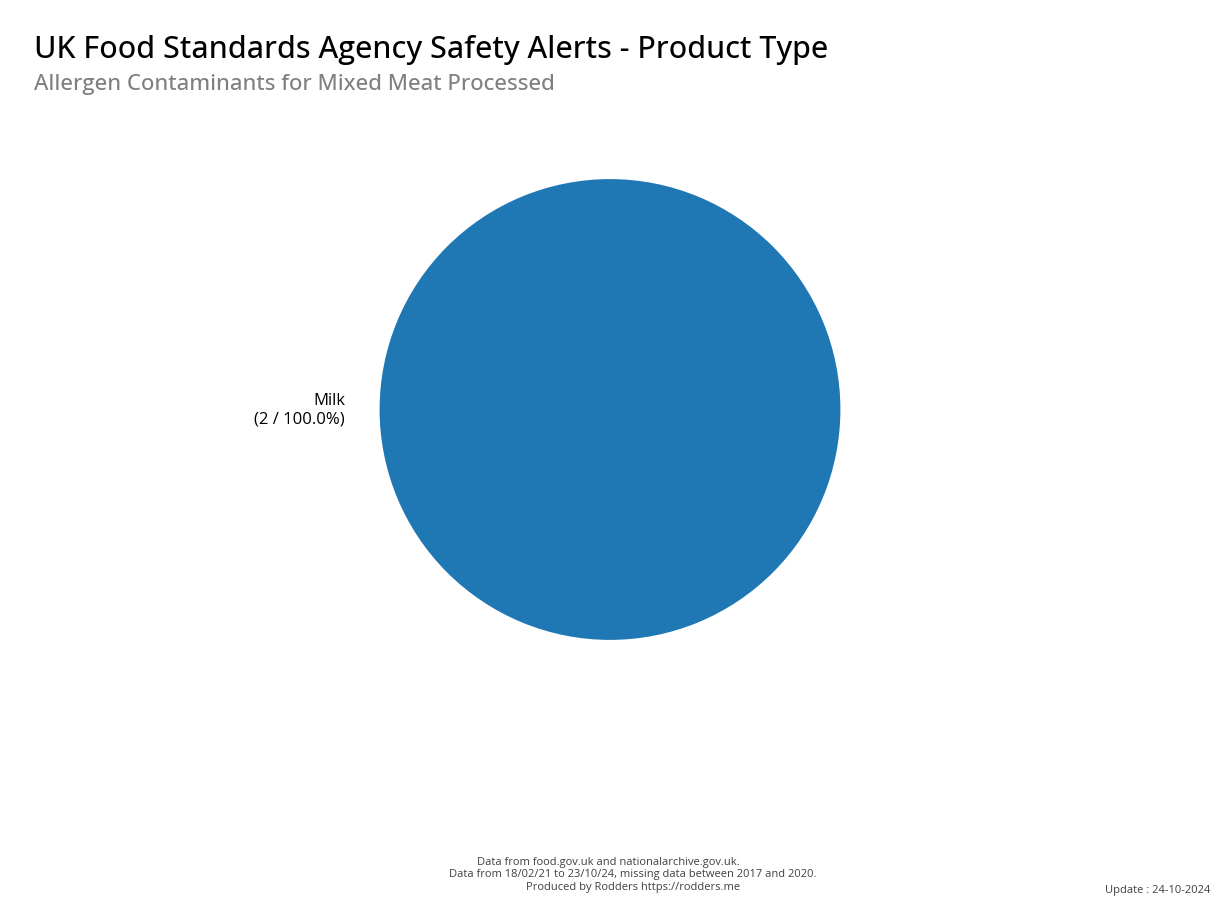
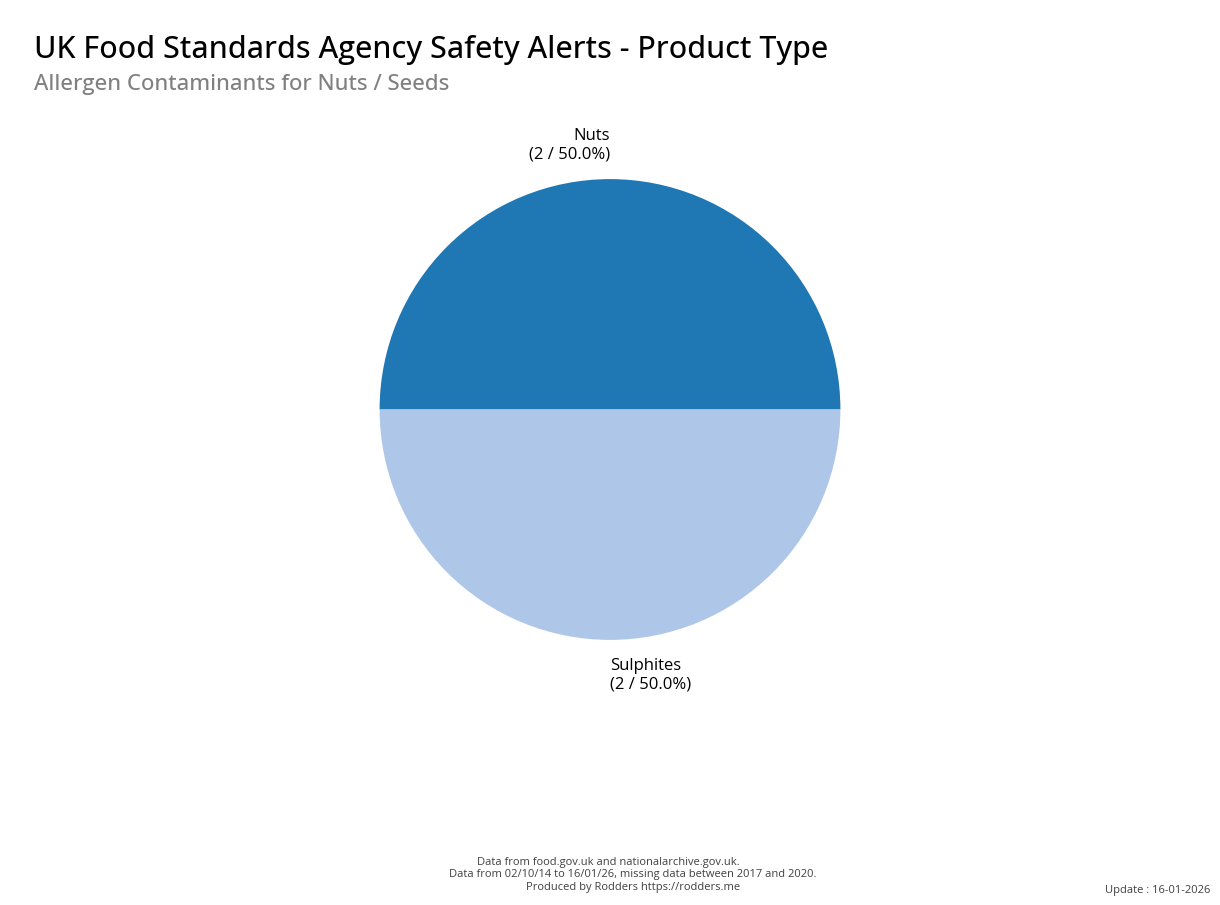
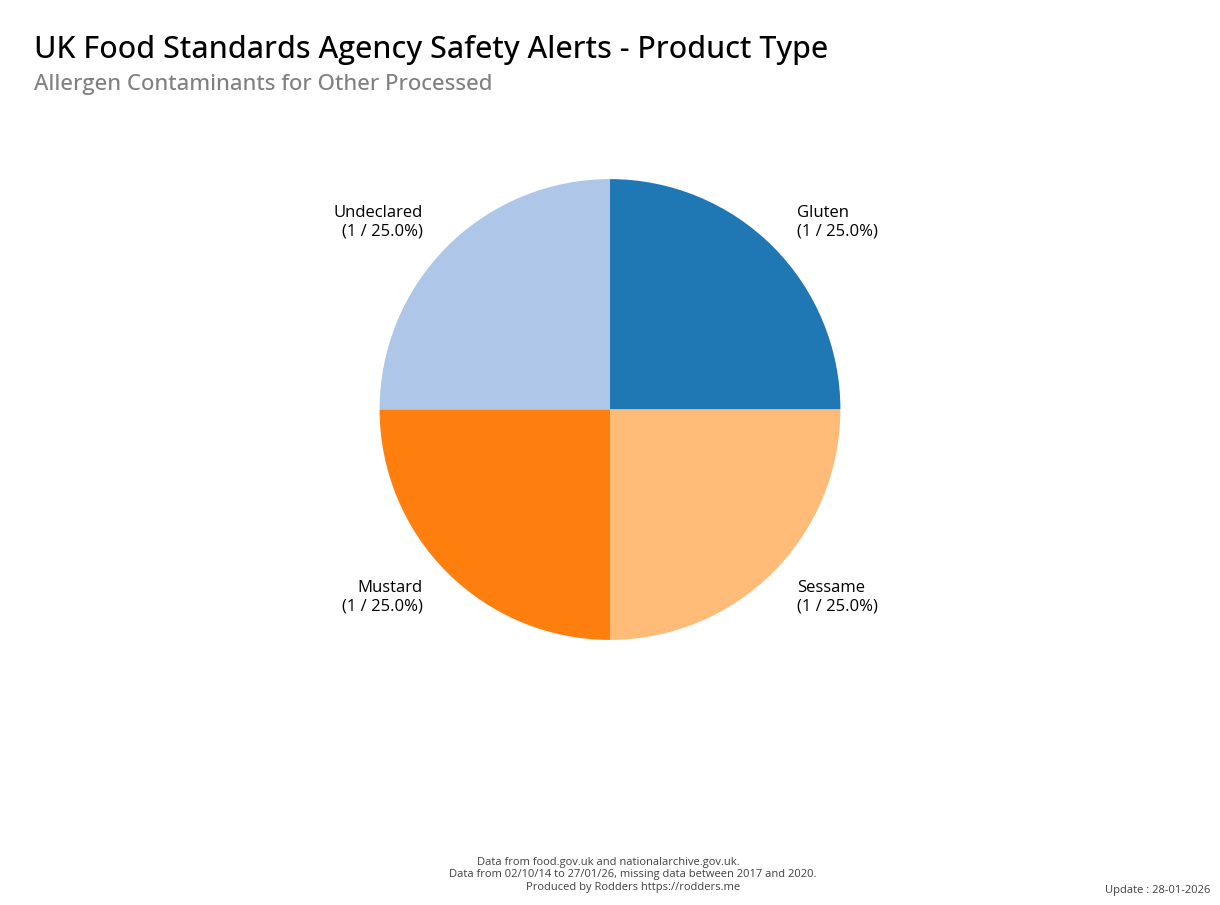
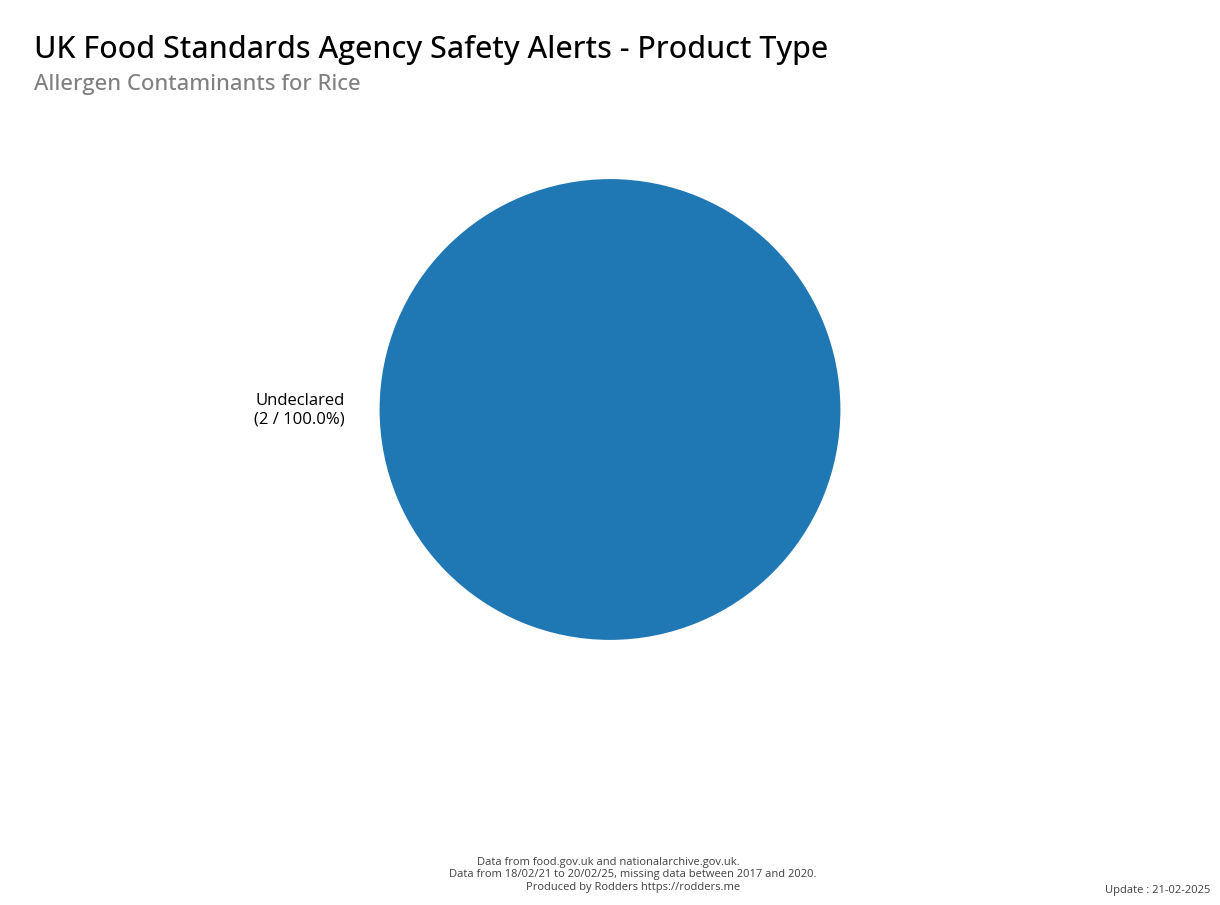
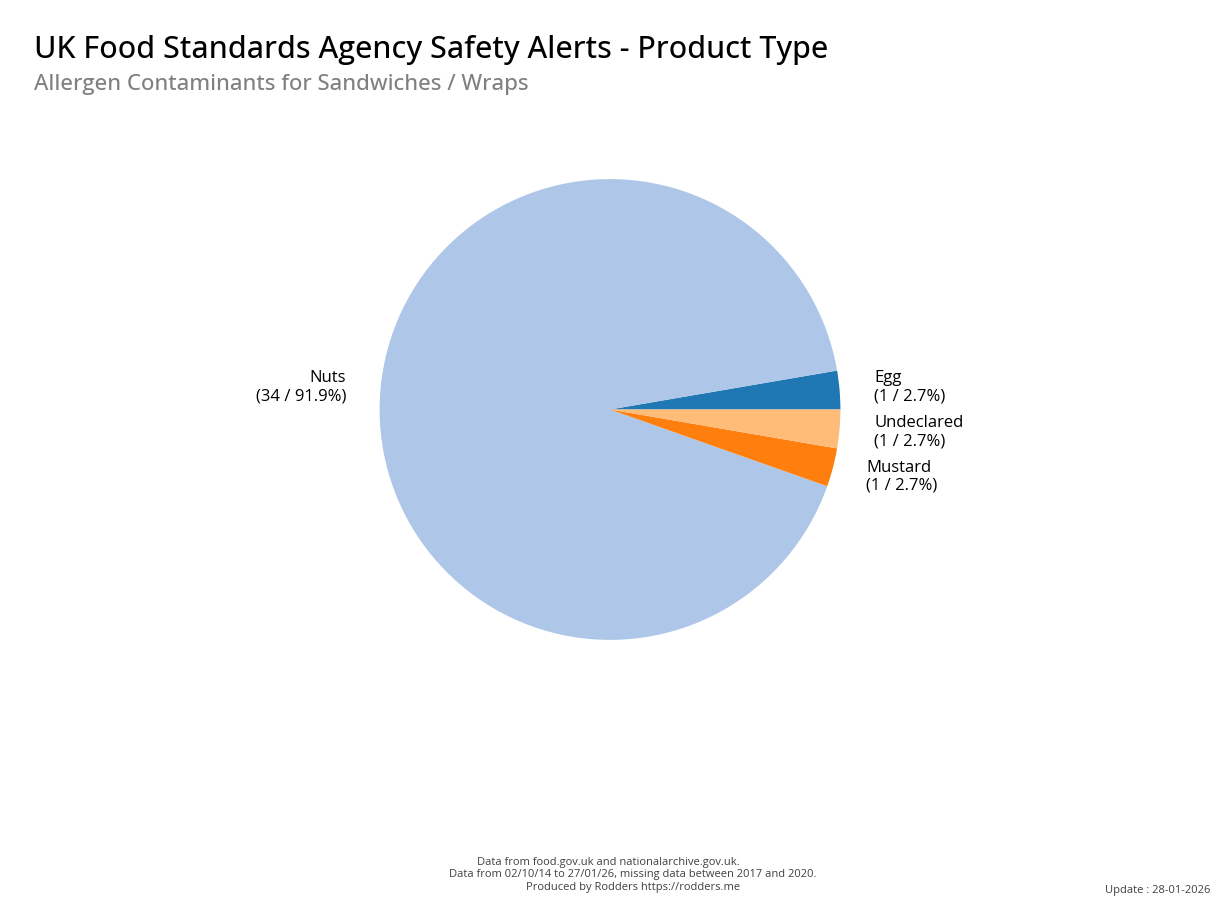
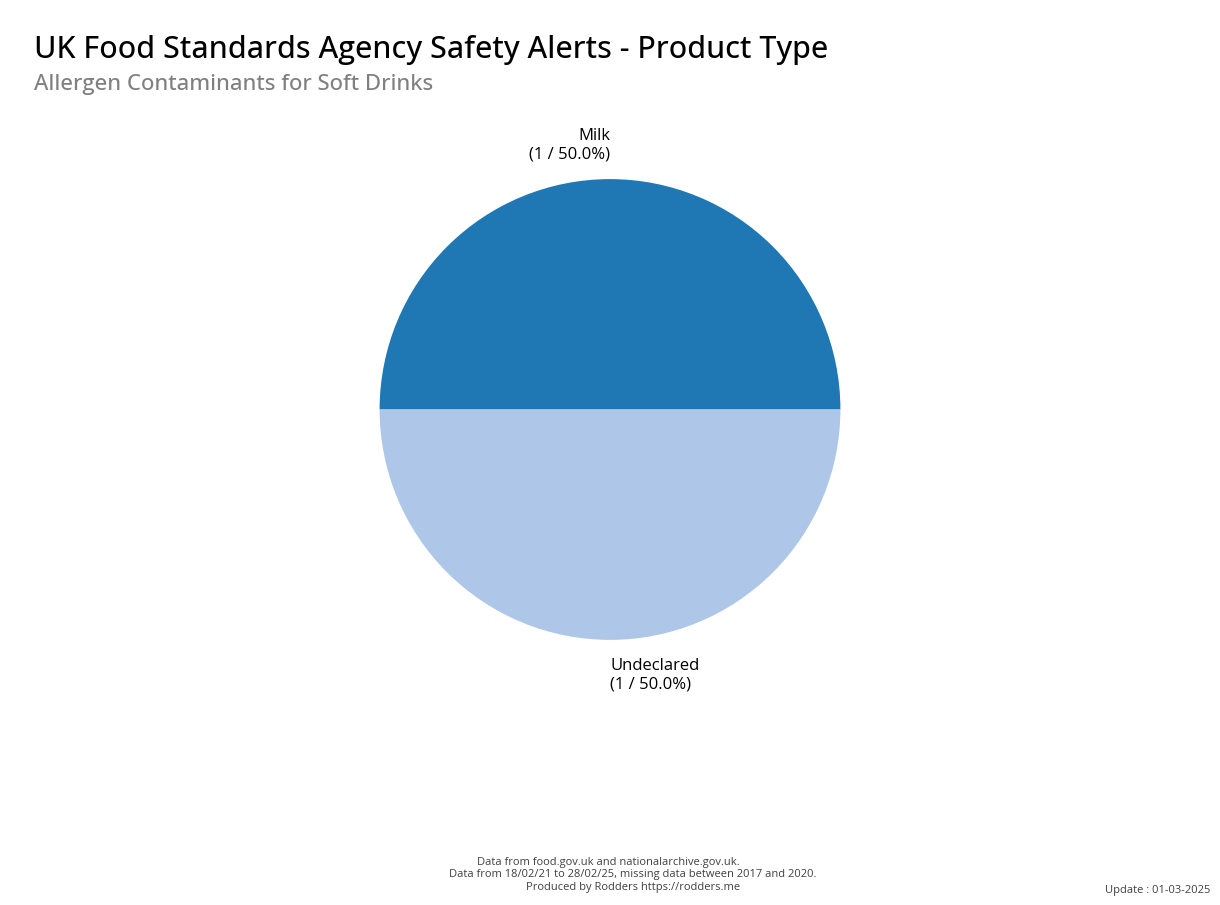
A Slice Above the Rest: Allergen Distribution Across Food Types
Confectionery | Ready Meal / Ready to Eat |
 |
 |
Confectionery | Ready Meal / Ready to Eat |
 |
 |
Confectionery | Ready Meal / Ready to Eat |
 |
 |
Confectionery | Ready Meal / Ready to Eat |
 |
 |
Confectionery | Ready Meal / Ready to Eat |
 |
 |
Top
Baby Foods / Formula | Beef Processed |
 |
 |
Top
Baked Goods | Beef Processed |
|
 |
Top
Baked Goods | Beef Processed |
 |
 |
Top
Baked Goods | Beef Processed |
 |
 |
Top
Herbs / Spices | Lamb Processed |
 |
 |
Top
Milk / Alt Milks | Mixed Meat Processed |
 |
 |
Top
Nuts / Seeds | Other Processed |
 |
 |
Top
Rice | Sandwiches / Wraps |
 |
 |
Top
Soft Drinks | |
 |
Top
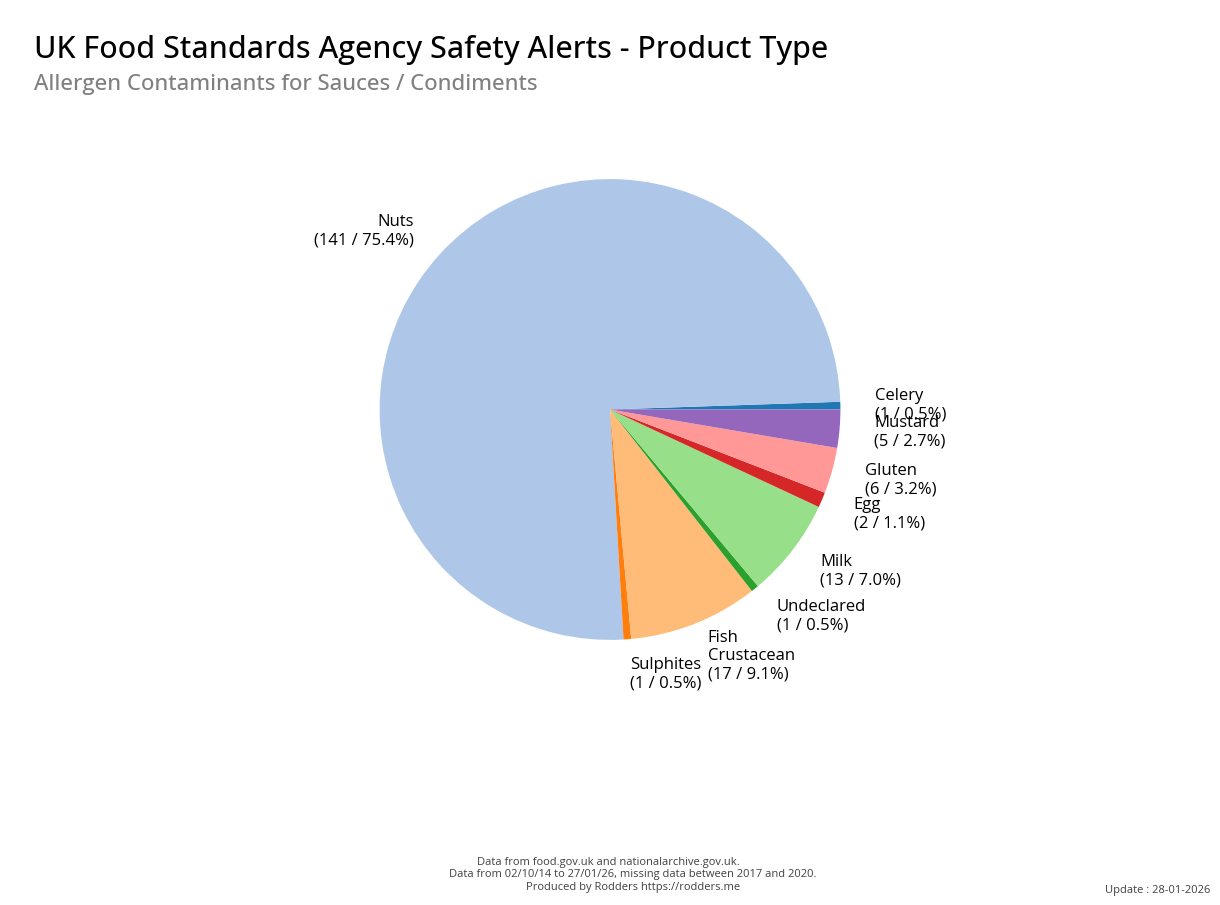
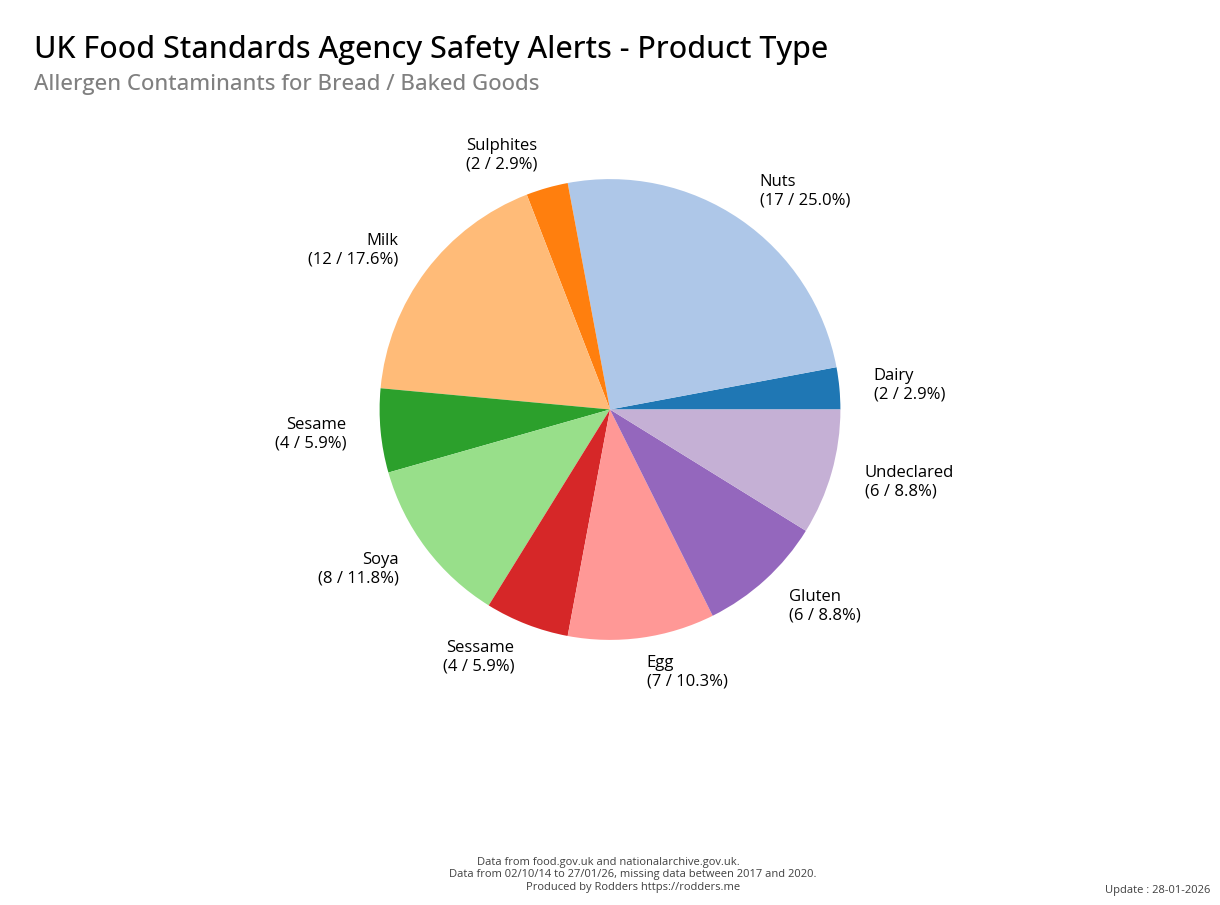
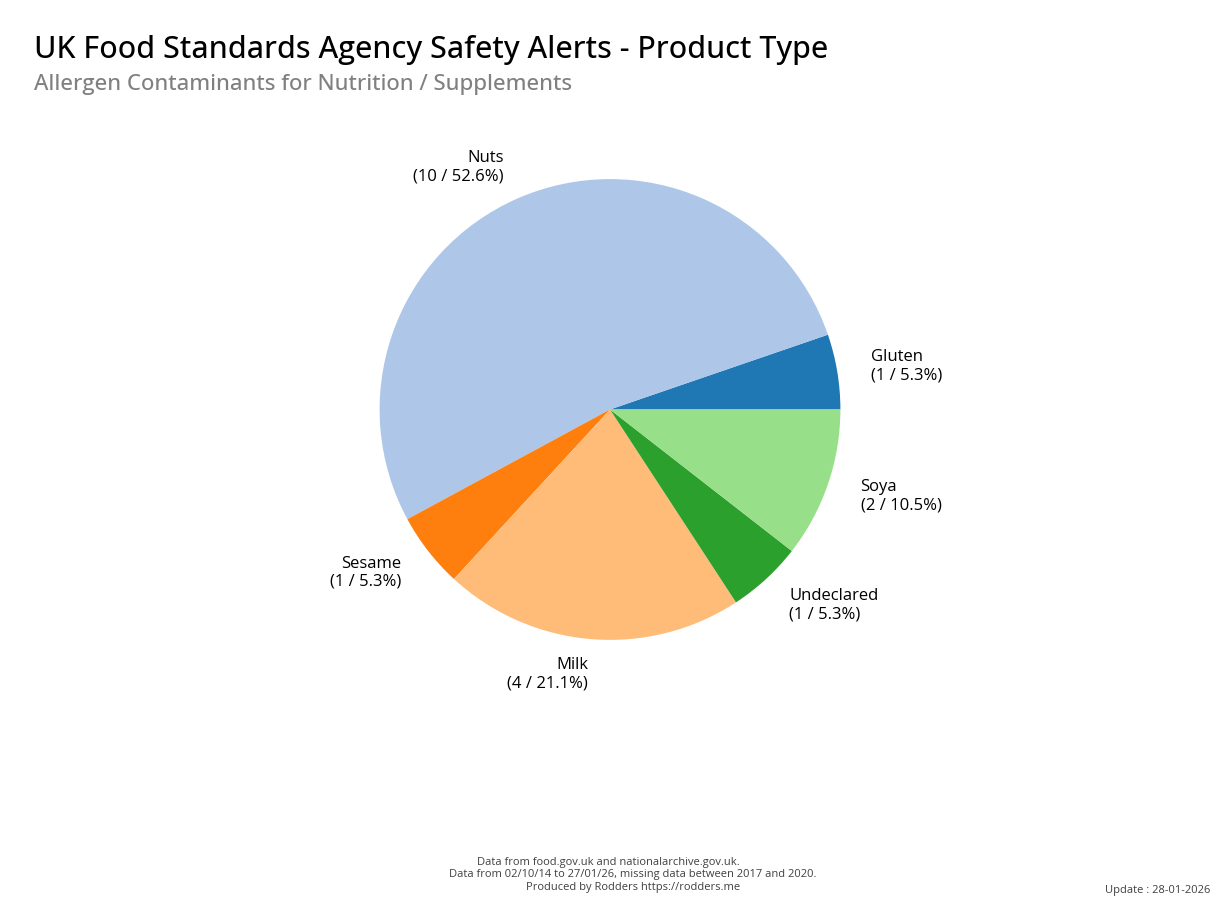
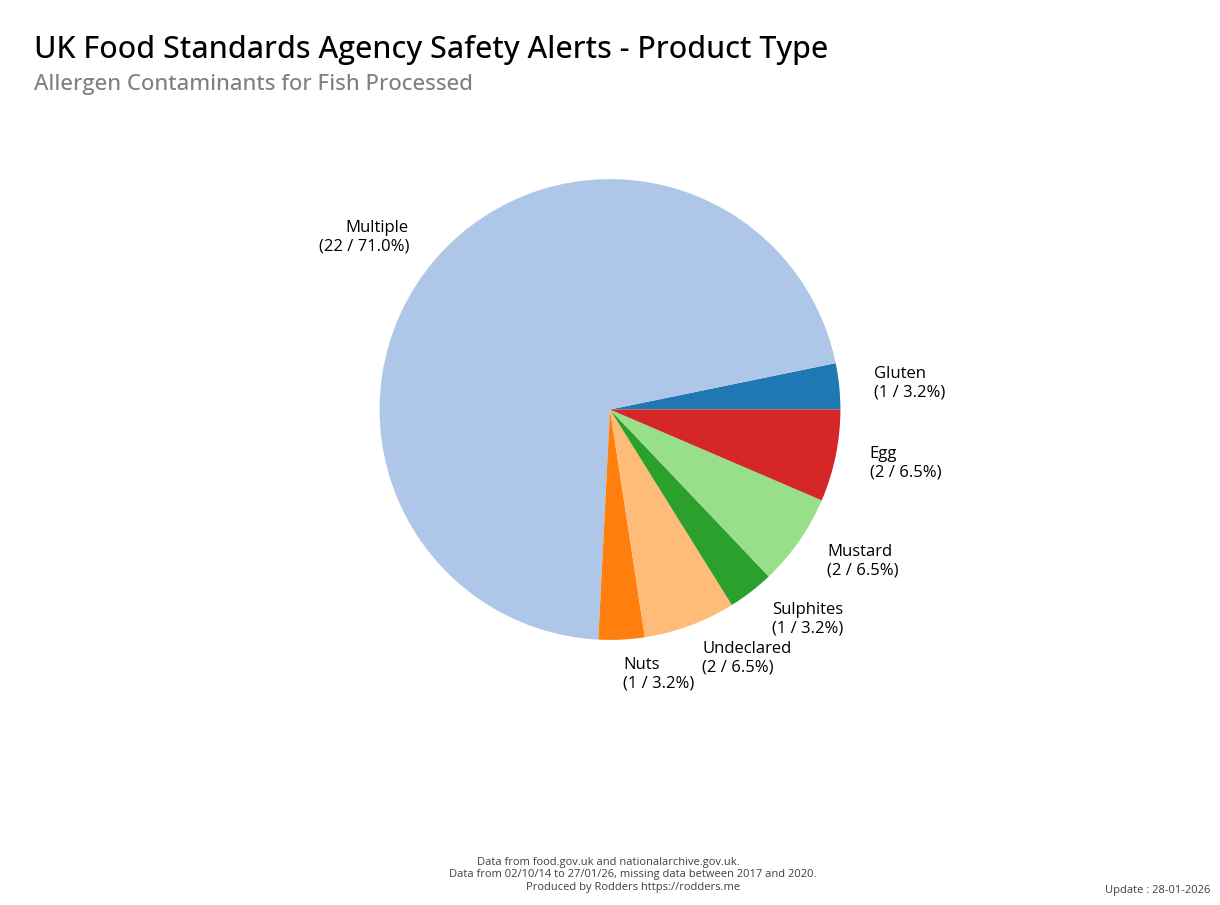
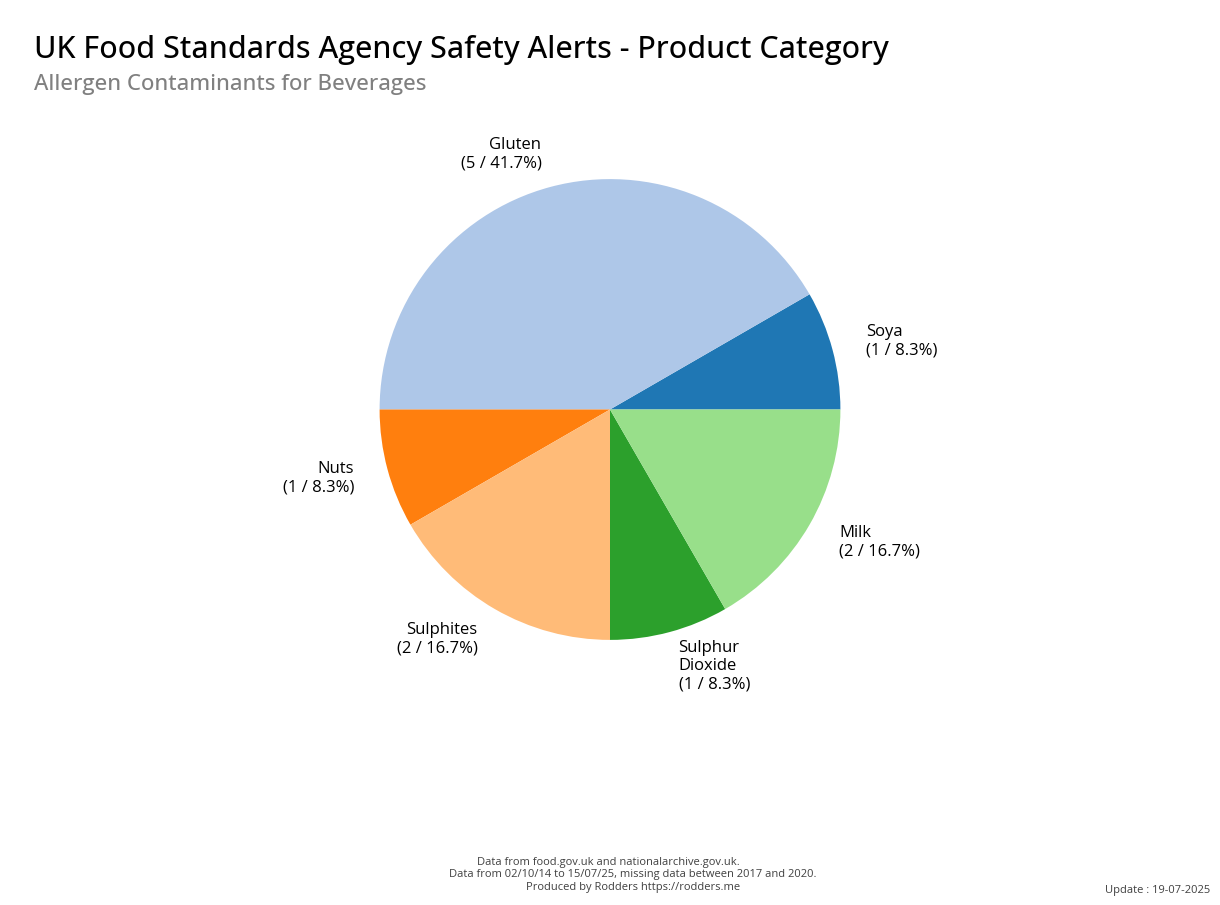
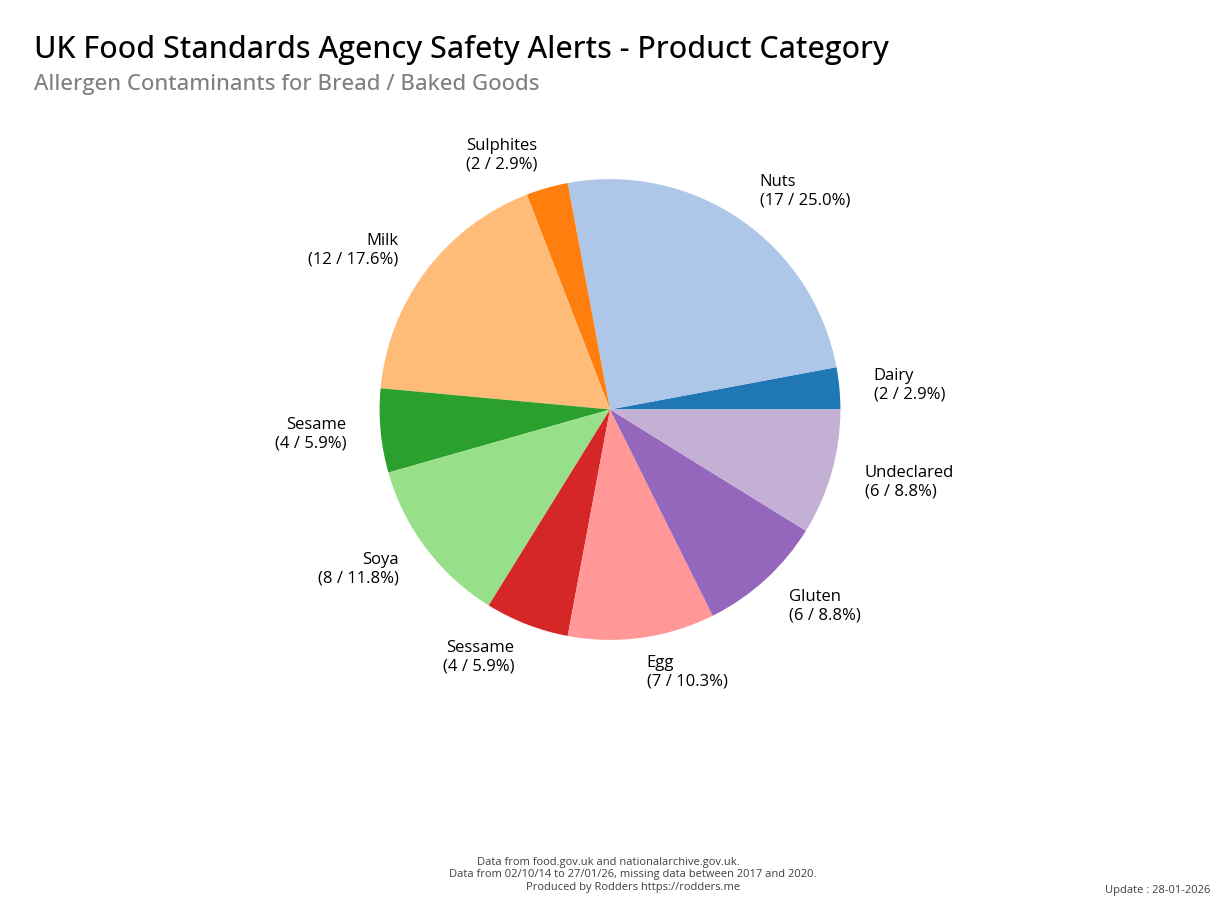
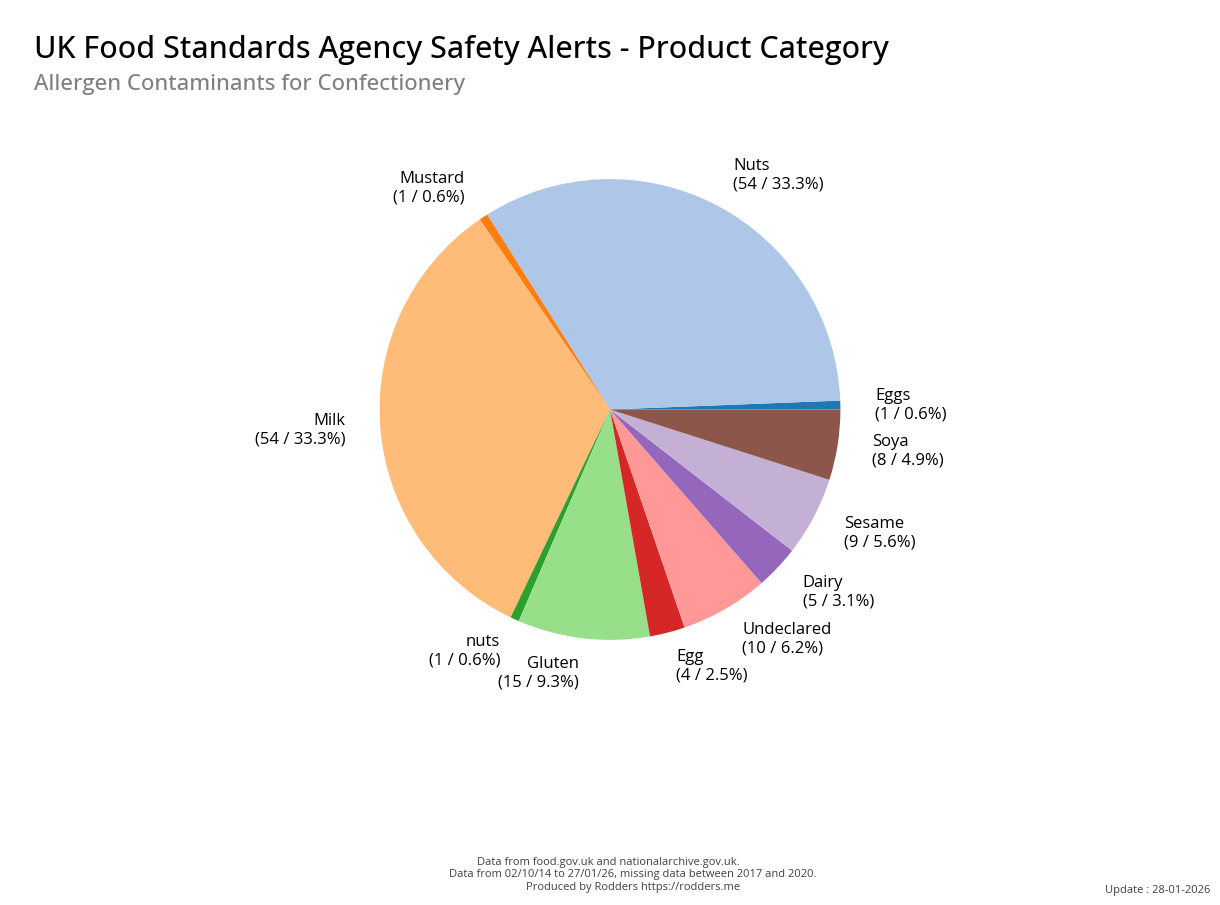
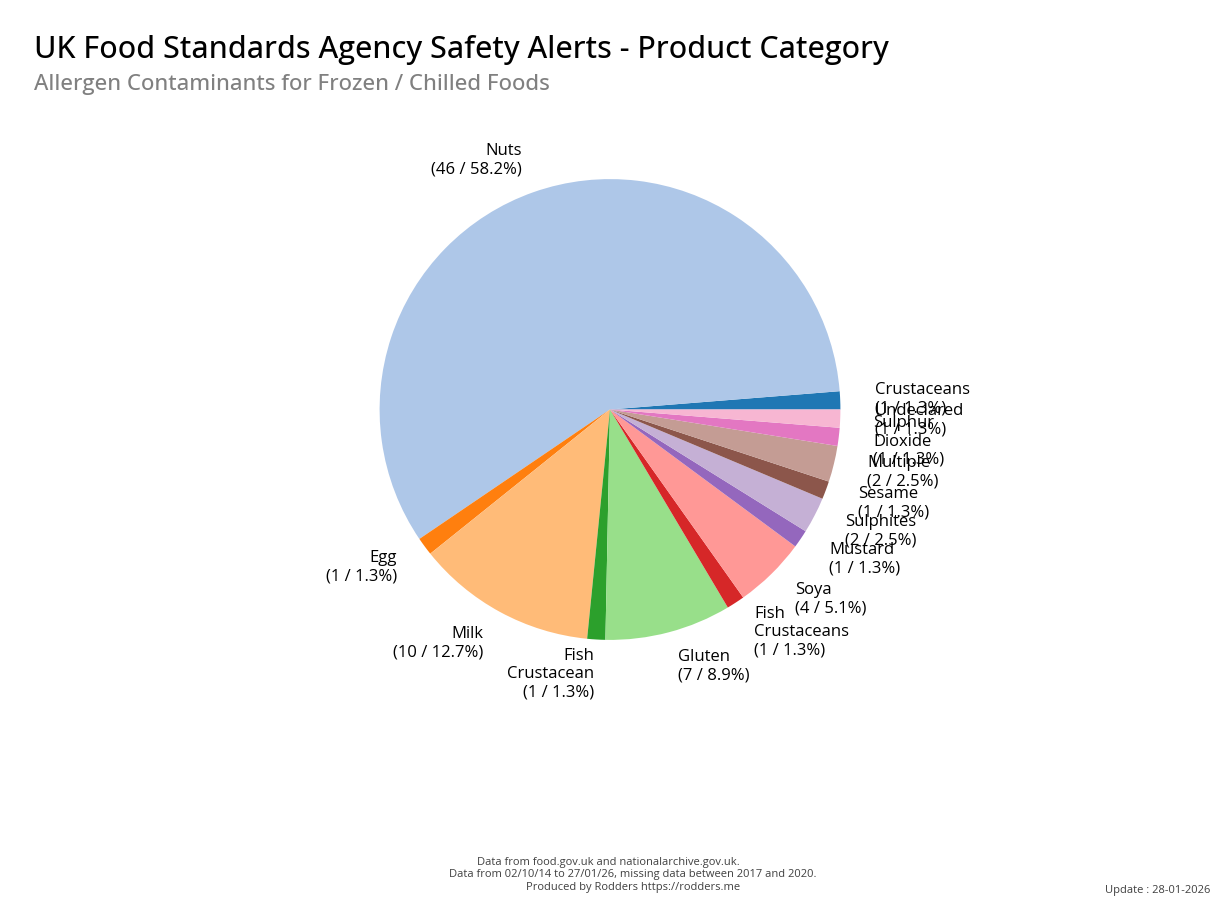
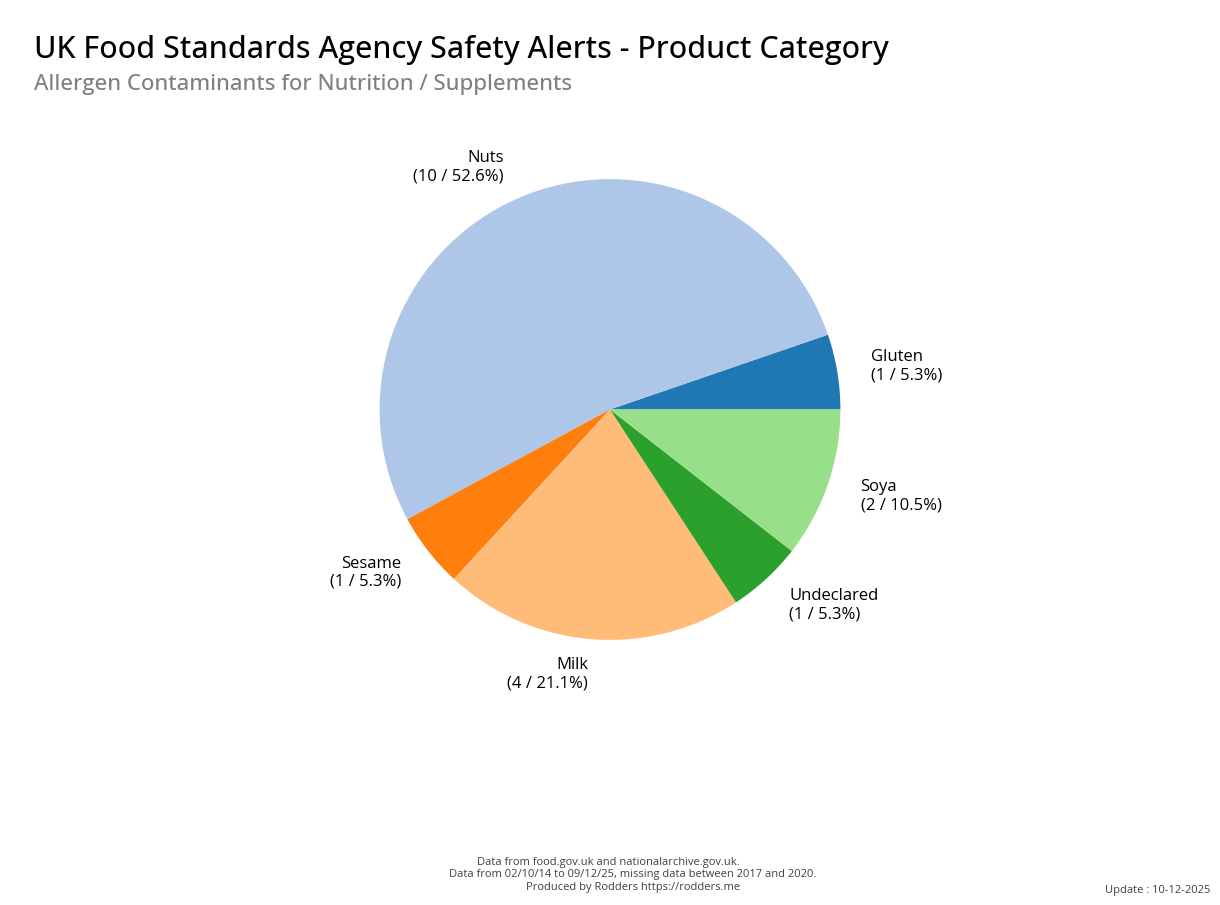
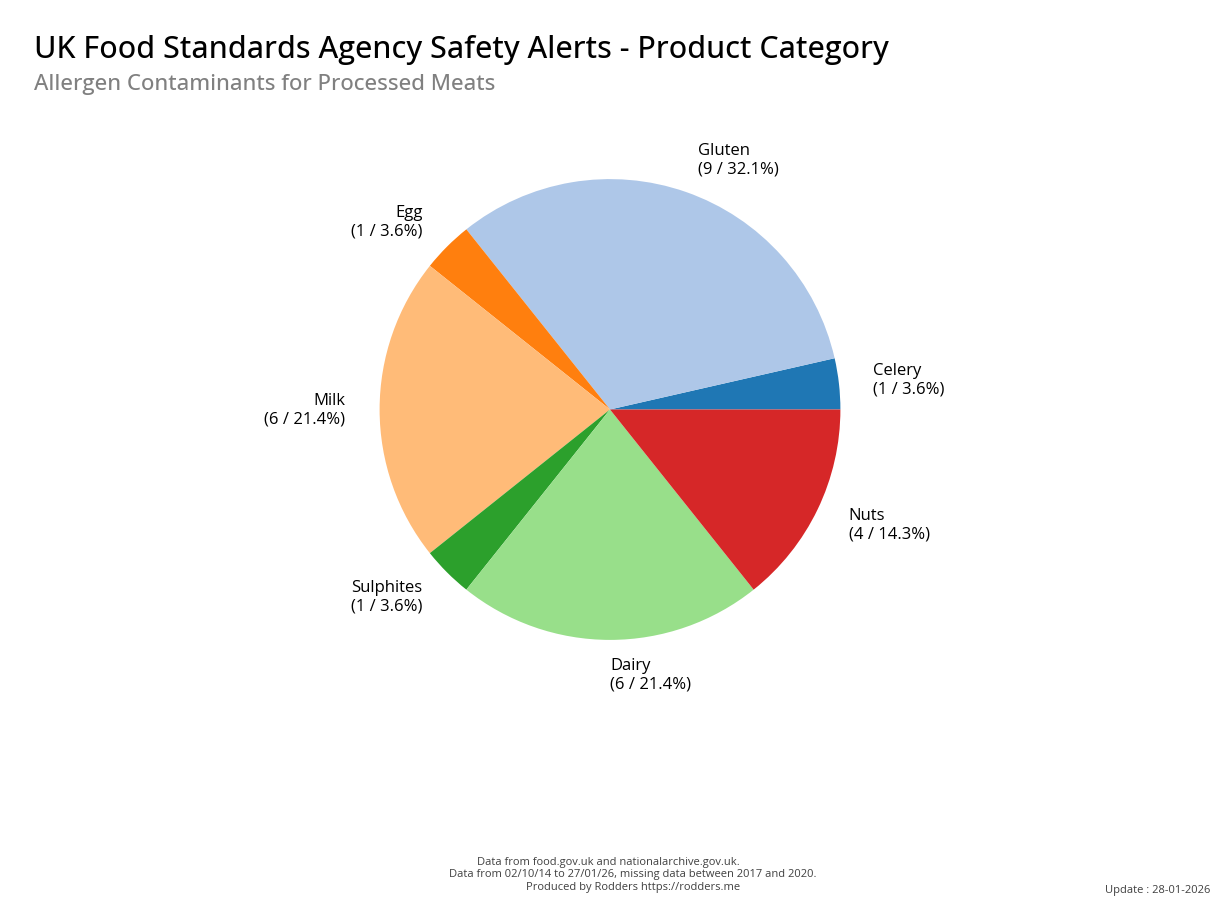
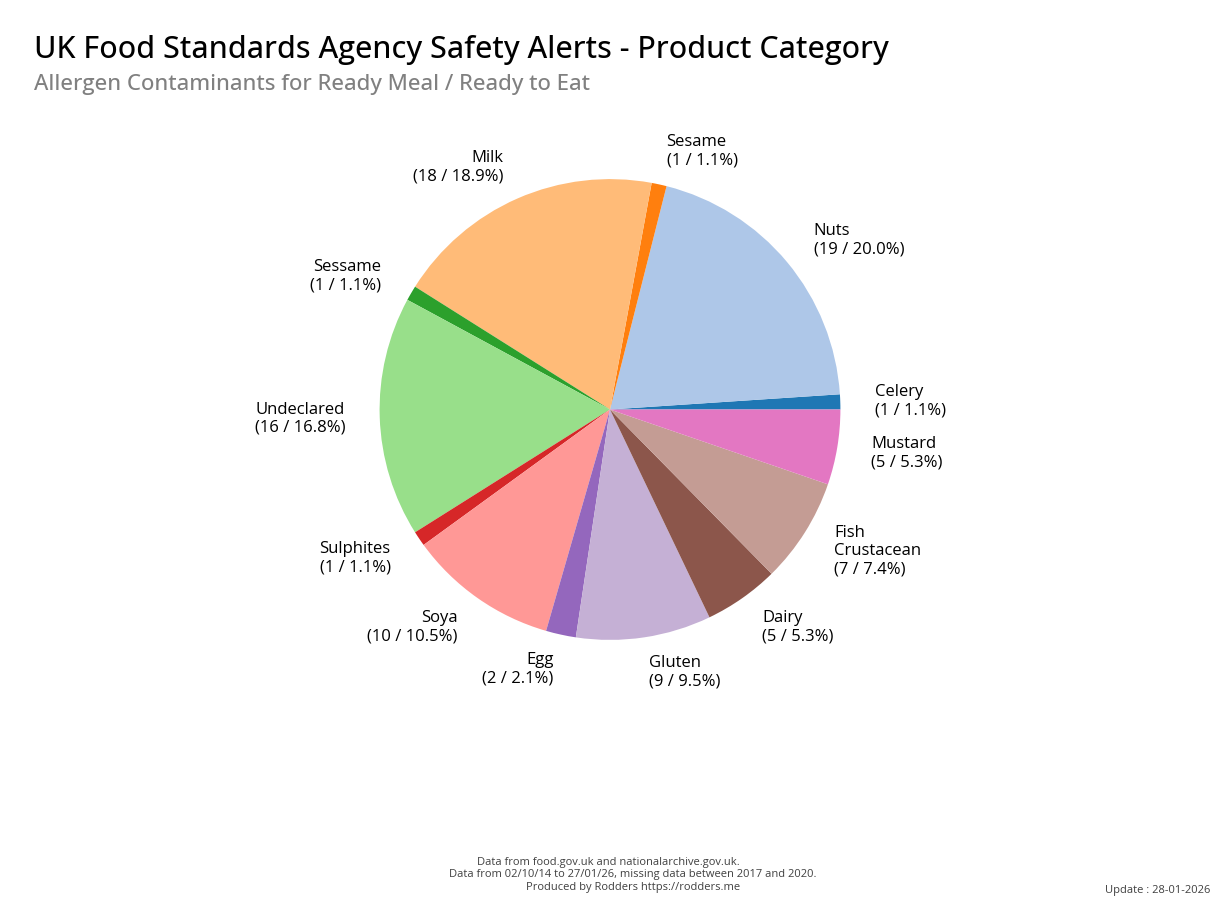
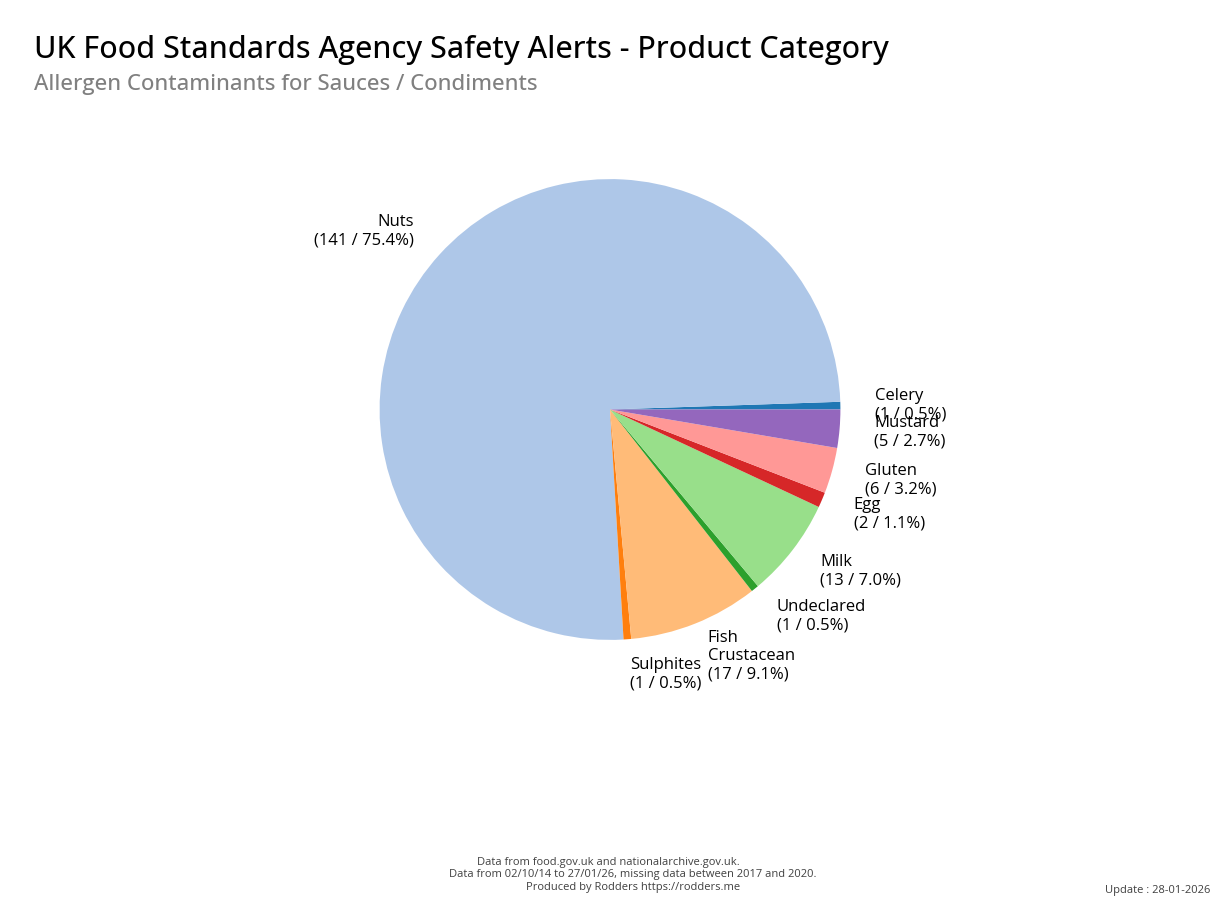
A Taste of Trouble: Common Food Contaminants by Product Category
Beverages | Bread / Baked Goods |
 |
 |
Top
Confectionery | Frozen / Chilled Foods |
 |
 |
Top
Nutrition / Supplements | Fish Processed |
 |
 |
Top
Meats Processed | Ready Meal / Ready to Eat |
 |
 |
Top
Sauces / Condiments | |
 |
Top
Summary
Safety alerts for Allergenic contaminations account for 33% of all safety alerts issued by the FSA
The most common allergens : Milk, Undeclared Allergens, Nuts, Gluten, Soya, Egg, Mustard account for 89% of all safety alerts issued for allergens.
| Allergen | 2015 | 2017 | 2019 | 2021 | 2022 | 2023 | 2024 | 2025 | 2026 | total |
|---|---|---|---|---|---|---|---|---|---|---|
| Nuts | 1 | 0 | 0 | 13 | 18 | 9 | 426 | 47 | 3 | 517 |
| Milk | 0 | 2 | 0 | 23 | 22 | 24 | 15 | 39 | 0 | 125 |
| Gluten | 0 | 0 | 0 | 11 | 7 | 13 | 8 | 33 | 2 | 74 |
| Mustard | 0 | 0 | 0 | 3 | 5 | 2 | 49 | 9 | 0 | 68 |
| wheat | 0 | 0 | 0 | 0 | 0 | 0 | 0 | 0 | 55 | 55 |
| Undeclared | 0 | 0 | 0 | 12 | 21 | 4 | 5 | 0 | 0 | 42 |
| Soya | 0 | 0 | 0 | 6 | 6 | 5 | 4 | 14 | 1 | 36 |
| Multiple | 0 | 0 | 0 | 0 | 0 | 0 | 2 | 26 | 0 | 28 |
| Sulphites | 0 | 0 | 1 | 2 | 3 | 1 | 3 | 17 | 0 | 27 |
| Fish / Crustacean | 0 | 0 | 0 | 3 | 2 | 3 | 17 | 1 | 0 | 26 |
| Egg | 0 | 0 | 0 | 4 | 5 | 7 | 0 | 5 | 0 | 21 |
| Dairy | 0 | 0 | 0 | 0 | 0 | 0 | 0 | 14 | 4 | 18 |
| Sesame | 0 | 0 | 0 | 3 | 3 | 0 | 2 | 8 | 0 | 16 |
| soya | 0 | 0 | 0 | 0 | 0 | 0 | 0 | 0 | 10 | 10 |
| Celery | 0 | 0 | 0 | 1 | 1 | 0 | 0 | 6 | 1 | 9 |
| Sessame | 0 | 0 | 0 | 0 | 0 | 0 | 0 | 6 | 0 | 6 |
| Sulphur Dioxide | 0 | 0 | 0 | 1 | 1 | 0 | 0 | 1 | 0 | 3 |
| nuts | 0 | 0 | 0 | 0 | 0 | 0 | 0 | 0 | 2 | 2 |
| Crustaceans | 0 | 0 | 0 | 0 | 0 | 0 | 0 | 1 | 0 | 1 |
| Fish / Crustaceans | 0 | 0 | 0 | 0 | 0 | 0 | 0 | 1 | 0 | 1 |
| Eggs | 0 | 0 | 0 | 0 | 0 | 0 | 0 | 1 | 0 | 1 |
| egg | 0 | 0 | 0 | 0 | 0 | 0 | 0 | 0 | 1 | 1 |
| milk | 0 | 0 | 0 | 0 | 0 | 0 | 0 | 0 | 1 | 1 |